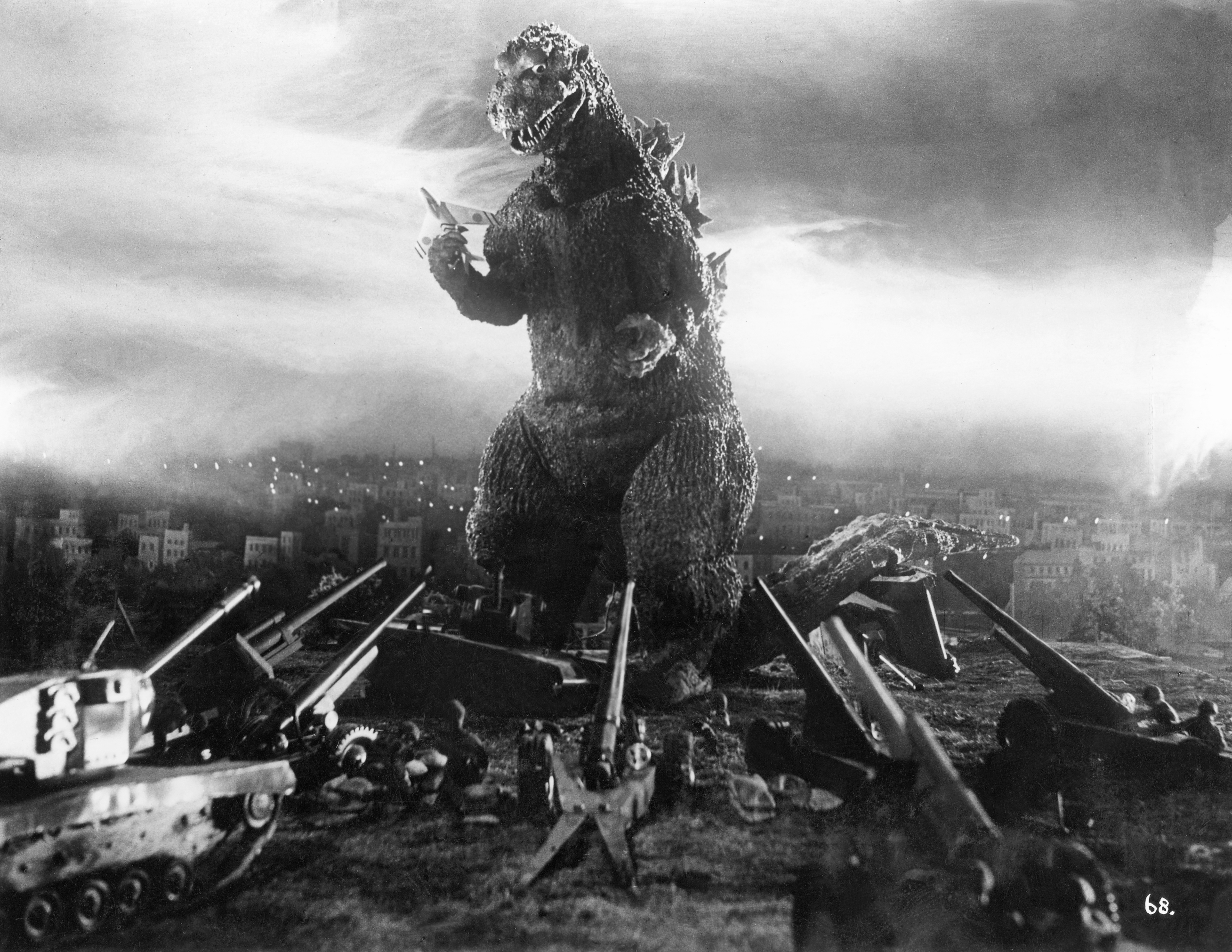
Godzilla
Appears In
Godzilla
Species
Prehistoric reptilian monster (mutated by nuclear radiation)
First Appearance
Godzilla (1954)
Occupation
Alpha predator, force of nature, protector of Earth (varies by era)
Creator
Ishirō Honda, Tomoyuki Tanaka, Eiji Tsuburaya
Overview
Origin Story
Godzilla originated as a prehistoric reptile that lived in the deep ocean, feeding on radiation. In 1954, hydrogen bomb tests conducted by the United States in the Pacific Ocean disturbed and mutated the creature, granting it immense size and the ability to emit radioactive breath. The monster first emerged near Odo Island, destroying fishing boats and terrorizing the islanders before making landfall in Tokyo. The Japanese government, unable to stop Godzilla with conventional weapons, turned to Dr. Daisuke Serizawa, who had secretly developed the Oxygen Destroyer. Serizawa reluctantly used the weapon, killing Godzilla but sacrificing himself to ensure the formula died with him.
The creature's origin has been reinterpreted across multiple timelines. In the Heisei era, Godzilla is revealed to be a dinosaur surviving from the Jurassic period, mutated by nuclear tests in the 1950s. In the MonsterVerse, Godzilla is an ancient alpha predator, one of several Titans that have existed for millions of years, maintaining balance on Earth. Shin Godzilla (2016) presents Godzilla as a rapidly evolving creature that emerges from Tokyo Bay, adapting to survive and absorbing radiation.
Personality
Godzilla's personality has shifted dramatically across decades. In the original 1954 film, the monster is a mindless, walking catastrophe driven by primal rage and pain, embodying the indiscriminate horror of nuclear weapons. There is no malice, only destruction. As the Shōwa era progressed, Godzilla became more playful and heroic, especially in films aimed at children, where he would fight alongside other monsters and even dance. This version showed affection for human characters and seemed to understand right from wrong.
Later eras restored a more ambiguous nature. The Heisei Godzilla is territorial and aggressive, attacking only when provoked or when other monsters threaten his domain. He shows no interest in humans but will destroy cities if they get in his way. The Legendary MonsterVerse Godzilla is an ancient, regal alpha who views humanity as beneath notice, yet he steps in when the natural order is threatened. Shin Godzilla portrays the creature as a biological anomaly, operating on pure survival instinct, with no discernible emotion or intent.
Story Arc
Godzilla's narrative journey spans multiple timelines and reboots. In the Shōwa era (1954–1975), the character transforms from a villain into a hero. After the original film's tragic ending, Godzilla reappears in sequels, gradually becoming a protector of Japan against alien invaders and rival monsters like King Ghidorah. By the end of the era, Godzilla is a beloved guardian, even teaming up with his former enemies.
The Heisei series (1984–1995) reboots the timeline, ignoring the Shōwa sequels. Godzilla returns as a destructive force, but the narrative explores the consequences of his existence. In Godzilla vs. Biollante, a scientist uses Godzilla's cells to create a plant monster. In Godzilla vs. Destoroyah, Godzilla's nuclear core becomes unstable, threatening to explode. He ultimately melts down, but his energy is absorbed by his son, Godzilla Junior, who becomes the new Godzilla.
The Millennium era (1999–2004) presents standalone stories. In Godzilla, Mothra and King Ghidorah: Giant Monsters All-Out Attack, Godzilla is a vengeful spirit of Pacific War dead. In Godzilla: Final Wars, Godzilla is awakened to fight alien-controlled monsters. The Reiwa era includes Shin Godzilla, where Godzilla evolves through multiple forms, and the anime trilogy, where Godzilla drives humanity off Earth. Godzilla Minus One (2023) returns to the original theme, set in postwar Japan, where Godzilla terrorizes a nation already in ruins.
In the American MonsterVerse, Godzilla is an ancient alpha who awakens in 2014 to restore balance. He fights the MUTOs, then later King Ghidorah and Mechagodzilla, solidifying his role as the king of the monsters. The MonsterVerse Godzilla is a neutral force, not inherently good or evil, but necessary for planetary equilibrium.
Powers & Abilities
Atomic Breath
Nuclear Pulse
Immense physical strength
Near-invulnerability (thick, radiation-absorbing skin)
Regeneration
Amphibious nature (can survive deep ocean pressure)
Magnetic field generation (Heisei era)
Heat resistance
Enhanced senses
Equipment & Signature Items
Dorsal fins (glow when charging atomic breath)
Spiked tail
Powerful claws and teeth
Relationships
Mothra
AllyAncient guardian moth who sometimes allies with Godzilla against common threats, though they have fought in some timelines.
King Ghidorah
EnemyThree-headed golden dragon and Godzilla's archenemy, often depicted as an alien invader or rival alpha.
Mechagodzilla
EnemyRobotic doppelgänger built by aliens or humans to destroy Godzilla.
Anguirus
AllyAnkylosaur-like monster who becomes Godzilla's first ally in the Shōwa era, often fighting alongside him.
Rodan
AllyGiant pterosaur who sometimes fights Godzilla but later becomes an ally.
Destoroyah
EnemyCrustacean-like monster born from the Oxygen Destroyer, created to be Godzilla's ultimate foe in the Heisei era.
Gigan
EnemyCyborg monster with a buzzsaw chest and hook hands, often serving alien invaders.
Godzilla Junior
FamilyGodzilla's adoptive son in the Heisei era, who later becomes the new Godzilla after absorbing his energy.
Memorable Quotes
“Let them fight.”
“The arrogance of man is thinking nature is in their control, and not the other way around.”
“Godzilla is the son of the atomic bomb.”
“Gojira!”
“We are all Godzilla's children.”
Portrayed By
Key Appearances
Godzilla (1954)
Godzilla Raids Again (1955)
King Kong vs. Godzilla (1962)
Mothra vs. Godzilla (1964)
Ghidorah, the Three-Headed Monster (1964)
Invasion of Astro-Monster (1965)
Ebirah, Horror of the Deep (1966)
Son of Godzilla (1967)
Destroy All Monsters (1968)
All Monsters Attack (1969)
Godzilla vs. Hedorah (1971)
Godzilla vs. Gigan (1972)
Godzilla vs. Megalon (1973)
Godzilla vs. Mechagodzilla (1974)
Terror of Mechagodzilla (1975)
The Return of Godzilla (1984)
Godzilla vs. Biollante (1989)
Godzilla vs. King Ghidorah (1991)
Godzilla vs. Mothra (1992)
Godzilla vs. Mechagodzilla II (1993)
Godzilla vs. SpaceGodzilla (1994)
Godzilla vs. Destoroyah (1995)
Godzilla 2000: Millennium (1999)
Godzilla vs. Megaguirus (2000)
Godzilla, Mothra and King Ghidorah: Giant Monsters All-Out Attack (2001)
Godzilla Against Mechagodzilla (2002)
Godzilla: Tokyo S.O.S. (2003)
Godzilla: Final Wars (2004)
Shin Godzilla (2016)
Godzilla: Planet of the Monsters (2017)
Godzilla: City on the Edge of Battle (2018)
Godzilla: The Planet Eater (2018)
Godzilla Minus One (2023)
Godzilla (1998, TriStar)
Godzilla (2014, Legendary)
Godzilla: King of the Monsters (2019)
Godzilla vs. Kong (2021)
Godzilla x Kong: The New Empire (2024)
Reception & Legacy
Godzilla is one of the most recognizable monsters in global pop culture. The original 1954 film was a critical and commercial success in Japan, praised for its serious allegory and groundbreaking special effects. Internationally, the character became a symbol of Japanese cinema. The franchise's longevity, spanning over 70 years, is unmatched. Fan reception varies by era: purists admire the original's darkness, while general audiences enjoy the campy Shōwa films or the spectacle of the MonsterVerse.
Godzilla has been referenced in countless works, from The Simpsons to Stranger Things. In 2004, Godzilla received a star on the Hollywood Walk of Fame. The character is the official mascot of Toho Studios. Critical reception of individual films ranges from the original being hailed as a masterpiece to later entries being dismissed as B-movie fare. However, Shin Godzilla and Godzilla Minus One revived critical interest, with the latter winning an Oscar. The MonsterVerse films have been commercially successful, cementing Godzilla's place in American blockbuster culture.
Interesting Facts and Legends
The name 'Gojira' is a portmanteau of 'gorira' (gorilla) and 'kujira' (whale), reflecting the creature's size and aquatic nature.
The original 1954 suit weighed over 100 kg (220 lbs) and was made of concrete, rubber, and latex. Actor Haruo Nakajima could only film in short bursts.
Godzilla's iconic roar was created by composer Akira Ifukube using a contrabass bow rubbed against a low-tuned string and a leather glove scraping piano wire.
The Oxygen Destroyer, used to kill the original Godzilla, was never reused because the inventor killed himself to prevent its misuse.
Godzilla holds the Guinness World Record for the longest continuously running film franchise.
The 1998 American Godzilla was so disliked by Toho that they officially renamed it 'Zilla' in Japan.
Godzilla Minus One (2023) won the Academy Award for Best Visual Effects, the first Oscar for the franchise.
Godzilla's height has varied: 50 meters in 1954, 100 meters in the Heisei era, and 120 meters in the Legendary MonsterVerse.
Frequently Asked Questions
Who is Godzilla?
Does Godzilla die?
Is Godzilla a villain or a hero?
Who plays Godzilla?
What are Godzilla's powers?
Keywords
Character Info
- Portrayed By
- Haruo Nakajima, Kenpachiro Satsuma, Tsutomu Kitagawa, Mansai Nomura, T.J. Storm, Hiroshi Sekita
- First Appearance
- Godzilla (1954)
- Height
- 50–120 meters (varies by era)
- Weight
- 20,000–90,000 tons (varies by era)
- Species
- Prehistoric reptilian monster (mutated by nuclear radiation)
- Affiliation
- None (sometimes allied with other monsters)
Join the community
fans discussing