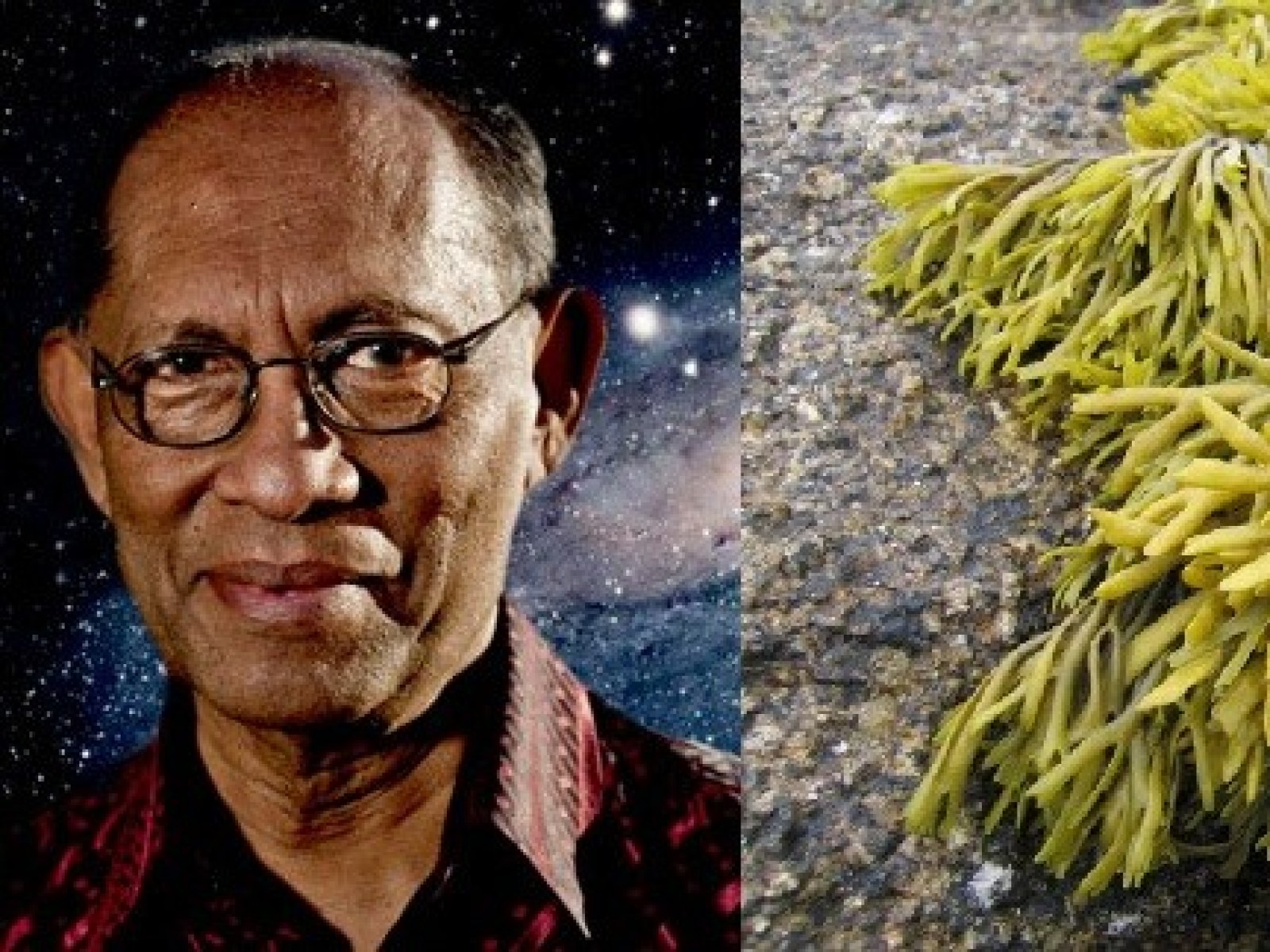
Chandra Wickramasinghe
 Sri Lanka
mathematician•astronomer•astrobiologist
Also known as: N. Chandra Wickramasinghe, Nalin Chandra Wickramasinghe, N. C. Wickramasinghe
Birthday
January 20, 1939
Birth Sign
Capricorn
Birthplace
Colombo, Sri Lanka
Age
87 years old
About
Nalin Chandra Wickramasinghe is a Sri Lankan-born British mathematician and astronomer whose career has been defined by a bold, unorthodox vision of life's place in the cosmos. He is best known as the leading modern advocate of panspermia, the theory that life's building blocks, or even living organisms, can travel through space and seed planets. For over four decades, he championed this idea alongside astrophysicist Fred Hoyle, and he continues to develop it today as an Honorary Professor at the University of Buckingham and director of its Centre for Astrobiology.
Wickramasinghe's work has always straddled the line between rigorous astronomy and speculative biology. He has made genuine contributions to the study of interstellar dust and infrared astronomy, yet he is equally famous for proposing that outbreaks of disease on Earth, including the 1918 flu pandemic, might have extraterrestrial origins. These claims have drawn sharp criticism from the scientific mainstream, but they have also earned him a devoted following among those fascinated by the possibility of life beyond our planet.
An author of more than 40 books and a familiar face on science documentaries, Wickramasinghe has spent decades bringing cosmic questions to the public. His fans see him as a fearless thinker willing to question scientific orthodoxy, while his critics view him as a fringe figure. Either way, his influence on the public imagination is undeniable.
Early Life & Background
Chandra Wickramasinghe grew up in Colombo, Sri Lanka, where his early fascination with the night sky took root. He attended Royal College, Colombo, one of the island's most prestigious schools, before moving on to the University of Ceylon. It was there that his talent for mathematics and physics became clear, earning him a scholarship to continue his studies in the United Kingdom.
Wickramasinghe arrived at the University of Cambridge in the late 1950s, where he pursued a PhD under the supervision of the legendary astronomer Fred Hoyle. This mentorship would prove transformative. Hoyle, already famous for his work on stellar nucleosynthesis, recognized in the young Sri Lankan a kindred spirit, someone willing to ask the biggest questions about the universe. Wickramasinghe's doctoral work focused on the interstellar medium, the tenuous gas and dust that fills the space between stars, and it was here that he first began to think about the possibility of organic molecules in space.
In 1960, he took up a position as a lecturer at Cardiff University, beginning an academic career that would span more than half a century. The early years were marked by rigorous, conventional research, but the seeds of his later iconoclasm were already being sown. By the early 1970s, he and Hoyle were collaborating closely, and their joint work would soon take them down a path that would set them apart from the rest of the astronomical community.
Career Growth
Wickramasinghe's breakthrough moment came in 1974, when he and Fred Hoyle published a paper proposing that interstellar dust grains showed spectral features similar to freeze-dried bacteria. The idea was met with widespread skepticism, and later research attributed the features to polycyclic aromatic hydrocarbons, but it marked the beginning of a decades-long campaign to promote panspermia.
Throughout the 1980s and 1990s, Wickramasinghe and Hoyle refined their theory, arguing that comets carry microbial life and that these organisms continuously rain down on Earth, influencing everything from the evolution of species to the outbreak of epidemics. They linked the 1918 flu pandemic, polio, and mad cow disease to extraterrestrial pathogens, claims that were almost universally rejected by the scientific community.
Despite the controversy, Wickramasinghe has maintained a productive academic career. He served as a professor at Cardiff University for many years and later became director of the Centre for Astrobiology at the University of Buckingham, a position he has held since 2011. He has authored or co-authored over 40 books, including the 2013 memoir A Journey with Fred Hoyle, and has appeared on numerous documentaries, including the Discovery Channel's Red Rain. In 2019, he weighed in on the potential habitability of the exoplanet K2-18b, and his research on microbial communication with alien species was highlighted in 2021. In 2025, he engaged in a public discussion about whether the origin of life from space can be considered a scientific question.
Career Timeline
Public Image & Style
Wickramasinghe is often portrayed in the media as a maverick scientist, a man unafraid to challenge the establishment. His public image is that of a passionate, articulate advocate for a radically different view of life's origins. He is a frequent guest on science documentaries and has a reputation for engaging with the public through interviews and Q&A sessions, such as his Reddit AMA. Fans of his work appreciate his willingness to entertain ideas that mainstream science dismisses, while his critics see him as a cautionary tale about the dangers of speculation. Regardless of where one stands, his presence in the public conversation about astrobiology is unmistakable.
Fame & Fandom (iFAMOUS Rankings)
Chandra Wickramasinghe’s following is not a conventional fandom. There is no official name, no fan clubs, no coordinated campaigns, nothing resembling the organized communities that surround entertainers or athletes. Instead, his audience is a niche but dedicated circle within astrobiology, panspermia, and alternative-science circles: researchers, students, and enthusiasts who track his work through his official website and his active Facebook page. He engages directly through channels like Reddit AMAs and podcast appearances, but the relationship remains academic and lecture-based rather than fan-driven. No documented fan projects or rituals exist; the closest to a celebration is the 2025 Golden Jubilee marking five decades in Sri Lanka’s tourism industry, a separate career track, not a fan event.
In the global fame landscape, iFANN’s Global Fame Engine has evaluated Wickramasinghe but he currently holds no placement in the published rankings, neither the Global Top 1,000 nor any Top-100 scope list. His fame is real but diffuse, driven by decades of media coverage and public controversy rather than a measurable, rankable fan base.
Within that niche, certain stories have become lore. The 2018 paper co-authored with colleagues, suggesting octopuses arrived from space, went viral, ScienceAlert called it “an insane paper that tests the limits of science.” His 2020 claim that COVID-19 came to Earth on a space rock sparked global headlines. These moments, met with a mix of amusement and exasperation by mainstream scientists, function as running jokes in science communication circles, the closest thing to inside humor his following has.
Interesting Facts and Legends
Wickramasinghe is a recipient of the Order of the British Empire (MBE), an honor rarely given to scientists with such controversial views. He once engaged in a published dialogue with Daisaku Ikeda, the president of the Soka Gakkai International Buddhist movement, exploring themes of space and existence. The 2013 Discovery Channel show Red Rain featured his work on the mysterious red rain phenomenon in Kerala, India, which he suggested might contain extraterrestrial cells. He has also been known to debate his critics in public forums, maintaining a lively presence on academic social networks like Academia.edu.
A story fans still retell is the 2018 paper he co-authored arguing that octopuses may have arrived on Earth as frozen eggs from space, a claim that went viral and became the defining pop-culture moment of his career. Another widely told tale is his 2020 assertion that SARS-CoV-2 arrived on a meteorite, building on his cometary panspermia framework. Both claims were universally rejected by mainstream science but cemented his reputation as a provocateur.
Family & Personal Life
Details about Wickramasinghe's family life are scarce in the public record. He has co-authored works with a Kamala Wickramasinghe, who edited the second edition of A Journey with Fred Hoyle, but it is not clear whether she is a relative. His personal life has remained largely private, and he has not publicly discussed his parents or siblings in the sources reviewed.
Notable Connections
Chandra Wickramasinghe is most closely associated with his mentor and collaborator Fred Hoyle, with whom he developed the modern version of panspermia. He has also interacted with figures like Daisaku Ikeda, the Buddhist leader, with whom he published a dialogue. His work has been referenced by other scientists and writers interested in astrobiology and the origins of life.
Relationships & Dating History
Salary, Net Worth In 2026
$5 Million
iFANN Editorial Team estimate
iFANN’s editorial analysis currently estimates Chandra Wickramasinghe’s net worth at $5 million. His income has come primarily from his long academic career, including salaries from positions at Cardiff University and the University of Buckingham, as well as royalties from his more than 40 books. He has also received fees for media appearances and public speaking engagements. While his controversial theories have limited his access to some research grants, they have not stopped him from building a comfortable financial position over a career spanning more than six decades.
Awards Won (1)
Chandra Wickramasinghe was appointed a Member of the Order of the British Empire (MBE) for his services to astronomy and astrobiology. This honor reflects his contributions to science and his role in bringing cosmic questions to a wider audience.
2016 · Civil
Services to astronomy and astrobiology
Known For
Panspermia theory
1974 · Co-developer with Fred Hoyle
Centre for Astrobiology, University of Buckingham
2011 · Director
A Journey with Fred Hoyle
2013 · Author
Keywords
Sources
Quick Facts
- Profession
- mathematician, astronomer, astrobiologist
- Born
- January 20, 1939
- Birthplace
- Colombo, Sri Lanka
- Gender
- Male
- Birth Sign
- Capricorn
- Education
- University of Cambridge (PhD)
- Known for
- Panspermia theory
Personal Details
- Full Name
- Nalin Chandra Wickramasinghe
- Children
- Education
- Royal College, Colombo; University of Ceylon; University of Cambridge (PhD)
Frequently Asked Questions
What is Chandra Wickramasinghe known for?
What is panspermia?
What are some of Chandra Wickramasinghe's controversial theories?
Where did Chandra Wickramasinghe study?
What is Chandra Wickramasinghe's role at the University of Buckingham?
Similar People
Join the community
fans discussing