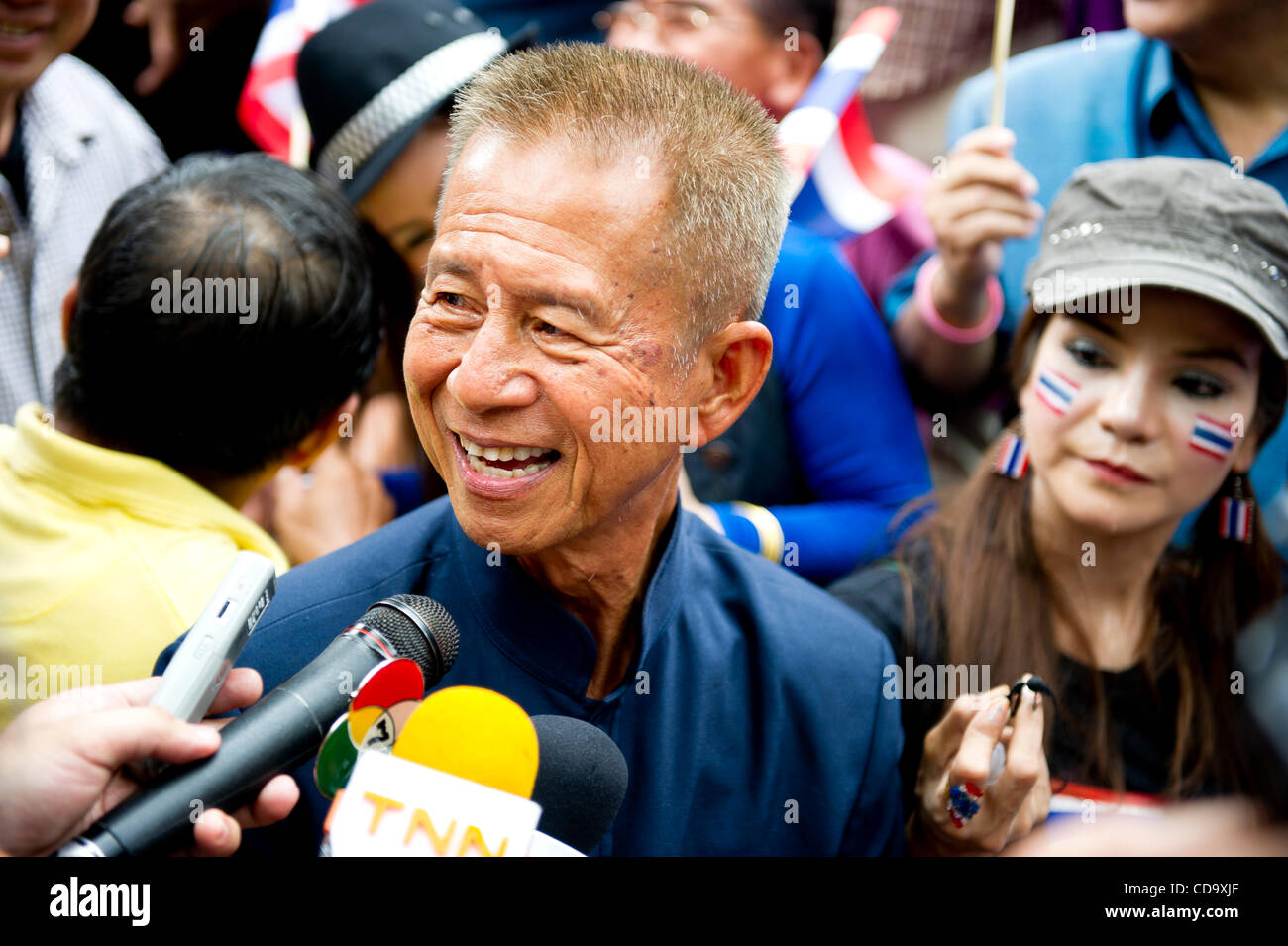
Chamlong Srimuang
 Thailand
politician•military personnel•activist
Also known as: Chamlong Srimuang
Birthday
July 5, 1935
Birth Sign
Cancer
Birthplace
Thonburi, Thailand
Age
91 years old
About
Chamlong Srimuang is a retired Thai army general, politician, and activist whose life has been defined by a rare blend of military discipline, Buddhist austerity, and a relentless fight for clean governance. Born in Thonburi in 1935, he rose through the ranks to become one of Thailand's most recognizable political figures, celebrated for leading the 1992 pro-democracy uprising and later opposing Thaksin Shinawatra through the People's Alliance for Democracy.
Today, Chamlong remains a revered elder statesman among conservative Bangkokians, though he has largely stepped back from frontline politics. His public persona is inseparable from his devotion to the strict Santi Asoke Buddhist sect, which has guided him toward a celibate, vegetarian lifestyle and a claim of owning no worldly possessions. Even in his nineties, he maintains the army-style buzz cut from his military days, a symbol of his enduring discipline.
His legacy rests on moments of moral courage: the hunger strike that catalyzed Black May, his six years as Bangkok's first directly elected governor, and his later role in the yellow-shirt protests. For many, he stands as a rare example of a politician who genuinely lived by his principles, earning him the Ramon Magsaysay Award in 1992.
Early Life & Background
Chamlong Srimuang was born on July 5, 1935, in Thonburi, then a separate province from Bangkok. Details of his childhood are scarce, but his path was set early toward a military career. He entered the Chulachomklao Royal Military Academy, Thailand's elite officer school, and in 1959 won his first election when fellow cadets chose him as Chief Cadet. After graduating at 25, he deliberately joined the Signals Corps, reasoning that a technical specialty would boost his odds of studying abroad.
That gamble paid off. During the early 1960s, he took electronics courses in New Jersey, Georgia, and Hawaii, and later earned a master's degree in management from the Naval Postgraduate School in Monterey, California (1972–1974). His military service took him to Laos as a communications officer during the Laotian Civil War, where he supported Thai units battling the Pathet Lao and North Vietnamese forces.
Back in Thailand, Chamlong's life took a spiritual turn. He became deeply religious, embracing the Santi Asoke sect, and spent much of his energy on lay preaching tours, urging villagers to practice abstinence. He also began urging people to form their own political parties to build genuine democracy. In 1980, he was appointed Secretary-General to the Prime Minister, but resigned the next year, partly over a proposed abortion bill. By 1983, he made his name as a democrat by campaigning against reactionary constitutional changes pushed by Army Commander-in-Chief General Arthit.
Career Growth
Chamlong's breakthrough came in 1985 when he won election as Bangkok's first directly elected governor, running on a platform of clean politics in a city known for graft. He served from November 14, 1985, to January 22, 1992, earning a reputation for disciplined, honest administration. During this period, he also founded the Palang Dharma Party, a Buddhist-inspired political movement that blended his religious convictions with a reformist agenda.
His defining moment arrived in May 1992. When military strongman Suchinda Kraprayoon seized power, Chamlong launched a highly publicized hunger strike and led a massive, largely peaceful middle-class revolt. The army responded with deadly force, an event now known as Black May, but the protests ultimately forced the military to back down and restored civilian government. That year, he received the Ramon Magsaysay Award for Government Service.
In his later years, Chamlong became a key leader of the People's Alliance for Democracy (PAD), the yellow-shirt movement opposed to Prime Minister Thaksin Shinawatra. He rallied tens of thousands of protesters in 2006 and supported the military coup that ousted Thaksin that September. In 2008, he was among the leaders of the PAD's occupation of Suvarnabhumi International Airport, a dramatic protest that ended with him handing the airport back to authorities.
Career Timeline
Public Image & Style
Chamlong's public image is built on austerity and moral clarity. He still sports the army-style buzz cut from his military days, and his simple dress and vegetarian, celibate lifestyle set him apart from typical Thai politicians. Western media has called him a celibate Buddhist ascetic, and the Washington Monthly described him as standing out on a Thai political scene dominated by interchangeable local bosses in black suits.
His rhetoric centers on clean government, Buddhist morality, and opposition to corruption. Supporters in the PAD protests wore yellow, the color of the Thai monarchy. While he has no organized fandom in the entertainment sense, he has long been revered among middle-class Bangkokians and conservative activists who opposed Thaksin Shinawatra.
Fame & Fandom (iFAMOUS Rankings)
Chamlong Srimuang's fame is rooted in his role as a pivotal figure in Thailand's modern political history, yet his global footprint remains modest. In August 2026, iFANN's Global Fame Engine evaluated his status but did not place him in the published rankings, neither in the Global Top 1,000 nor in any Top-100 scope list. This absence reflects a career that, while transformative within Thailand, has not translated into sustained international name recognition.
His renown peaked during the 1992 pro-democracy uprising, when his leadership and subsequent hunger strike drew worldwide media attention. The iconic image of him kneeling before King Bhumibol Adulyadej on May 20, 1992, became a symbol of peaceful resolution, broadcast globally and etched into collective memory. Yet, unlike political figures who leverage such moments into enduring celebrity, Chamlong retreated from the spotlight, embracing an ascetic Buddhist lifestyle that shunned personal aggrandizement.
His fanbase, though devoted, lacks a formal name or organized structure. In Thai public discourse, he is affectionately called "Uncle Chamlong" (ลุงจำลอง), a term that conveys warmth and respect, as seen in a June 2026 YouTube short where he was tagged #UncleChamlong. His supporters have historically been drawn from military circles and urban middle-class Bangkokians, who admired his clean-government stance. They engage not through fan clubs but through political and religious movements, revering his moral authority rather than cultivating celebrity culture. No documented fan campaigns, rituals, or inside jokes exist, consistent with a figure who consistently prioritized principle over popularity.
Interesting Facts and Legends
Chamlong's career choices were often calculated. He picked the Signals Corps specifically to increase his odds of studying overseas, a strategy that worked. He won his first election in 1959 as Chief Cadet at Chulachomklao Military Academy, long before entering politics. Before marrying in 1964, he spent three months as a monk, a traditional rite of passage. His resignation as Secretary-General to the Prime Minister in 1981 was partly a protest against a proposed abortion bill, a stance consistent with his strict Buddhist ethics. During the 2006 anti-Thaksin protests, the demonstrations had a block party atmosphere, with families on blankets eating mango ices and a young singer performing. Chamlong has been the subject of a scholarly biography, Duncan McCargo's Chamlong Srimuang and the New Thai Politics, published in 1997.
One of the most enduring legends is his hunger strike in May 1992, which he abandoned after six days, but which became a rallying point for demonstrators. Another iconic moment occurred on May 20, 1992, when he knelt before King Bhumibol Adulyadej alongside his adversary Suchinda Kraprayoon, an act that helped end the bloody crackdown and is still retold as a symbol of his humility. His ascetic lifestyle, including sleeping on a simple mat and eating one meal a day, has become the stuff of legend among Bangkok's middle class, though some stories of his incorruptibility are unverifiable folklore.
Notable Quotes
“Form your own political parties to help create genuine Thai democracy.”
“I have no worldly possessions.”
Family & Personal Life
Chamlong married Major Sirilak Kheolaor on June 14, 1964. They met during an Army-Navy rugby match when he was still a cadet. Sirilak, a graduate of Chulalongkorn University's School of Pharmacy, also served in the army. The couple have no children. As a follower of the Santi Asoke sect, Chamlong has adopted a celibate lifestyle, so their marriage is understood as a spiritual and companionate partnership rather than a conventional romantic one. They live simply, consistent with his claim of owning no worldly possessions.
Notable Connections
Chamlong's wife, Major Sirilak Kheolaor, has been his partner since 1964. His biographer, Duncan McCargo, wrote Chamlong Srimuang and the New Thai Politics (1997). He opposed General Arthit in 1983, Suchinda Kraprayoon in 1992, and Thaksin Shinawatra through the PAD. Krisda Arunvongse na Ayudhya succeeded him as Bangkok governor.
Relationships & Dating History
Chamlong Srimuang's personal life has been remarkably stable and private. His only documented relationship is his marriage to Major Sirilak Kheolaor, whom he wed on June 14, 1964. They met during an Army-Navy rugby match when Chamlong was a cadet. Sirilak, a graduate of Chulalongkorn University's School of Pharmacy, also served in the army. The couple have no children.
Given Chamlong's commitment to a celibate lifestyle as a follower of the Santi Asoke Buddhist sect, their marriage is understood to be a spiritual and companionate union rather than a conventional romantic partnership. As of 2026, Chamlong remains married to Sirilak, and there are no records of any other romantic relationships.
- MarriedSirilak Kheolaor1964 - presentCurrentMet during an Army-Navy rugby match; married June 14, 1964; no children.
Salary, Net Worth In 2026
$1 Million
iFANN Editorial Team estimate
Chamlong Srimuang's net worth is not publicly documented, and by his own account, he owns nothing. As a devoted follower of the Santi Asoke Buddhist sect, he has renounced personal possessions and lives a life of austerity. iFANN currently estimates his net worth at $1 Million, a figure that reflects his minimal personal wealth rather than any significant assets. His income likely comes from a military pension and modest savings, given his long service as an army officer and public official. His wife also served in the army, so the household likely relies on two military pensions. There are no known investments, properties, or business ventures. In 2026, any estimate of his wealth is speculative, but it is safe to say it is minimal compared to most politicians. His true legacy is not financial but moral, built on decades of public service and principled stands.
Awards Won (1)
Chamlong Srimuang received the Ramon Magsaysay Award for Government Service in 1992, recognizing his integrity and public service, particularly his leadership during the Black May uprising. Often called Asia's Nobel Prize, this is his most significant formal honor. His career has been marked more by moral leadership than by institutional awards.
1992 · Government Service
Public service and leadership during Black May uprising
Known For
Black May 1992 Uprising
1992 · Leader
Bangkok Governor
1985-1992 · Governor
People's Alliance for Democracy
2006-2008 · Leader
Keywords
Sources
Quick Facts
- Profession
- politician, military personnel, activist
- Born
- July 5, 1935
- Birthplace
- Thonburi, Thailand
- Gender
- Male
- Birth Sign
- Cancer
- Spouse
- Sirilak Kheolaor
- Children
- None
- Education
- Chulachomklao Royal Military Academy; Naval Postgraduate School
Personal Details
- Spouse
- Sirilak Kheolaor
- Children
- None
- Education
- Chulachomklao Royal Military Academy; Naval Postgraduate School (Master's in Management)
Frequently Asked Questions
How old is Chamlong Srimuang?
Is Chamlong Srimuang married?
What is Chamlong Srimuang's net worth?
What did Chamlong Srimuang do in 1992?
Does Chamlong Srimuang have children?
Join the community
fans discussing