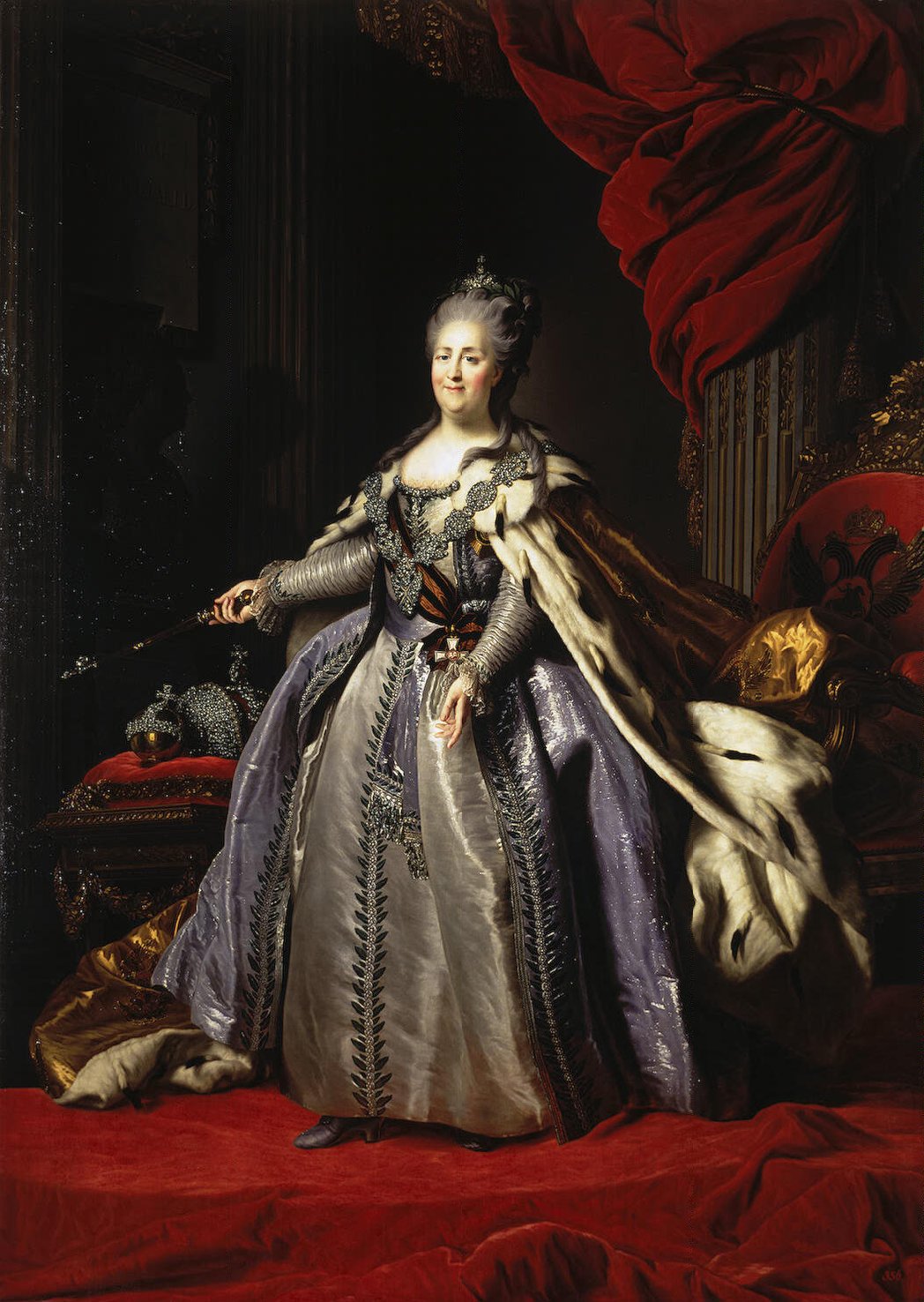
Catherine II of Russia
 Russia
Also known as: Catherine the Great, Yekaterina Velikaya, Sophie Auguste Friederike von Anhalt-Zerbst-Dornburg
Birthday
May 2, 1729
Birth Sign
Taurus
Birthplace
Stettin, Prussia (now Szczecin, Poland)
Age
Died at 67
About
Catherine II of Russia, known to history as Catherine the Great, was Empress of Russia from 1762 until her death in 1796. Born a minor German princess, she seized the throne in a coup that deposed her husband, Peter III, and went on to rule for 34 years, the longest reign of any female Russian leader. Her era is often called Russia's golden age, marked by territorial expansion, cultural flourishing, and ambitious reform.
Catherine is remembered as an enlightened despot who corresponded with Voltaire and Diderot, founded the Hermitage Museum, and established the Smolny Institute, Europe's first state-funded women's higher education institution. She expanded Russia's borders to the Black Sea and into Poland, and her patronage turned St. Petersburg into one of Europe's most cosmopolitan capitals. Though her Enlightenment ideals clashed with the realities of autocracy and serfdom, her legacy as a formidable and cultured ruler endures.
Early Life & Background
Born Princess Sophie Auguste Friederike von Anhalt-Zerbst-Dornburg on May 2, 1729, in Stettin, Prussia, Catherine grew up in a family of modest means despite her royal title. Her father, Christian August, was a Prussian general, and her mother, Johanna Elisabeth, was ambitious for her daughter's future. Catherine was educated at home by tutors, learning French, German, and Russian, along with history, music, and religion. Her mother largely ignored her, focusing attention on her younger brother Wilhelm until his death from scarlet fever at age 12; Catherine had a closer bond with her father.
In 1744, Empress Elizabeth of Russia chose Catherine, then 15, as the bride for her nephew and heir, Peter of Holstein-Gottorp. Catherine traveled to Russia, converted to Russian Orthodoxy, and took the name Catherine Alekseyevna. She threw herself into mastering the Russian language and customs, rising at six each morning to study. She later wrote that she resolved to do whatever was required to become worthy of the crown, and she worked diligently to win the affection of the empress, her husband, and the Russian people.
Career Growth
Catherine's reign began with a dramatic coup in June 1762. Just six months after Peter III ascended the throne, Catherine, supported by the Imperial Guards and her lover Grigory Orlov, marched into St. Petersburg and had herself proclaimed empress in the Kazan Cathedral. Peter abdicated and was assassinated eight days later, a death Catherine likely did not order but bore public responsibility for. She was formally crowned in Moscow that September, wearing the newly created Imperial Crown of Russia.
Over the next 34 years, Catherine pursued an expansionist foreign policy. The First Russo-Turkish War (1768–1774) brought Russia to the Black Sea, and in 1783 she annexed Crimea. The Second Russo-Turkish War (1787–1792) extended Russian territory further, and the partitions of Poland in 1793 and 1795 added vast lands to the empire. At home, she reorganized the country into provinces after Pugachev's Rebellion (1773–1775), founded universities and theaters, and opened schools and hospitals in every province. She also became the first person in Russia to be inoculated for smallpox, a bold move that encouraged its adoption among the nobility.
Catherine's cultural patronage transformed St. Petersburg. She acquired art collections that became the foundation of the Hermitage Museum, commissioned the Bronze Horseman monument to Peter the Great, and corresponded with Enlightenment thinkers like Voltaire and Diderot. Under her rule, Russians became the first Europeans to settle in Alaska, creating Russian America. Yet her reign also saw the intensification of serfdom, and after the French Revolution in 1789, she grew more conservative, famously remarking, "If Russians knew how to read, they would write me off."
Career Timeline
Public Image & Style
Catherine the Great's public image is a blend of Enlightenment ideals and autocratic power. She cultivated an image as a cultured, progressive ruler, corresponding with philosophers and amassing a world-class art collection. At the same time, she was a shrewd and sometimes ruthless politician, not above using military force to expand her empire. Her personal life, with its many lovers and the mysterious death of her husband, has fueled endless fascination and myth.
In modern culture, Catherine is often portrayed as a larger-than-life figure, from serious historical dramas to satirical comedies. The persistent myth that she died attempting to have sex with a horse is a fabrication with no basis in fact, likely spread by her political enemies. Her aesthetic is associated with Russian imperial grandeur, classical architecture, and the opulence of the Hermitage. No official fandom name exists, but she remains a subject of enduring popular interest, with her Wikipedia page drawing over 300,000 views in two months.
Fame & Fandom (iFAMOUS Rankings)
Catherine II of Russia commands a global attention that spans centuries, with her legacy tracked across media coverage, search trends, and consumption signals worldwide. According to the iFANN Global Fame Rankings, she is currently ranked as the 12th most famous person from Russia, a position holding steady from the previous cycle. In the specific domain of historical influence and culture, she holds the 14th most famous person in Art & Design, also maintaining her standing from the prior assessment. These placements reflect her enduring status as one of history's most significant figures. Regarding her modern following, there is no formal fandom name or organized group of enthusiasts who identify by a specific moniker. As an 18th-century monarch, she predates the concept of celebrity fan clubs, and her admirers are primarily historians, students, and cultural scholars rather than a mobilized fanbase. While recent events have seen her jewels scheduled for auction and her image invoked in geopolitical discourse, these are institutional engagements rather than fan-driven campaigns. The audience for Catherine remains defined by academic study and museum visitation, lacking the interactive rituals or social media movements characteristic of contemporary stars.
Interesting Facts and Legends
Beyond her political achievements, Catherine was a woman of surprising habits and interests. She rose at six every morning to study Russian grammar and speech, a discipline she maintained throughout her life. She was also the first person in Russia to be inoculated for smallpox, setting an example that encouraged widespread vaccination. Her coronation crown, designed by Jérémie Pauzié, contained 4,936 Indian diamonds and a large ruby, and became the official coronation crown for all subsequent Russian sovereigns. Catherine wrote a self-composed epitaph in which she stated that at fourteen, she had three desires: to be loved by her husband, Empress Elizabeth, and her people. She noted that she succeeded only in the last. She was an avid letter writer, exchanging correspondence with Voltaire and other Enlightenment figures, and she even authored several plays and memoirs. Her art collection, which she amassed with a keen eye, included works by Rembrandt and Rubens, and formed the core of one of the world's greatest museums, the Hermitage. A widely retold story from her reign involves the dramatic coup d'état where she deposed her husband Peter III to secure the throne, an event often cited as the foundational myth of her power. Another persistent legend contrasts her humble origins as Sophie of Anhalt-Zerbst with her transformation into the powerful "Catherine the Great," a narrative of reinvention that defines her public image. Recent lore also includes the rediscovery of imperial jewels linked to her collection after a century of hiding, leading to high-profile auctions in the mid-2020s.
Notable Quotes
“This idea of a crown began running in my head like a tune, and has been running a lot in it ever since.”
“I tried to be as charming as possible to everyone and studied every opportunity to win the affection of those whom I suspected of being in the slightest degree ill-disposed towards me.”
“If Russians knew how to read, they would write me off.”
“Here lies Catherine II, born in Stettin in 1729. She arrived in Russia in 1744 to marry Peter III. At fourteen, she had three desires – to be loved by her husband, Empress Elizabeth, and her people. She omitted nothing to achieve this.”
Family & Personal Life
Catherine's family life was complicated from the start. She married Grand Duke Peter in 1745, but the union was deeply unhappy; both were unfaithful, and Catherine later admitted she was more interested in the crown than in her husband. She had three children officially recorded as Peter's, though paternity was questioned. Paul, her eldest, was likely fathered by Sergei Saltykov, a courtier. Anna was probably the daughter of Stanislaw Poniatowski, who later became King of Poland. Alexei, her youngest, was most likely Grigory Orlov's son.
Catherine's mother, Johanna Elisabeth, was a difficult presence, and Catherine had a closer bond with her father, Christian August, who died in 1747. Her brother Wilhelm's death from scarlet fever when he was 12 deeply affected the family. As empress, Catherine kept her children at a distance, especially Paul, whom she saw as a rival for the throne. She did, however, lavish attention on her grandchildren, particularly Alexander, whom she groomed as her successor.
Notable Connections
Catherine surrounded herself with a remarkable circle of advisors, lovers, and military commanders. Grigory Orlov, her lover and the leader of the 1762 coup, was a powerful figure early in her reign. Grigory Potemkin, perhaps her most famous favorite, was a brilliant statesman and military leader who played a key role in Russia's victories over the Ottoman Empire. She also worked with generals Alexander Suvorov and Pyotr Rumyantsev, and admirals Samuel Greig and Fyodor Ushakov. Her intellectual correspondence with Voltaire influenced her political outlook, and she maintained ties with Stanislaw Poniatowski, who became King of Poland through her support.
Relationships & Dating History
Catherine's romantic life was as storied as her reign. Her marriage to Peter III in 1745 was unhappy from the start; both were unfaithful, and Catherine later wrote she was more interested in the crown than in her husband. Early in her marriage, she had an affair with Sergei Saltykov, a courtier, who was widely speculated to be the biological father of her son Paul, though this was never confirmed. Around 1755, she began a relationship with Stanislaw Poniatowski, a Polish nobleman who later became King of Poland, and who was likely the father of her daughter Anna.
In 1759, Grigory Orlov became her lover and played a crucial role in the coup that brought her to power in 1762. He was likely the father of her youngest child, Alexei. Their relationship lasted until about 1772. After Orlov, she had a brief liaison with Alexander Vasilchikov, who had little political influence. In 1774, she began her most famous relationship with Grigory Potemkin, a brilliant statesman and military leader. Potemkin remained a close advisor even after their romantic relationship ended, and some historians believe they may have secretly married, though this is unconfirmed. After Potemkin's death in 1791, Catherine took several younger favorites, the last being Platon Zubov, who was with her until her death in 1796. Catherine died a widow, Peter III having been assassinated in 1762.
- MarriedPeter III of Russia1745 - 1762Unhappy marriage; Catherine deposed him in a coup, and he was assassinated eight days later.
- DatedSergei Saltykov1752 - 1754Courtier and early lover; widely speculated to be the biological father of Paul I.
- DatedStanislaw Poniatowski1755 - 1758Polish nobleman who later became King of Poland; likely father of Catherine's daughter Anna.
- DatedGrigory Orlov1759 - 1772Military officer and leader of the 1762 coup; likely father of Alexei Bobrinsky.
- DatedAlexander Vasilchikov1772 - 1774Brief successor to Orlov as favorite; had little political influence.
- DatedGrigory Potemkin1774 - 1791Most famous lover and statesman; remained a close advisor after their romantic relationship ended.
- DatedPlaton Zubov1789 - 1796Final favorite, from about 1789 until Catherine's death in 1796.
Death & Aftermath
Died
November 17, 1796 (aged 67)
Death Place
St. Petersburg, Russia
Cause of Death
Sudden cerebral hemorrhage
The nation observed periods of official mourning and issued tributes from the nobility, the Orthodox Church, and foreign dignitaries who recognized her as a transformative ruler. Her funeral was a grand, state-sponsored event held shortly after her death in December 1796 at the Peter and Paul Cathedral in St. Petersburg, where her sarcophagus remains today. Catherine II of Russia passed away on November 17, 1796, at the Winter Palace while seated at her writing desk during breakfast. She had been feeling unwell for several weeks prior to her death, missing public appearances due to recurring headaches and dizziness, yet she continued to conduct official business until the day of her passing.
Contemporary accounts describe her as having collapsed suddenly, losing consciousness immediately, and dying within hours without regaining awareness. The cause of death was established through immediate medical observation by her personal physicians and court attendants present at the scene, accepted as a natural stroke based on the symptoms observed and reported to her successor, Paul I. In the posthumous era, she has been the subject of numerous films, books, and documentaries, including the BBC documentary series, and remains honored with dedications such as the Catherine II Saint Petersburg Mining University.
Net Worth (Estate Value)
N/A
iFANN Editorial Team estimate
As an 18th-century monarch, Catherine II's wealth was tied to the Russian imperial treasury rather than personal assets. Her personal art collection, which she amassed during her reign, was extraordinary and formed the basis of the Hermitage Museum. The collection includes works by Rembrandt, Rubens, and other masters, and is considered priceless today. The Imperial Crown of Russia, made for her coronation, was adorned with 4,936 Indian diamonds and a large ruby, and became a symbol of Russian imperial power. Per iFANN's editorial analysis, the estate value is not calculable in modern terms, resulting in a net worth figure of N/A. Since her death in 1796, no posthumous earnings figures apply to the individual. The Hermitage, now a state museum, is one of the world's most visited cultural institutions, drawing millions of visitors annually. The Russian government manages the collection, and while Catherine's legacy continues to generate significant economic and cultural value through tourism, exhibitions, and scholarly research, this value cannot be attributed to a personal fortune.
Awards Won (1)
As an 18th-century monarch, Catherine II's honors were not modern awards but imperial distinctions and lasting achievements. She established the Smolny Institute, Europe's first state-funded women's higher education institution, and founded the Hermitage Museum, which became one of the world's greatest art collections. She also commissioned the Bronze Horseman monument to Peter the Great, a symbol of Russian imperial pride. Her coronation crown, designed by Jérémie Pauzié, became the official coronation crown for all subsequent Russian sovereigns.
1762 · Imperial Order
As Empress of Russia
Known For
Empress of Russia
1762-1796 · Monarch
Founder of the Hermitage Museum
1764 · Patron
Smolny Institute of Noble Maidens
1764 · Founder
Keywords
Sources
Quick Facts
- Profession
- Empress of Russia
- Born
- May 2, 1729
- Birthplace
- Stettin, Prussia (now Szczecin, Poland)
- Died
- November 17, 1796
- Death Place
- Tsarskoye Selo, Russia
- Gender
- Female
- Spouse
- Peter III of Russia
- Birth Sign
- Taurus
Personal Details
- Full Name
- Princess Sophie Auguste Friederike von Anhalt-Zerbst-Dornburg
- Spouse
- Peter III of Russia
- Children
- Paul I of Russia, Anna Petrovna, Alexei Bobrinsky
- Education
- Educated at home by tutors; studied French, German, Russian, history, music, and religion
Frequently Asked Questions
How did Catherine the Great die?
Did Catherine the Great really have a horse?
How many lovers did Catherine the Great have?
Was Catherine the Great Russian?
Who was Catherine the Great's husband?
Similar People
Join the community
fans discussing