“Casablanca is not just a great movie, it is the great movie, the one that defines what we mean when we talk about the magic of Hollywood. It has everything: romance, intrigue, wit, and a moral center that holds.”
Roger Ebert
Chicago Sun-Times
 United States
"In Casablanca, love and duty collide."
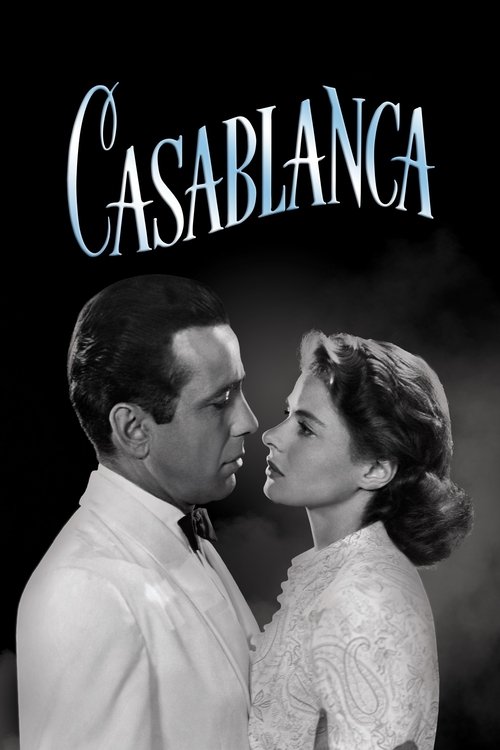
Set in December 1941, Casablanca captures the tense, cosmopolitan atmosphere of a Moroccan city that has become a waiting room for refugees fleeing Nazi-occupied Europe. At the center of this swirling world is Rick Blaine, an American expatriate who runs a popular nightclub and gambling den. When his former lover Ilsa Lund walks through the door with her husband, the resistance leader Victor Laszlo, Rick's carefully maintained neutrality is put to the test. Directed by Michael Curtiz, the film pairs Humphrey Bogart's weary cynicism with Ingrid Bergman's luminous vulnerability, creating one of cinema's most enduring love triangles. Paul Henreid brings quiet heroism to Victor, while Claude Rains and Conrad Veidt add layers of moral ambiguity and menace as the local police captain and a Nazi major. Produced by Warner Bros. for a modest $878,000, the picture grossed over $10 million worldwide, a sign of its immediate and lasting appeal.
With its blend of wartime suspense, romance, and moral reckoning, Casablanca remains a touchstone of classic Hollywood, celebrated for its sharp dialogue, memorable supporting cast, and a score by Max Steiner that underscores every moment of longing and sacrifice. The film's production was rushed to coincide with the Allied invasion of North Africa, and its release in January 1943 capitalized on the real-life Casablanca Conference. The screenplay, adapted from the unproduced play Everybody Comes to Rick's, was rewritten continuously during shooting, with actors receiving new pages each morning. The ending was only finalized late in production, leaving even Ingrid Bergman uncertain whether her character would leave with Rick or Victor. This improvisational energy, combined with Curtiz's efficient direction, gave the film a freshness that has never faded.
Stream
Availability and pricing can change. Confirm on the provider's site before purchasing.
As the Second World War grinds across Europe, the Moroccan city of Casablanca has become a bottleneck for refugees desperate to reach neutral Lisbon and then America. Among the crowds moving through its streets and cafés are resistance fighters, black marketeers, and agents of the Vichy regime, all circling the exit visas that mean freedom. Rick Blaine, an American with a murky past, runs Rick's Café Américain, a nightspot where the local police prefect Captain Louis Renault turns a blind eye to gambling and other vices for a cut of the profits. Rick himself maintains a strict policy of non-involvement, insisting he sticks his neck out for nobody.
That stance is tested when Ilsa Lund, the woman who broke his heart in Paris, appears at the café with her husband Victor Laszlo, a celebrated Czech resistance leader who has just escaped a concentration camp. The two are hunted by Major Heinrich Strasser, a Nazi officer who has come to Casablanca specifically to prevent Laszlo from slipping away. Rick and Ilsa's history is revealed in flashback: a whirlwind romance in Paris, cut short when the Germans advanced and Ilsa failed to meet Rick at the train station. She left without explanation, and Rick has carried the bitterness ever since.
Around this triangle, a web of intrigue tightens. Ugarte, a sleazy opportunist, entrusts Rick with two letters of transit signed by General de Gaulle, which grant their bearer safe passage through Vichy territory. Shortly after, Ugarte is arrested and killed by the police, leaving Rick in possession of the priceless documents. Signor Ferrari, who runs the rival Blue Parrot, offers to buy them, but Rick refuses. Meanwhile, Laszlo seeks to buy the letters from Rick, unaware of the history between Rick and Ilsa. Ilsa, torn between her love for Rick and her loyalty to her husband, confronts Rick alone, hoping to persuade him to help Laszlo escape. Rick, still nursing his hurt, coldly rebuffs her.
The film builds toward a tense standoff at the café, where Laszlo leads the patrons in singing La Marseillaise to drown out the German officers' anthem. Strasser, furious, orders the café closed. As the pressure mounts, Rick must decide whether to cling to his cynicism or act on a deeper sense of decency. The fate of Laszlo, Ilsa, and the resistance effort hangs in the balance, and Rick's choice will define him.
4K Trailer
Modern Trailer
Blu-ray Trailer
Critical Consensus
Casablanca is widely regarded as one of the greatest films ever made, celebrated for its perfect blend of romance, political intrigue, and moral complexity. Critics consistently praise the film's sharp, quotable dialogue, the electric chemistry between Bogart and Bergman, and Curtiz's efficient, atmospheric direction.
“Casablanca is not just a great movie, it is the great movie, the one that defines what we mean when we talk about the magic of Hollywood. It has everything: romance, intrigue, wit, and a moral center that holds.”
Roger Ebert
Chicago Sun-Times
“The movie is a romantic melodrama that has become a classic of the genre, with Bogart at his most iconic and Bergman at her most luminous. It's the rare film that improves with every viewing.”
Pauline Kael
The New Yorker
“Warner Brothers has a picture which makes the spine tingle and the heart beat faster. It is a film that combines the excitement of a spy thriller with the poignancy of a love story, and it does both with uncommon skill.”
Bosley Crowther
The New York Times
“Casablanca is a top-notch melodrama, well directed by Michael Curtiz, with Humphrey Bogart giving a standout performance as the cynical café owner who finds his conscience.”
Variety Staff
Variety
“Casablanca is the ultimate Hollywood movie, a perfect synthesis of studio craftsmanship, star power, and narrative economy that has never been surpassed.”
Dave Kehr
Chicago Reader
Humphrey Bogart
Rick Blaine
Ingrid Bergman
Ilsa Lund
Paul Henreid
Victor Laszlo
Claude Rains
Captain Louis Renault
Conrad Veidt
Major Heinrich Strasser
Sydney Greenstreet
Signor Ferrari
Peter Lorre
Ugarte
Dooley Wilson
Sam
S.Z. Sakall
Carl
Madeleine Lebeau
Yvonne
Joy Page
Annina Brandel
John Qualen
Berger
Director
Michael Curtiz
Writers
Julius J. Epstein, Philip G. Epstein, Howard E. Koch, Murray Burnett, Joan Alison
Composer
Max Steiner
Cinematographer
Arthur Edeson
Producers
Hal B. Wallis, Jack L. Warner
Academy Awards (1944)
Best Picture: Won
Academy Awards (1944)
Best Director: Won
Academy Awards (1944)
Best Writing, Screenplay: Won
Academy Awards (1944)
Best Actor: Nominated
Academy Awards (1944)
Best Supporting Actor: Nominated
Academy Awards (1944)
Best Cinematography, Black-and-White: Nominated
Academy Awards (1944)
Best Film Editing: Nominated
Academy Awards (1944)
Best Music, Original Score: Nominated
National Film Registry (1989)
Preserved: Selected
Join the community
fans discussing