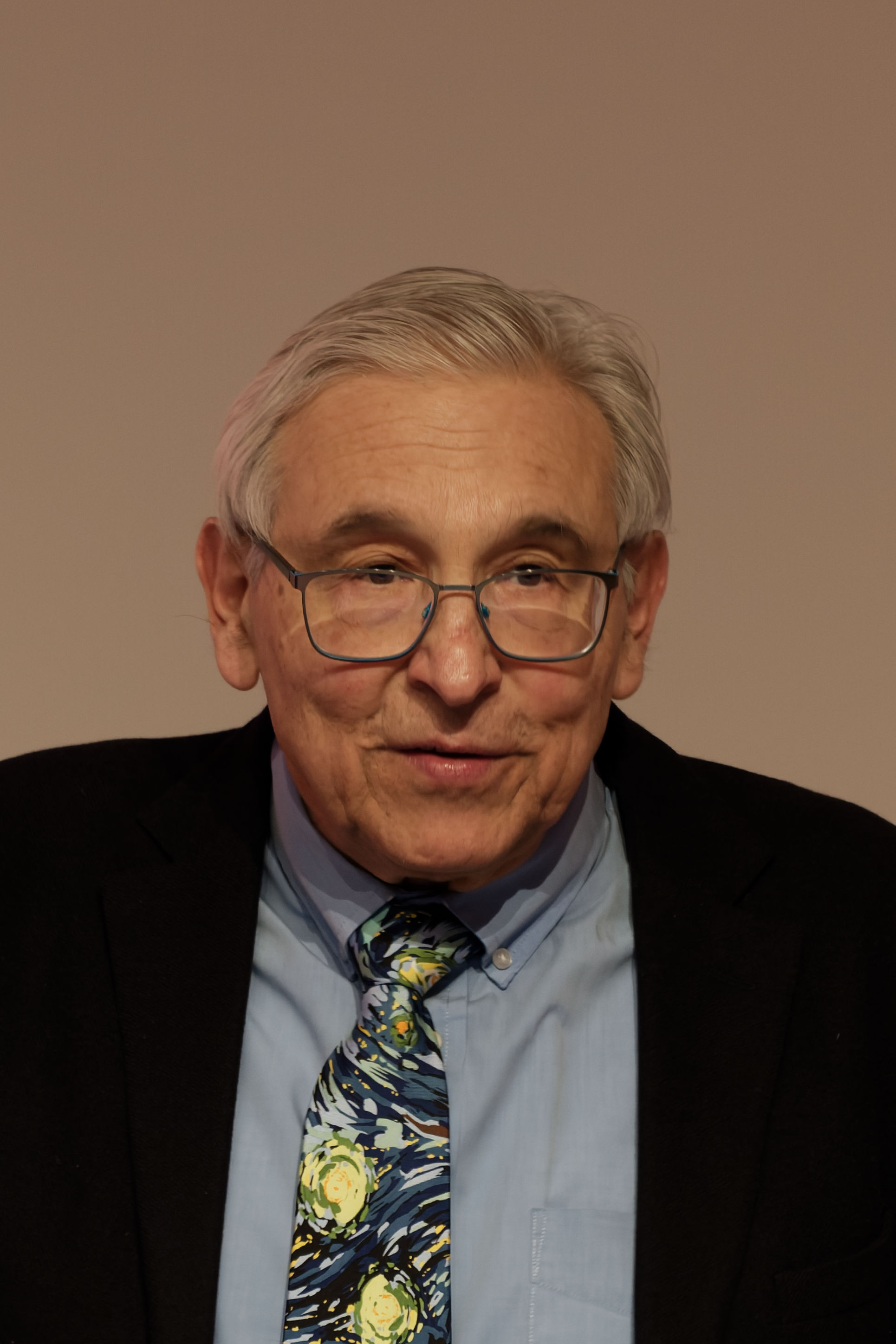
Carlos Frenk
 Mexico
cosmologist•astrophysicist•physicist
Also known as: Carlos Silvestre Frenk, Carlos S. Frenk, Sir Carlos Frenk
Birthday
October 27, 1951
Birth Sign
Scorpio
Birthplace
Mexico City, Mexico
Age
74 years old
About
Sir Carlos Frenk is a Mexican-British cosmologist who has spent more than four decades probing the universe's grandest questions. As Ogden Professor of Fundamental Physics at Durham University since 2001, he leads research into galaxy formation, dark matter, and the cosmic web, using supercomputers to simulate the universe's evolution from the Big Bang to the present. His work has fundamentally shaped modern cosmology, earning him a knighthood in 2025.
Frenk is best known for co-developing the Navarro–Frenk–White profile, a mathematical description of dark matter halo structure that has become a cornerstone of astrophysics, cited over 10,000 times. He has published more than 500 papers, with over 200,000 citations, making him one of the most influential astronomers alive. His simulations, from the Millennium Run to the EAGLE project, have set benchmarks for the field.
Beyond research, Frenk is a passionate science communicator, having given public lectures at the Royal Albert Hall and the Edinburgh International Science Festival, and he chairs public engagement committees at the Royal Society. Fans and colleagues admire his relentless curiosity and his commitment to testing even his own theories.
Early Life & Background
Carlos Frenk grew up in Mexico City as the eldest of six children. His father, a German-Jewish physician, had emigrated to Mexico before World War II, while his mother, a Mexican pianist and chemist, filled the home with music and science. He often joked that his family was split between doctors and musicians, and neither path suited him; he preferred mathematics and the natural world.
A camping trip in southern Mexico during his teenage years changed his life. Gazing at a night sky "alight with stars," he resolved to understand the universe's origins. He initially enrolled in engineering at university but switched to physics, realizing he cared more about "why things work" than "how." In his spare time, he played basketball semi-professionally.
Frenk earned a BSc in physics from the National Autonomous University of Mexico in 1976, then moved to England for graduate study. He completed Part III of the Mathematical Tripos at Cambridge in 1977 and finished his PhD in astrophysics in 1981, writing his thesis on globular clusters under Bernard J. T. Jones. Those Cambridge years, spent as a graduate student at King's College, set the stage for his groundbreaking career.
Career Growth
Frenk's breakthrough came in 1985 when he co-authored the landmark paper "The evolution of large-scale structure in a universe dominated by cold dark matter" with Marc Davis, George Efstathiou, and Simon White. Published in the Astrophysical Journal, it has accumulated over 5,500 citations and established the cold dark matter paradigm, which remains the standard model of cosmic structure formation.
In 1986, he joined Durham University as a lecturer, and in 2001 he became the founding director of the Institute for Computational Cosmology. That same year, he was appointed to the Ogden Chair of Fundamental Physics. His team's EAGLE project, published in 2015, refined galaxy evolution models and has been cited over 5,000 times. He also co-created the Ogden Centre for Fundamental Physics.
Frenk's honours include the Gruber Prize in Cosmology (2011), the Gold Medal of the Royal Astronomical Society (2014), the Rumford Medal (2021), and a CBE in 2017. In 2025, he was knighted by King Charles III for services to astrophysics and cosmology. He continues to test cold dark matter theory, calling it "unfinished business with the Universe."
Career Timeline
Public Image & Style
Carlos Frenk is regarded as a warm and engaging figure in the scientific community, known for his ability to explain complex cosmology in accessible terms. He frequently appears at public lectures, from the Royal Albert Hall to the Edinburgh International Science Festival, and has served as chair of the Royal Society's Public Engagement Committee.
His style is that of a mentor who encourages skepticism and rebellion in science, believing that new ideas require challenging established norms. Fans of cosmology appreciate his candidness about the limits of current knowledge and his determination to test even his own theories.
On social media and in interviews, Frenk comes across as approachable and passionate, often sharing the excitement of discovery rather than just results. This has endeared him to students and science enthusiasts alike.
Fame & Fandom (iFAMOUS Rankings)
Carlos Frenk's name echoes through cosmology conferences, royal honours lists, and the lecture halls of Durham, but his global footprint is that of a scientific luminary rather than a pop-culture phenomenon. The iFANN Global Fame Engine has evaluated him, yet as of August 2026 he holds no placement in the published rankings, neither the Global Top 1,000 nor any Top-100 scope list. His fame is real, but it is the fame of a knighthood, a 10,000-cited paper, and a face that has explained dark matter from the Royal Albert Hall stage, not the fame that charts on a weekly basis.
His audience is a devoted constellation of astrophysicists, students, and science enthusiasts who follow his work with the fervour others reserve for sports teams. Yet this following has no formal name, no fan campaigns, no birthday billboards. The closest thing to a fandom is the community that packs his lectures and quotes his simulations in their own research. It is a fanbase built on ideas, not idols, and that, perhaps, is exactly how a rebel of the cosmos would want it.
Interesting Facts and Legends
Frenk's path to the stars began on a basketball court, where he played semi-professionally in his youth, a detail that still surprises colleagues who picture him only behind a supercomputer. He has long argued that scientists must be "rebels" to push the boundaries of knowledge, a philosophy he has championed in lectures and interviews. His brother Julio Frenk, a physician, served as Mexico's Secretary of Health and later president of the University of Miami, making science a family affair.
In a reflection of his commitment to outreach, Frenk initiated a summer camp at Durham teaching STEM to Ukrainian children who have lost a parent in the war, a quiet act of humanity that mirrors his public engagement. He has delivered named lectures, including the Oort Lecture at Leiden and the Brinson Lecture in Chicago.
A story fans still retell is his shock at the state of UK university buildings when he arrived from Mexico, and his determination to transform them, a tale the Guardian captured in 2015, dubbing him "the cosmologist who makes beautiful university buildings appear." And in June 2026, he was knighted by King Charles III for services to astrophysics, a moment that made headlines across the North East and beyond.
Notable Quotes
“Scientists are sceptics. But the main thing is you have to be a rebel, because otherwise you don't contribute to new ideas.”
“I want to understand why the universe is the way it is.”
“If the cold dark matter theory is wrong, I want to be the one to discover it.”
Family & Personal Life
Carlos Frenk is married to Dr Susan Frenk, and together they have two children. The couple has kept their family life largely private, though they are known to reside in Durham.
Frenk's father was a German-Jewish physician who fled to Mexico before the Second World War, and his mother was a Mexican pianist and chemist. He is the eldest of six siblings. His younger brother, Julio Frenk, became a prominent figure in global public health, serving as Mexico's Secretary of Health and later as president of the University of Miami.
Growing up in a household that valued both medicine and music, Frenk has said that neither path appealed to him, but the blend of disciplines fostered his curiosity about the natural world.
Notable Connections
Frenk's closest collaborators include Marc Davis, George Efstathiou, and Simon White, with whom he developed the cold dark matter paradigm. He also worked with Julio Navarro on the NFW profile, and his doctoral advisor was Bernard J. T. Jones. His brother Julio Frenk is a prominent public health leader.
Relationships & Dating History
Carlos Frenk is married to Dr Susan Frenk. The couple has been together for many years and has two children. Details of their courtship are not publicly known, but they have maintained a stable and private family life in Durham, where Susan has supported his demanding career.
As of 2026, Frenk remains married to Susan, and the couple continues to live in Durham.
- MarriedDr Susan FrenkCurrentMarried with two children; details of their wedding date are not public.
Salary, Net Worth In 2026
$5 Million
iFANN Editorial Team estimate
Carlos Frenk's net worth is not publicly documented, as is typical for academic scientists. His income derives primarily from his professorial salary at Durham University and research grants. As of 2026, iFANN's editorial analysis estimates his net worth at $5 million, reflecting decades of academic earnings and honors. Unlike commercial figures, Frenk does not have celebrity endorsements or business ventures. His wealth has grown steadily through his university positions and awards, but it remains modest compared to public figures in entertainment or business. His contributions to science, however, are immeasurable.
Awards Won (5)
Carlos Frenk has received numerous prestigious awards throughout his career. He shared the 2011 Gruber Prize in Cosmology for pioneering cosmological simulations that established the cold dark matter paradigm. In 2014, he received the Gold Medal of the Royal Astronomical Society, and in 2021, the Rumford Medal of the Royal Society. He has also been honored with the Daniel Chalonge Medal and the Hoyle Medal and Prize.
2011 · Cosmology
Pioneering simulations of cold dark matter
2014 · Astronomy
Lifetime contributions to cosmology
Known For
Navarro–Frenk–White (NFW) profile
1997 · Co-developer
Cold dark matter simulations
1985 · Co-author of landmark paper
EAGLE project
2015 · Leader
Keywords
Sources
Quick Facts
- Birthday
- October 27, 1951
- Birthplace
- Mexico City, Mexico
- Nationality
- Mexican-British
- Field
- Cosmology, Astrophysics
- Institution
- Durham University
- Known for
- NFW profile, cold dark matter simulations
- Awards
- Gruber Prize, Gold Medal RAS, Rumford Medal, Knighthood
Personal Details
- Full Name
- Carlos Silvestre Frenk
- Spouse
- Dr Susan Frenk
- Children
- 2
- Education
- BSc in Physics, National Autonomous University of Mexico (1976); Part III Mathematical Tripos, University of Cambridge (1977); PhD in Astrophysics, University of Cambridge (1981)
Frequently Asked Questions
What is Carlos Frenk known for?
Is Carlos Frenk related to Julio Frenk?
Where does Carlos Frenk work?
Was Carlos Frenk knighted?
What awards has Carlos Frenk won?
Similar People
Join the community
fans discussing