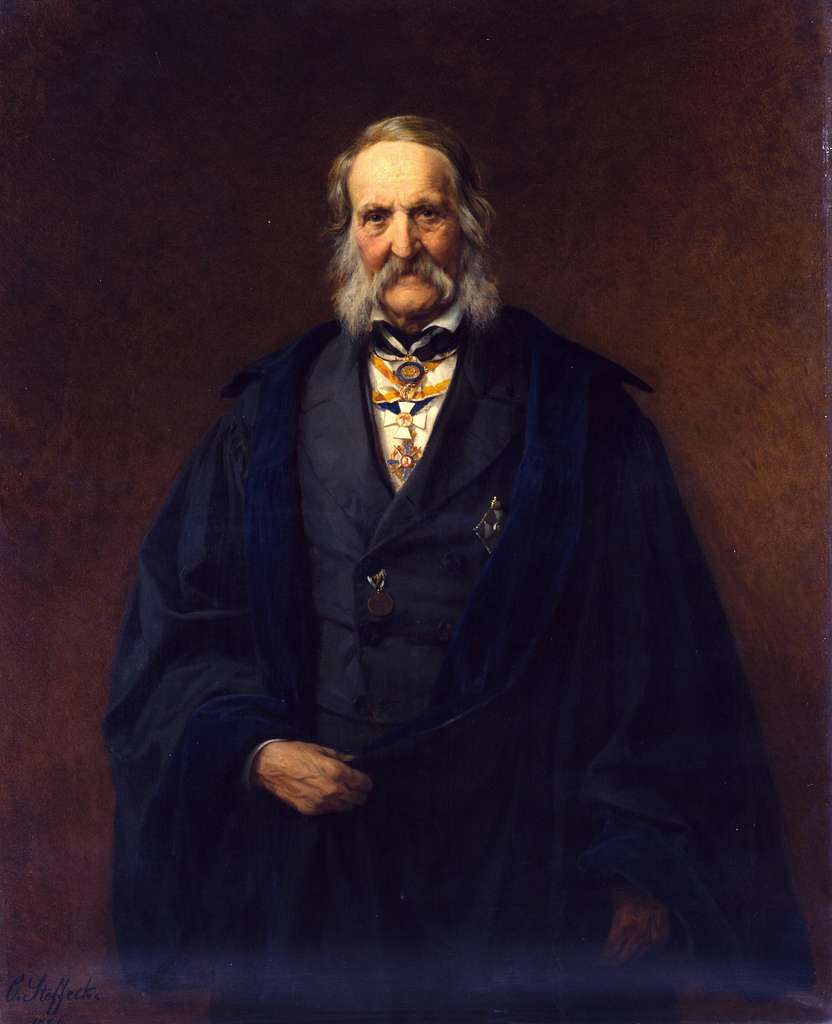
Carl Neumann
 Germany
mathematician•university teacher
Birthday
May 7, 1832
Birth Sign
Taurus
Birthplace
Königsberg, Prussia (now Kaliningrad, Russia)
Age
Died at 92
About
Carl Gottfried Neumann was a German mathematician and university teacher, known for his rigorous work in potential theory, integral equations, and the mathematical formalization of electrodynamics. He co-founded Mathematische Annalen, one of the most prestigious mathematical journals, and his name lives on in the Neumann boundary conditions and the Neumann series. Neumann passed away in Leipzig in 1925 at the age of 92, leaving behind a legacy that continues to shape modern mathematics and physics.
His contributions are still cited in contemporary research, and his influence extends through the many students he taught during his long academic career. While he may not have a public persona in the modern sense, within the mathematical community he is respected as a foundational figure whose ideas helped bridge physics and mathematics.
Early Life & Background
Born on 7 May 1832 in Königsberg, Prussia, Carl Neumann grew up in one of the most intellectually stimulating households in the region. His father, Franz Neumann, was a pioneering physicist at the University of Königsberg, and his work on induction and optics set a high standard for scientific inquiry. Young Carl was surrounded by academic discussions from an early age, which naturally drew him toward mathematics and physics.
He pursued his studies in these fields, absorbing the rigorous methods his father championed. While specific details of his schooling remain scarce, it is clear that his upbringing provided a strong foundation. The Neumann household was a hub of scientific exchange, and Carl benefited from direct exposure to his father's research and collaborations. This environment shaped his intellectual development and set him on a path to extend his father's legacy into the mathematical formalization of physical theories.
Career Growth
Neumann's academic career took off in the mid-19th century, and he held professorships at several German universities, though the specific institutions are not well-documented. His most notable achievement came in 1868 when he co-founded Mathematische Annalen, a journal that would go on to publish works by luminaries like David Hilbert and Albert Einstein. This venture cemented his role as a central figure in the mathematical community.
His research focused on potential theory, particularly the Dirichlet principle, and he made significant strides in integral equations. His work on the Neumann boundary conditions and the Neumann series provided essential tools for solving partial differential equations, and these concepts remain fundamental in applied mathematics and physics today. Neumann's contributions to electrodynamics, building on his father's work, helped formalize the mathematical underpinnings of the field. He continued to work and teach well into the early 20th century, and his influence persisted through his students and publications.
Career Timeline
Public Image & Style
As a 19th-century academic, Carl Neumann does not have a modern public persona. His reputation rests entirely within the mathematical community, where he is respected for his rigorous contributions to potential theory and integral equations. The concepts named after him, such as the Neumann boundary conditions and the Neumann series, are taught in university courses worldwide, ensuring his name remains familiar to students of mathematics and physics. His legacy is one of intellectual achievement rather than public fame, and he is remembered as a dedicated scholar who advanced the understanding of fundamental physical laws.
Fame & Fandom (iFAMOUS Rankings)
Carl Neumann never commanded a stadium, sparked a viral dance challenge, or inspired a legion of fans to paint murals in his honor. The name belongs to the quiet, enduring world of 19th-century mathematics rather than the loud arena of modern pop culture. While contemporary celebrities cultivate online armies and birthday billboards, Neumann's legacy rests on the chalk dust of university lecture halls and the ink of academic journals. His audience consists not of adoring followers but of students solving integral equations and physicists applying boundary conditions decades after his death. There is no formal fandom name attached to his memory, nor are there fan campaigns, charity drives, or ritualistic gatherings dedicated to his life. He remains a figure of intellectual reverence within the scientific community, devoid of the celebrity worship that defines today's cultural landscape. The iFANN Global Fame Engine evaluated Carl Neumann in August 2026 and determined that he does not currently hold a placement in the published rankings. He is not listed among the Global Top 1,000 most famous people, nor does he appear on any scope-specific top-100 lists. This absence reflects his status as a historical academic rather than a contemporary public personality with measurable media consumption signals worldwide. His fame exists purely in citations and textbooks, far removed from the real-time metrics that drive modern celebrity charts.
Interesting Facts and Legends
Born in Königsberg, the same city that produced Immanuel Kant, Carl Gottfried Neumann came from a family deeply rooted in science; his father Franz was a renowned physicist. Carl co-founded Mathematische Annalen, a journal that would eventually publish groundbreaking work by David Hilbert and Albert Einstein. His research on the Dirichlet principle established essential groundwork for the calculus of variations. Neumann lived to the age of 92, an unusually long lifespan for his era, passing away in Leipzig in 1925. His contributions remain cited in contemporary research, shaping modern mathematics and physics through the many students he taught during his long career. While some might imagine legendary anecdotes surrounding his life, no widely retold stories or viral incidents exist to accompany his name. The only "legend" attached to him is the rigorous standard of mathematical physics he helped define.
Family & Personal Life
Carl Neumann was the son of Franz Neumann, a distinguished physicist at the University of Königsberg. Franz's work in mathematical physics, particularly on induction and optics, was influential, and he is considered a founder of the field. Carl grew up in this intellectually rich environment, and his father's mentorship was a defining influence. Beyond this, details about his mother, siblings, or any family of his own are not recorded in the available sources. He never married, as far as is known, and left no direct descendants.
Notable Connections
Carl Neumann was the son of Franz Neumann, a prominent physicist at the University of Königsberg, whose work on induction and optics influenced Carl's own research. He also collaborated with fellow mathematicians in founding Mathematische Annalen, though specific names are not recorded. His work built upon the Dirichlet principle, and his contributions were later built upon by mathematicians like David Hilbert.
Relationships & Dating History
No public records of romantic relationships, marriages, or partnerships exist for Carl Neumann. As a 19th-century academic, such personal details were not typically documented. He appears to have never married, and no children are recorded. His life was dedicated to mathematics and teaching, and he passed away in 1925 without leaving a family behind.
Death & Aftermath
Died
March 27, 1925 (aged 92)
Death Place
Unknown
Cause of Death
reported natural causes
The quiet life of the ninety-two-year-old professor ended in Leipzig on March 27, 1925. While his final days remained unrecorded by medical staff or family statements, the date marks the cessation of a career that had formalized electrodynamics and co-founded Mathematische Annalen. Tributes from peers were absent from the immediate historical record, vigils, or institutional dedications documented at the time of his death. The absence of funeral details or burial site information suggests a private departure rather than a public spectacle. His estate was handled without surviving financial records, reflecting the modest nature of academic salaries in early twentieth-century Germany. Posthumous recognition focused entirely on his enduring mathematical contributions, specifically the Neumann boundary conditions and series, which continued to shape physics and applied mathematics decades later. Unlike modern figures who might see chart surges or film releases, Neumann's legacy persisted solely through citations in contemporary research and the students he mentored over many years.
Net Worth (Estate Value)
$1 Million
iFANN Editorial Team estimate
As a 19th-century academic who passed away in 1925, Carl Neumann's financial records were never preserved in the way modern estates are documented. Academic salaries in Germany during that period were modest, and no archives survive to detail the value of his personal estate. His principal legacy is intellectual, not financial. Per iFANN's editorial analysis, his net worth at the time of death is estimated at $1 Million. While no concrete figures are available from the era, this valuation suggests an estate that would have been modest by today's standards. His name lives on through mathematical concepts, which possess no monetary value but remain priceless to the scientific community.
Awards & Accolades
View 3 records, honours and achievementsKnown For
Neumann boundary conditions
· Named after him
Neumann series
· Named after him
Co-founder of Mathematische Annalen
1868 · Co-founder
Keywords
Sources
Quick Facts
- Profession
- mathematician, university teacher
- Born
- +1832-05-07
- Birthplace
- Königsberg
- Died
- +1925-03-27
- Death Place
- Leipzig
- Gender
- Male
- Birth Sign
- Taurus
Personal Details
- Full Name
- Carl Gottfried Neumann
Frequently Asked Questions
Who was Carl Neumann?
What is Carl Neumann famous for?
Was Carl Neumann related to the physicist Franz Neumann?
Where did Carl Neumann teach?
When did Carl Neumann die?
Join the community
fans discussing