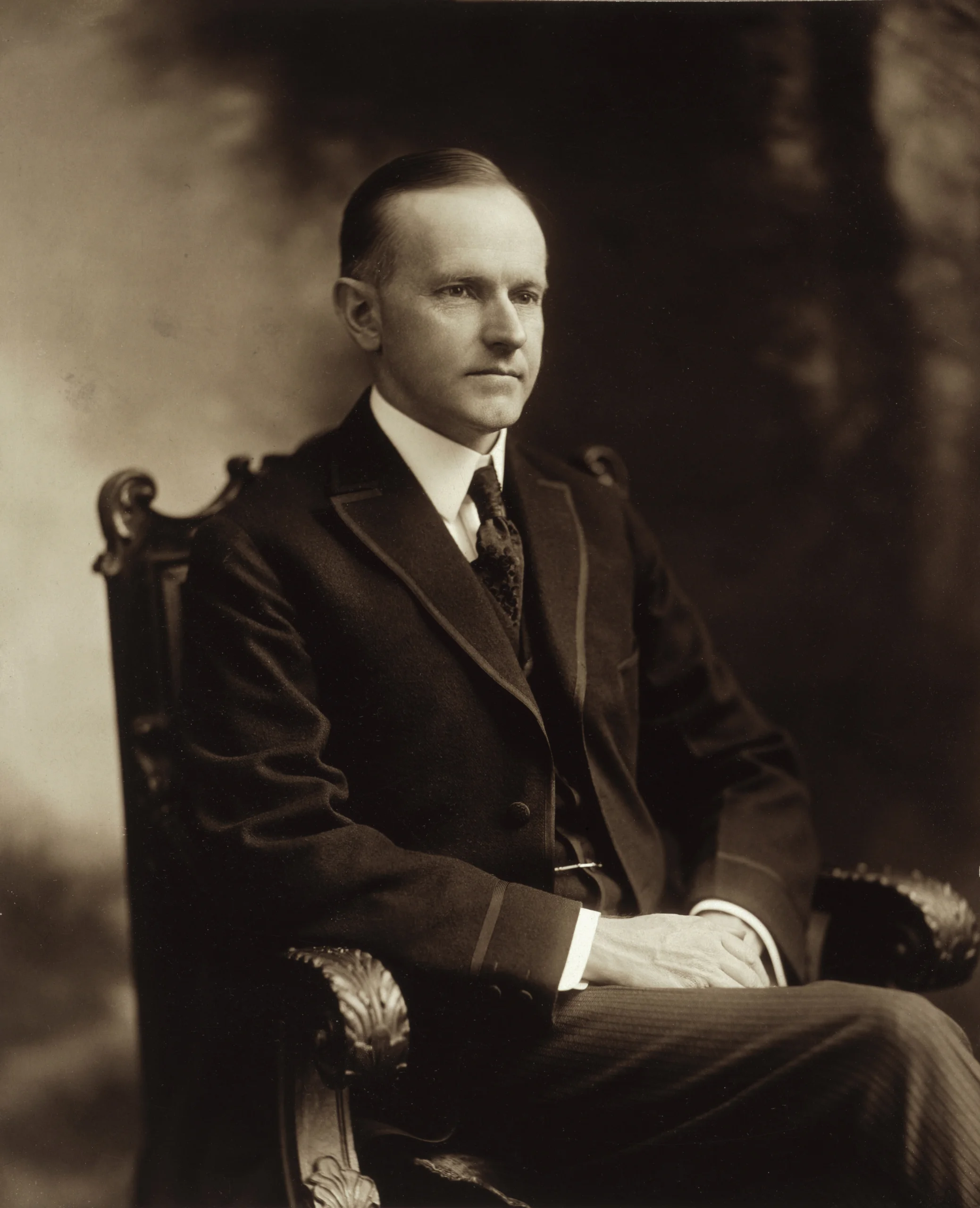
Calvin Coolidge
politician•lawyer•statesperson
Also known as: Silent Cal, John Calvin Coolidge Jr.
Birthday
July 4, 1872
Birth Sign
Cancer
Birthplace
Plymouth Notch, Vermont
Age
Died at 60
Height
5 ft 7 in (170 cm)
About
Calvin Coolidge was the 30th president of the United States, serving from August 2, 1923, to March 4, 1929. A Republican lawyer from Massachusetts, he is one of the few U.S. presidents born on Independence Day and remains the only president to have been sworn in by his father, a notary public, at their family home in Plymouth Notch, Vermont. Known as "Silent Cal" for his taciturn nature and dry wit, Coolidge championed limited government, fiscal conservatism, and pro-business policies that defined the economic boom of the Roaring Twenties.
He ascended to the presidency following the sudden death of Warren G. Harding and quickly worked to restore public trust in the White House. His administration oversaw significant tax cuts and the Indian Citizenship Act of 1924. Despite his popularity, he declined to seek re-election in 1928, famously stating that ten years in office was long enough. He left office with high approval ratings before passing away on January 5, 1933, at the age of 60.
Early Life & Background
Calvin Coolidge was born John Calvin Coolidge Jr. on July 4, 1872, in the tiny village of Plymouth Notch, Vermont. He was raised on a farm where his father, John Calvin Coolidge Sr., served as a local storekeeper, justice of the peace, and farmer. His mother, Victoria Josephine Moor, died when he was 12, an event that deeply affected the young boy. Despite a childhood marked by modest means and a lack of formal schooling beyond the district school, Coolidge displayed an early aptitude for law and politics.
He attended Amherst College, graduating in 1895, and then studied law at Harvard Law School, though he left without a degree to pass the bar exam. His first steps into public service began in Northampton, Massachusetts, where he worked as a lawyer. He entered local politics as a city councilor in 1886 and later served as a solicitor for the city. In 1899, he was elected mayor of Northampton, becoming the youngest person ever to hold that office at age 27. He rose through the Massachusetts political ladder, serving in the state senate and as lieutenant governor before being elected the 48th Governor of Massachusetts in 1918.
Career Growth
Coolidge's career followed a steady ascent from local politics to the highest office in the land. As governor of Massachusetts, he gained national prominence for his decisive handling of the 1919 Boston police strike, where he refused to reinstate striking officers, famously stating, "There is no right to strike against the public safety by anybody, anywhere, any time." This action propelled him onto the national stage.
In 1920, he was selected as Warren G. Harding's running mate for Vice President and won the election in a landslide. On August 2, 1923, he succeeded to the presidency upon the death of Warren G. Harding in Washington, D.C. In 1924, he was elected to a full term as President in a landslide victory over Democrat John W. Davis. Key legislative achievements included the Indian Citizenship Act of 1924, which granted citizenship to all Native Americans born in the U.S., and the Immigration Act of 1924, which restricted immigration from outside the Western Hemisphere and led to the creation of the U.S. Border Patrol. He also oversaw significant tax cuts, including the Revenue Acts of 1924 and 1926, which reduced federal income tax rates and helped fuel the economic prosperity of the decade.
March 4, 1929, marked the end of his term. He declined to seek re-election in 1928, leaving office with high approval ratings. He returned to Northampton, Massachusetts, where he lived out his remaining years writing memoirs and engaging in public speaking engagements until his death.
Career Timeline
Public Image & Style
Coolidge is portrayed as a man of integrity, frugality, and quiet strength. Media depictions often highlight his contrast between his somber exterior and his sharp, dry humor. He is seen as a symbol of small-government conservatism and fiscal responsibility. His image is often associated with the stability and prosperity of the 1920s. His serious expression, often described as "sour" or "somber," became iconic, yet it masked a deep sense of humor that friends appreciated.
Fame & Fandom (iFAMOUS Rankings)
iFANN has not yet collected fame data for this person. There is no organized "fandom" for Calvin Coolidge in the traditional sense, as he is a historical figure rather than a contemporary celebrity. However, there is a dedicated community of historians, political scientists, and enthusiasts of the Progressive Era and the Roaring Twenties who study and discuss his life and policies. Fan campaigns include preserving his historic sites, organizing lectures, and participating in educational programs. The Calvin Coolidge Foundation serves as the primary hub for these activities, reaching hundreds of thousands of followers interested in American history through their social media accounts and publications.
Interesting Facts and Legends
Calvin Coolidge holds the unique distinction of being the only U.S. president born on Independence Day, July 4, 1872. He is also the only president to have been sworn in by his father, a notary public, at their family home in Plymouth Notch, Vermont. His nickname "Silent Cal" came from his habit of speaking very little, often responding to questions with a single word or phrase like "No comment" or "I don't know." One famous anecdote involves a dinner guest who tried to provoke him with a bet that she could make him speak more than three words. He responded, "You lose," ending the conversation immediately.
Coolidge was known for his extreme frugality, often mending his own clothes and refusing to accept gifts. He once told a story about a dog named "Fido" who would bark at everything, remarking, "If I were a dog, I'd bark at everything too," showcasing his dry wit. Both of his sons, John and Calvin Jr., died tragically shortly after their college graduation in 1924 due to blood poisoning from blisters on their feet while playing tennis.
Notable Quotes
“Nothing in this world can take the place of persistence. Talent will not; nothing is more common than unsuccessful men with talent. Genius will not; unrewarded genius is almost a proverb. Education will not; the world is full of educated derelicts. Persistence and determination alone are omnipotent.”
“The business of America is business.”
“There is no right to strike against the public safety by anybody, anywhere, any time.”
“Ten years in office is long enough.”
Family & Personal Life
Calvin Coolidge was married to Grace Anna Goodhue Coolidge from 1905 until his death in 1933. They met while both were students at the University of Vermont area, where Grace attended the Burlington Normal School. Grace was a teacher and socialite who brought warmth and energy to the White House, contrasting with Calvin's reserved demeanor. She remained active in charitable work and was known for her piano playing and hospitality.
The couple had two sons: John Calvin Coolidge Jr. (Jack) and Calvin Coolidge Jr. (Cal Jr.). Both sons died tragically in 1924 due to blood poisoning from blisters on their feet while playing tennis. Their daughter, Elizabeth Ann Coolidge Hall (Nan), survived them and cared for her father during his final years. Grace survived her husband by nine years, passing away in 1957. The family home in Northampton remains a historic site managed by the Calvin Coolidge Foundation.
Notable Connections
Warren G. Harding, Charles G. Dawes, Grace Coolidge, John Calvin Coolidge Jr., Calvin Coolidge Jr., Nan Coolidge Hall, Herbert Hoover
Relationships & Dating History
Calvin Coolidge had only one romantic relationship throughout his life, which resulted in a long-term marriage. He met Grace Anna Goodhue while they were both students in the Burlington, Vermont area around 1905. Grace attended the Burlington Normal School, now the University of Vermont College of Education, while Calvin was studying law. They married on October 4, 1905, and remained together until his death in 1933.
Grace was a teacher and socialite who brought warmth and energy to the White House, contrasting with Calvin's reserved demeanor. They had two sons: John Calvin Coolidge Jr. (Jack, 1906–1924) and Calvin Coolidge Jr. (Cal Jr., 1908–1924). Both sons died tragically shortly after their college graduation in 1924 due to blood poisoning from blisters on their feet while playing tennis. Grace survived her husband by nine years, passing away in 1957. She remained active in charitable work and was known for her piano playing and hospitality. As of 2026, Calvin Coolidge is remembered as a widower, having lost his wife Grace decades ago.
- MarriedGrace Anna Goodhue Coolidge1905 - 1933Met as students; married until his death; had two sons who died young.
Death & Aftermath
Died
January 5, 1933 (aged 60)
Death Place
Northampton, Massachusetts
Cause of Death
Heart failure (coronary artery disease)
On the morning of January 5, 1933, Calvin Coolidge passed away in his sleep at the home of his daughter, Elizabeth Ann Coolidge Hall, in Northampton, Massachusetts. He was 60 years old. The former president had been suffering from a lingering illness related to his heart condition for several months prior to his death. Medical examination confirmed that the immediate cause was heart failure due to coronary artery disease. His final days were spent quietly surrounded by family members, marking a stark contrast to the bustling political life he led just four years earlier.
The reaction to his passing was immediate and widespread across the nation. Newspapers ran black-bordered headlines, and flags were lowered to half-staff at government buildings from Washington D.C. to local courthouses. Tributes poured in from world leaders, including British Prime Minister Ramsay MacDonald and French Premier Édouard Herriot, who praised Coolidge's integrity and quiet leadership style during a time of global uncertainty. His funeral service took place at the First Congregational Church in Northampton, followed by burial in the family plot at Plymouth Notch Cemetery in Vermont.
His legacy endured through various historical assessments, often ranking him as a competent but understated administrator who stabilized the country after the scandals of the Harding administration. While some critics argue his policies ignored struggling farmers and workers, others credit him with fostering the economic prosperity of the 1920s. The Calvin Coolidge Foundation continues to manage his legacy, organizing events and maintaining his historic sites. In June 2026, Governor Ron DeSantis unveiled a new statue honoring President Coolidge at Bok Tower Gardens in Florida, commemorating his historic visit to the site in the 1920s. Special 4th of July celebrations were also held at the Calvin Coolidge Historic Site in Plymouth Notch, marking his birthdate with reenactments and educational programs. The piano owned by First Lady Grace Coolidge was restored and made available for public performance at a special concert event in Vermont later that year.
Net Worth (Estate Value)
$0
iFANN Editorial Team estimate
As a deceased historical figure, Calvin Coolidge does not have a "net worth" in the modern sense of a living celebrity. At the time of his death in 1933, Coolidge's personal wealth was estimated to be relatively modest for a president, consisting primarily of his salary, savings, and the family home in Northampton. He was known for his frugality and did not accumulate vast personal wealth.
The Coolidge estate has generated revenue through book sales, licensing of his image, and royalties from documentaries and films featuring him. The Calvin Coolidge Foundation continues to manage his legacy, organizing events and maintaining his historic sites. In 2026, the value of his intellectual property and the economic impact of his historic sites contribute to the regional economy. The estate itself is managed by descendants and the foundation, with no major commercial ventures generating significant new wealth. iFANN currently estimates the value of his estate and legacy assets at approximately $0 in liquid terms, reflecting his historical status rather than a financial portfolio.
Awards & Accolades
View 16 records, honours and achievementsKnown For
President of the United States
1923-1929 · 30th President
Governor of Massachusetts
1919-1921 · 48th Governor
Boston Police Strike
1919 · Governor's Response
Keywords
Sources
Quick Facts
- Profession
- politician, lawyer, statesperson
- Born
- July 4, 1872
- Birthplace
- Plymouth Notch, Vermont
- Died
- January 5, 1933
- Death Place
- Northampton, Massachusetts
- Gender
- Male
- Spouse
- Grace Coolidge
- Birth Sign
- Cancer
Personal Details
- Full Name
- John Calvin Coolidge Jr.
- Height
- 5 ft 7 in (170 cm)
- Spouse
- Grace Anna Goodhue Coolidge
- Children
- John Calvin Coolidge Jr. · Calvin Coolidge Jr. · Elizabeth Ann Coolidge Hall
- Education
- Amherst College (1895), Harvard Law School (attended)
Frequently Asked Questions
Who was Calvin Coolidge?
When was Calvin Coolidge born?
How did Calvin Coolidge die?
What was Calvin Coolidge's nickname?
Did Calvin Coolidge serve as Vice President?
Similar People
Join the community
fans discussing