
Burning Man
 United States
"A temporary city built on radical self-expression and community."
7+
Editions
78850
Peak Attendance
About
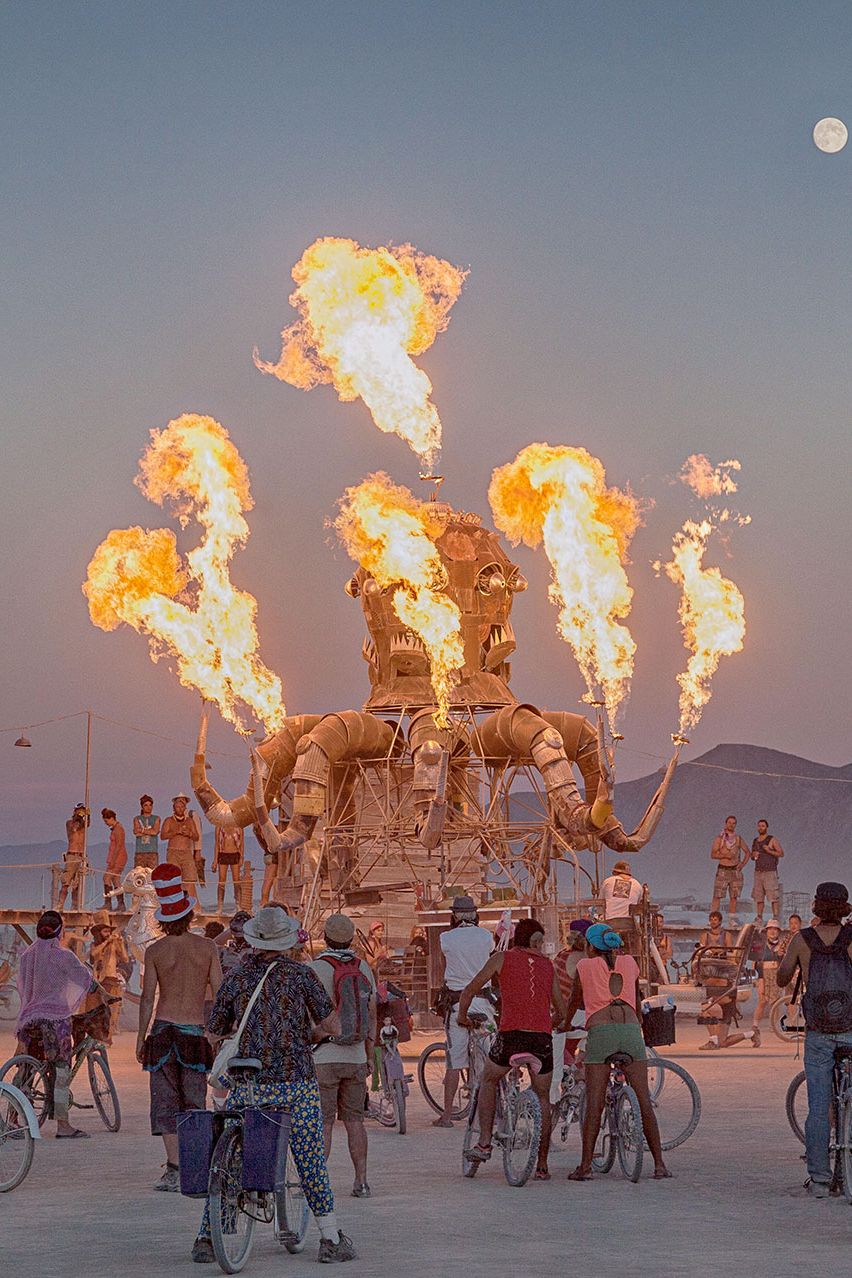
Burning Man transforms the Black Rock Desert of Nevada into a temporary metropolis known as Black Rock City, operating for eight days each year from the last Sunday in August through Labor Day. Unlike traditional festivals that rely on headliners or passive audiences, this gathering functions as a do-ocracy where every participant is expected to contribute actively. The event rejects commercial sponsorships within its boundaries, enforcing a strict decommodification policy that mandates a gift economy where food, water, and art are exchanged freely without expectation of return.
The physical layout radiates outward in a semicircular grid from a central effigy called the Man, surrounded by massive interactive sculptures and theme camps that shift daily based on the whims of their creators. Participants adhere to ten guiding principles established by co-founder Larry Harvey, including radical self-reliance and leaving no trace, which requires the entire city to be dismantled immediately after the festival ends. The week culminates in two major rituals: the burning of the Man on Saturday night, symbolizing transformation, followed by the solemn burning of the Temple on Sunday to honor those who have passed away.
History
On June 22, 1986, Larry Harvey and Jerry James constructed an 8-foot wooden effigy and burned it on Baker Beach in San Francisco alongside about 20 friends. This spontaneous act evolved into an annual tradition during the late 1980s with assistance from the San Francisco Cacophony Society. By 1990, authorities halted the beach burn due to safety concerns and lack of permits, forcing organizers to relocate the gathering to the remote Black Rock Desert in Nevada.
The desert location allowed the event to expand rapidly, introducing its first official theme, Good and Evil, in 1995 to guide artistic expression and costumes. As attendance surged past 10,000 in the late 1990s, the organization formed Black Rock City LLC to handle legal and logistical complexities. In 2014, the entity transitioned to nonprofit status under the Burning Man Project, which now manages the main desert event and supports over 100 regional gatherings worldwide.
Notable Editions
1995: First Theme Introduced
4000 attendeesIntroduction of the first official theme, Good and Evil, setting a precedent for thematic guidance in art and costume.
1997: Attendance Surges Past 10,000
10000 attendeesFormation of Black Rock City LLC to manage the growing logistical demands of the event.
2004: Crossing the 30,000 Threshold
30000 attendeesThe festival crossed the 30,000 attendee mark for the first time, signaling its transition from counterculture experiment to large-scale cultural phenomenon.
2014: Nonprofit Transition
65000 attendeesOrganizational shift to nonprofit status under the Burning Man Project, coinciding with attendance reaching 65,000.
2019: Record Attendance Year
78850 attendeesRecord-breaking attendance of 78,850 people filled the playa before the pandemic era began.
Notable Moments
1986
First Burn on Baker Beach
Larry Harvey and Jerry James ignite an 8-foot wooden man on a San Francisco beach, attended by roughly 20 people.
1990
Relocation to the Desert
After being shut down by police, the group moves the event to the Black Rock Desert, establishing the permanent venue.
1995
Adoption of Themes
The Good and Evil theme launches the tradition of annual themes that dictate the creative direction of the entire city.
2000
Temple Burn Debut
The first Temple is constructed and burned, creating a sacred space for grief and remembrance that remains a core ritual today.
2014
Nonprofit Reorganization
The Burning Man Project assumes control as a 501(c)(3) nonprofit, formalizing governance for the expanding global network.
2020
Global Pandemic Halt
Health officials cancel the event for the first time in history, leading to a mass exodus of attendees and digital-only programming.
2023
Playa Turns to Mud
Heavy rains create impassable mud conditions, trapping vehicles and requiring massive rescue operations involving military-style logistics.
Cultural Impact
The ethos of Burning Man has permeated global culture, influencing how festivals approach community building and interactive art. Its model of a temporary city has inspired urban planners and architects to design more flexible public spaces. The Ten Principles have been adopted by corporate retreats and community organizations seeking to foster creativity and collaboration. Over 100 regional events now operate on six continents, spreading the values of gifting and radical self-expression far beyond the Nevada desert. The emphasis on large-scale participatory art has set new standards for public installations worldwide.
Controversies
Critics argue that rising ticket prices and the proliferation of luxury plug-and-play camps have transformed the event into a playground for the wealthy, undermining its countercultural roots. Data indicates a demographic shift toward older, wealthier millennials while Gen Z attendance has declined. Environmental groups point out the significant carbon footprint generated by tens of thousands of travelers flying to a remote desert despite the Leave No Trace principle. Safety concerns also persist, with isolated deaths and injuries occurring annually; in 2026, three fatalities were reported, tripling the average number of deaths and sparking debates over liability and medical coverage. A specific incident involved a skydiver landing on another attendee, raising questions about accident responsibility.
Related Events
Keywords
Sources
Event Info
- First burn date
- June 22, 1986
- Founders
- Larry Harvey, Jerry James
- Event duration
- 8 days (last Sunday of August to Labor Day)
- Peak attendance
- 78,850 (2019)
- Number of regional events
- Over 100
Join the community
fans discussing