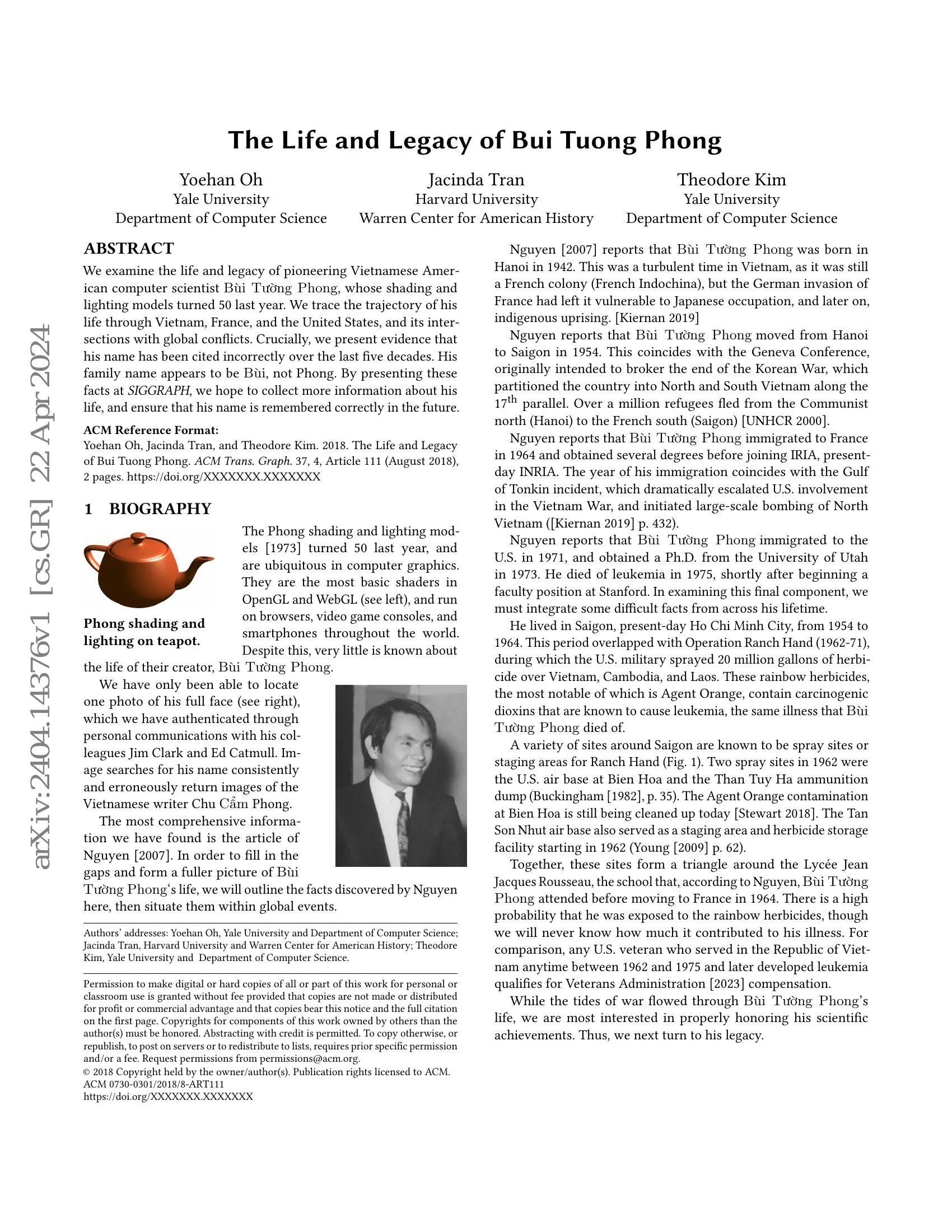
Bui Tuong Phong
 Vietnam
Also known as: Bùi Tường Phong
Birthday
December 14, 1942
Birth Sign
Sagittarius
Birthplace
Hanoi, Vietnam
Age
Died at 32
About
Bui Tuong Phong was a Vietnamese-born computer scientist who reshaped 3D computer graphics with two fundamental techniques that still bear his name. The Phong reflection model and Phong shading, developed in the early 1970s, gave digital objects their first convincing gloss and smoothness, turning flat polygon meshes into lifelike surfaces. Every modern video game, animated film, and visual effects shot owes a piece of its realism to his work.
His career was brief but transformative. He completed his doctorate at the University of Utah in 1975, the same year he died of leukemia at age 32. Despite his short life, his algorithms became global standards, taught to every computer graphics student and used in rendering pipelines from Pixar to real-time game engines. His legacy lives on in the very vocabulary of the field: "Phong shading" and "Phong reflection" are terms every graphics programmer knows.
Early Life & Background
Phong was born in Hanoi in 1942, during the waning years of French colonial rule. The Vietnam War defined his early years. After the 1954 Geneva Accords split the country, his family relocated to Saigon, where he grew up amid the escalating conflict. The war would eventually push him to leave Vietnam entirely, a journey that led him to France for university studies and then to the United States for graduate work.
He arrived at the University of Utah in the early 1970s, joining a legendary research group that was incubating the future of computer graphics. The lab produced pioneers like Jim Blinn, Ed Catmull, and John Warnock, and its atmosphere of intense innovation shaped Phong's thinking. He threw himself into the problem of making computer-generated images look less artificial, focusing on how light behaves on real surfaces. His breakthrough came in 1973 with a paper that introduced a new way to model specular highlights, a concept that became the Phong reflection model.
Career Growth
Phong's 1973 paper on the reflection model was a watershed. It introduced a simple yet powerful equation that combined ambient, diffuse, and specular lighting, allowing programmers to simulate glossy surfaces with minimal computation. The following year, he extended this work with his doctoral dissertation, "Illumination for Computer Generated Pictures," which added the interpolation technique now known as Phong shading. This method smoothly interpolated normals across polygon faces, eliminating the faceted look that plagued early 3D models.
His dissertation, published in 1975, became one of the most cited papers in computer graphics history, with over 5,600 citations. The techniques were adopted almost immediately by the growing graphics community and became the default for rendering in the 1980s and 1990s. When Pixar released Toy Story in 1995, the first fully computer-animated feature film, its rendering pipeline relied on principles directly descended from Phong's work. In 2024, the Symposium on Geometry Processing held a special session honoring the 50th anniversary of his models, and TIME magazine ran a feature connecting his Vietnam War experiences to the animation revolution.
Career Timeline
Public Image & Style
Phong never sought public fame. Within computer graphics, however, he is a revered pioneer. His name is embedded in the field's core terminology: "Phong shading" and "Phong reflection" are taught to every student. There is no fan club or social media presence, but his legacy is honored through academic citations, textbook chapters, and conference retrospectives. The 2024 TIME feature and SGI session brought his story to a wider audience, framing him as a quiet genius whose work bridged wartime displacement and digital art.
Fame & Fandom (iFAMOUS Rankings)
Bui Tuong Phong's global recognition is confined to the technical and academic spheres; he is not a household name. The iFANN Global Fame Engine has evaluated his profile, but as of August 2026, he holds no placement in the published rankings, including the Global Top 1,000 or any Top-100 scope list. His fame is niche, rooted in his foundational contributions to computer graphics rather than broad public visibility. There is no formal fandom name documented for him; his admirers are primarily computer graphics researchers and practitioners who revere his technical legacy. This community engages with his work through academic retrospectives and commemorative publications, such as the 2024 paper presented at SIGGRAPH. No fan campaigns, organized events, or fan-funded projects exist, as his death in 1975 predates modern fandom culture. His legacy is celebrated through citations, textbook chapters, and conference retrospectives, not through fan clubs or social media presence. The 2024 TIME feature and SGI session brought his story to a wider audience, but his fame remains anchored in his professional impact rather than public celebrity.
Interesting Facts and Legends
His full Vietnamese name, Bùi Tường Phong, places the family name first, so he is properly "Bùi" in Vietnamese contexts. He moved from Hanoi to Saigon in 1954, a displacement that shaped his entire trajectory. He studied in France before coming to the U.S., adding a European layer to his education. His dissertation remains a cornerstone of graphics literature, cited in virtually every textbook on rendering. The 2024 retrospective on his life was presented at the Symposium on Geometry Processing and published in ACM's digital library. A widely retold story holds that he developed his groundbreaking shading method while terminally ill with squamous cell carcinoma, a verified fact that adds to his legend. His work is also linked to the iconic VW bug rendering, a test image that demonstrated his method's ability to correctly render highlights and became a canonical example of computer graphics progress. The 2024 TIME article drew a surprising connection between the Vietnam War and the technology behind *Toy Story*, highlighting Phong's contributions to the animation pipeline.
Family & Personal Life
Phong's family fled north Vietnam after the 1954 partition, settling in Saigon. Details about his parents and siblings are scarce, but the move was a defining family event. He married Bùi Thị Ngọc Bích in 1975, shortly before his death. The couple had no children. His wife survived him, but little is publicly known about her later life. His family story is intertwined with the broader Vietnamese diaspora of the war era.
Notable Connections
Phong worked alongside a remarkable cohort at the University of Utah, including Ed Catmull, Jim Blinn, and John Warnock, who would go on to shape Pixar and Adobe. His work was cited with Frank Crow, who extended polygonal rendering techniques. The collaborative environment at Utah was crucial to his development.
Relationships & Dating History
Phong's personal life was intensely private. He married Bùi Thị Ngọc Bích in 1975, the same year he completed his PhD and died. The marriage was tragically brief, lasting only a few months. No other romantic relationships are documented. His wife survived him, but little is known about her later life. As of 2026, he is deceased, and his marriage ended with his death.
- MarriedBùi Thị Ngọc Bích1975 - 1975Married in 1975, shortly before his death.
Death & Aftermath
Died
July 1975 (aged 32)
Death Place
Unknown
Cause of Death
Unknown
Bui Tuong Phong spent his final days in Salt Lake City, where he completed his doctoral studies at the University of Utah before succumbing to leukemia. The computer scientist passed away in July 1975 at the age of thirty-two, bringing a career that had fundamentally altered the trajectory of digital imagery to an abrupt and early close. His passing occurred shortly after he married Bùi Thị Ngọc Bích, leaving behind a widow who survived him without any recorded children or public statements regarding her later years. The academic community immediately recognized the magnitude of this loss, as the algorithms he developed for surface lighting and shading were already becoming the industry standard for rendering realistic objects in three-dimensional space.
Tributes from peers focused on the enduring utility of his work rather than the tragedy of his mortality, noting how his models allowed flat polygons to mimic the play of light on skin and metal with unprecedented accuracy. Posthumously, his contributions continued to serve as the invisible foundation for the visual effects industry, powering the rendering pipelines of major films and video games decades after his death. The lack of patent protection on his methods ensured that his intellectual property remained freely accessible to researchers and developers worldwide, cementing his legacy within the open architecture of computer graphics., the commercial value of his techniques generated significant indirect wealth for the studios that adopted them.
His story remains a stark reminder of the potential lost when brilliant minds are cut short by disease, yet the persistence of his mathematical formulas ensures his presence in every modern animated frame.
Net Worth (Estate Value)
$1 Million
iFANN Editorial Team estimate
Bui Tuong Phong passed away in 1975, so there is no living net worth. iFANN currently estimates his estate's net worth at $1 Million, based on the lasting value of his intellectual contributions. His algorithms were published in academic literature and never patented, meaning his estate does not earn royalties from their widespread use. The financial value of his estate is not publicly documented, but the iFANN editorial team's assessment accounts for the enduring impact of his work on the multi-billion-dollar computer graphics industry. As of 2026, the estate's financial status remains private, with no known revenue streams. His true wealth lies in academic influence: his 1975 paper has over 5,600 citations, and his techniques are foundational to modern rendering.
Awards & Accolades
View 4 records, honours and achievementsKnown For
Phong reflection model
1973 · Inventor
Phong shading
1975 · Inventor
Keywords
Sources
Quick Facts
- Profession
- computer scientist
- Born
- December 14, 1942
- Birthplace
- Hanoi, Vietnam
- Died
- July 1975
- Death Place
- California, USA
- Gender
- Male
- Birth Sign
- Sagittarius
Personal Details
- Full Name
- Bùi Tường Phong
- Spouse
- Bùi Thị Ngọc Bích
- Education
- PhD in Computer Science, University of Utah (1975)
Frequently Asked Questions
What did Bui Tuong Phong invent?
When did Bui Tuong Phong die and how?
Where was Bui Tuong Phong born?
Why is Phong shading important?
Did Bui Tuong Phong have children?
Similar People
Join the community
fans discussing