“Buffy is a formative text for modern TV, praised for its emotional realism wrapped in monster suits.”
Emily Nussbaum
The New Yorker
 United States
"Get home before dark."
User Score
2,094 votes
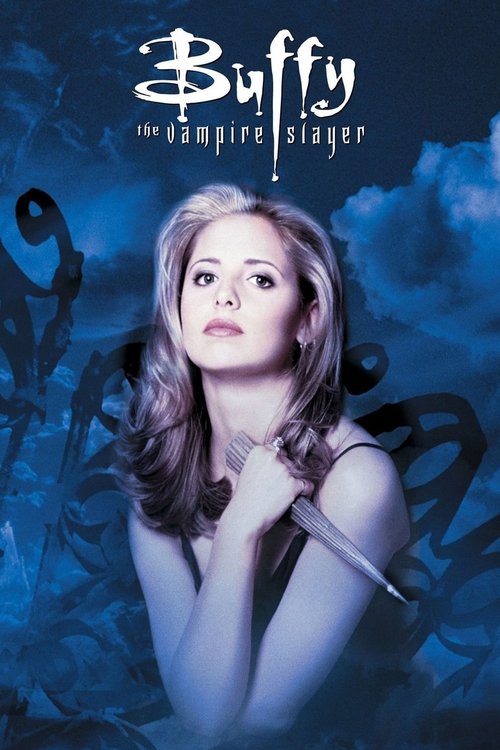
Joss Whedon's Buffy the Vampire Slayer took a throwaway horror-movie premise and turned it into one of television's sharpest shows about growing up. Sarah Michelle Gellar plays Buffy Summers, a California teenager who happens to be the Chosen One: the lone girl in each generation gifted with the strength to fight vampires, demons, and whatever else crawls out of the Hellmouth beneath her town. The WB aired the first five seasons starting March 10, 1997; UPN carried the last two before the show signed off on May 20, 2003. Seven seasons, 144 episodes, and a tone that could swing from slapstick to gut-punch inside a single scene.
What made it work was the ensemble. Nicholas Brendon's Xander and Alyson Hannigan's Willow are the friends who refuse to let Buffy carry the apocalypse alone, and their own arcs grow as much as hers does. Add Emma Caulfield's blunt ex-demon Anya, Michelle Trachtenberg as Buffy's suddenly-appearing little sister Dawn, and James Marsters's bleach-blond vampire Spike, and you get a show that treats its supporting cast as full people rather than sidekicks.
Critics and viewers responded. The series holds an 8.1 rating across roughly 2,100 votes, and its influence on later genre TV is easy to trace. It's a comedy, a drama, and a horror show at once, and it rarely lets one mode undercut the others.
Stream
Availability and pricing can change. Confirm on the provider's site before purchasing.
Buffy Summers is not supposed to be here. Expelled from her Los Angeles high school after a gym full of vampires burned to the ground, she and her recently divorced mother Joyce move to Sunnydale, a sun-baked California town that looks like any other suburb. It isn't. Sunnydale sits directly on a Hellmouth, a convergence of mystical energy that pulls monsters in like a drain. Within a day of arriving at Sunnydale High, Buffy meets the school librarian, Rupert Giles, who turns out to be her new Watcher, a member of an ancient council that trains Slayers. She also falls in with two social misfits, Xander Harris and Willow Rosenberg, who refuse to let her fight alone. The three of them, plus the popular and frequently horrified Cordelia Chase, become the Scooby Gang.
The first season sets the template: twelve episodes, a monster-of-the-week rhythm, and a vampire called the Master building toward a prophecy about Buffy's death. It is lean and occasionally creaky, but the characters are already alive. The second season is where the show finds its depth. Two punk vampires, Spike and Drusilla, arrive in town, and Buffy's romance with the soul-cursed Angel turns catastrophic when a moment of happiness strips him of his soul and releases Angelus, the sadistic killer he used to be. That arc, which ends with Buffy sending the man she loves to hell to save the world, announced that this show would hurt its characters and mean it.
Season three covers senior year and introduces Faith, a second Slayer called after Buffy's brief death in the season one finale. Faith is everything Buffy could have become without friends: reckless, rootless, and eventually murderous. The season builds to a graduation day that doubles as a battle, with the class of 1999 fighting a giant snake demon in gowns. Then the show moves the characters to college for season four, a looser, funnier year that introduces a secret military outfit called the Initiative and gives Willow her first serious study of magic. It is the season that gave us the silent episode Hush, still one of the most formally daring hours of network television from that era.
Season five drops a bombshell in the premiere: Buffy suddenly has a fourteen-year-old sister, Dawn, who has always been there. The explanation is mystical and the emotional fallout is real. A hellgod named Glory arrives looking for a key that turns out to be Dawn herself, and the season ends with Buffy making the most selfless choice of her life. Season six, the first on UPN, is the show's darkest. Buffy is resurrected by her friends and comes back depressed, disconnected, and eventually entangled with Spike in a relationship that is as much about self-destruction as desire. Willow's magic turns to addiction, and a trio of nerdy would-be supervillains provides a comic threat that curdles into something much worse. It is a polarizing season, but it is also the one that most directly confronts adulthood.
Season seven brings the series full circle. Buffy becomes a mentor to a house full of Potential Slayers, girls from around the world who are being hunted by the First Evil, a primordial force with no body to punch. The season is about leadership, isolation, and the cost of being the one girl in all the world. It builds toward a finale that deliberately dismantles the show's founding premise, but the journey there is the point. Across seven years and 144 episodes, the show never stopped asking what it means to be chosen, and what it means to choose your own life anyway.
Season 1 Trailer
Critical Consensus
Buffy the Vampire Slayer is widely regarded as a landmark of television, praised for fusing horror, comedy, and teen drama into a sharp metaphor for adolescence and adulthood. Critics celebrate its witty dialogue, its richly drawn ensemble, and its willingness to take emotional risks. It is frequently ranked among the greatest shows of all time and credited with paving the way for female-led genre television.
“Buffy is a formative text for modern TV, praised for its emotional realism wrapped in monster suits.”
Emily Nussbaum
The New Yorker
“One of the most influential dramas of its era, a genre-bender that made the personal political.”
Alan Sepinwall
The Star-Ledger / Rolling Stone
“Smart, funny, and emotionally devastating in ways television rarely attempted.”
Tim Goodman
The Hollywood Reporter
“Remarkable consistency and ambition; few shows swung for the fences so often and connected so hard.”
The A.V. Club
The A.V. Club
“A feminist landmark disguised as a teen horror show.”
The Guardian
The Guardian
Sarah Michelle Gellar
Buffy Summers
Nicholas Brendon
Xander Harris
Alyson Hannigan
Willow Rosenberg
Charisma Carpenter
Cordelia Chase
Anthony Stewart Head
Rupert Giles
David Boreanaz
Angel
James Marsters
Spike
Emma Caulfield
Anya Jenkins
Michelle Trachtenberg
Dawn Summers
Seth Green
Oz
Kristine Sutherland
Joyce Summers
Juliet Landau
Drusilla
Directors
Joss Whedon, David Solomon, James A. Contner
Writers
Joss Whedon, Marti Noxon, Drew Goddard, Drew Z. Greenberg, Rebecca Rand Kirshner
Composers
Christophe Beck, Nerf Herder
Cinematographer
Michael Gershman
Producers
Joss Whedon, Marti Noxon, Gail Berman, Sandy Gallin, Fran Rubel Kuzui, Dolly Parton
Primetime Emmy Award (1998)
Outstanding Makeup for a Series: Won
Primetime Emmy Award (1998)
Outstanding Music Composition for a Series (Dramatic Underscore): Won
Saturn Award (1998)
Best Genre Television Series: Won
Saturn Award (1999)
Best Actress on Television (Sarah Michelle Gellar): Won
Golden Globe Award (2001)
Best Performance by an Actress in a Television Series – Drama (Sarah Michelle Gellar): Nominated
Join the community
fans discussing