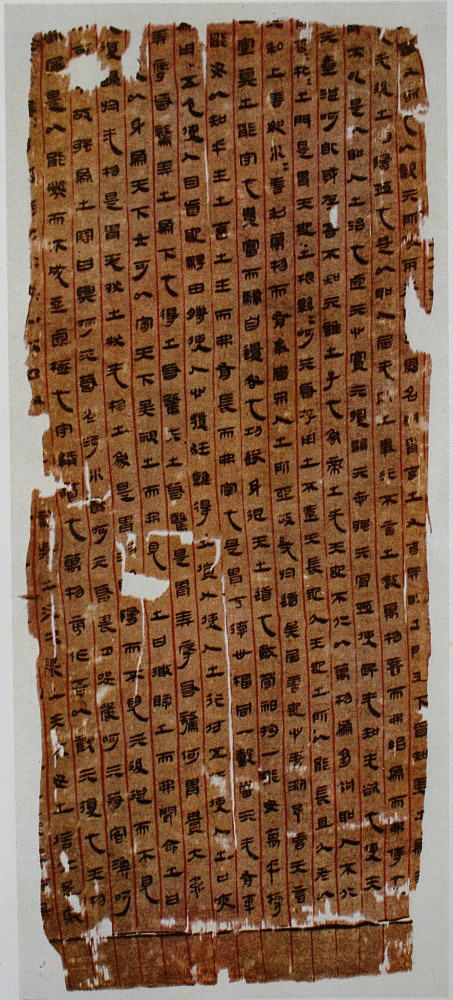
Tao Te Ching
"Classic of the Way and Its Virtue"
Laozi
Overview
Excavated in 1993, the Guodian Chu slips revealed fragments of a text that would eventually become one of the most influential works in human history. These bamboo strips, dating to roughly 300 BCE, contain versions of the Tao Te Ching that differ slightly from later editions, proving the text existed centuries before the Han Dynasty standardized its name. While tradition attributes the work to Laozi, a contemporary of Confucius, scholars now place the composition of the surviving manuscript in the mid-third century BCE during the chaotic Warring States period.
The book functions as a collection of 81 short, poetic chapters rather than a linear narrative. It explores the nature of the Tao, an ineffable force underlying all things, and Te, the power gained by aligning with this natural order. Central to its message is the concept of wu wei, or non-action, which advises rulers and individuals to act in harmony with the flow of nature instead of forcing outcomes through aggressive will. The text frequently champions the uncarved block, simplicity, and humility over ambition and wealth.
Modern readers encounter the text through thousands of translations, making it the second most translated book in the world after the Bible. Notable versions include those by Ursula K. Le Guin and Victor Mair, while David Bentley Hart released a new translation titled The Way That Abides Forever in May 2026. This enduring relevance spans diverse fields; Steve Jobs and Mao Zedong both drew strategic wisdom from its principles, and the text continues to influence Western movements like Transcendentalism and Existentialism alongside Eastern traditions such as Chan Buddhism.
Keywords
Sources
Book Info
- Author
- Laozi
- Language
- Classical Chinese
- Original Language
- Classical Chinese
- Estimated Composition Date
- Mid-3rd century BCE
- Chapter Count
- 81
- Character Count
- Approximately 5,000
- Key Discovery Site
- Guodian (1993)
- Notable Translation Year
- May 2026 (David Bentley Hart)
- Global Rank
- Second most translated book
Join the community
fans discussing