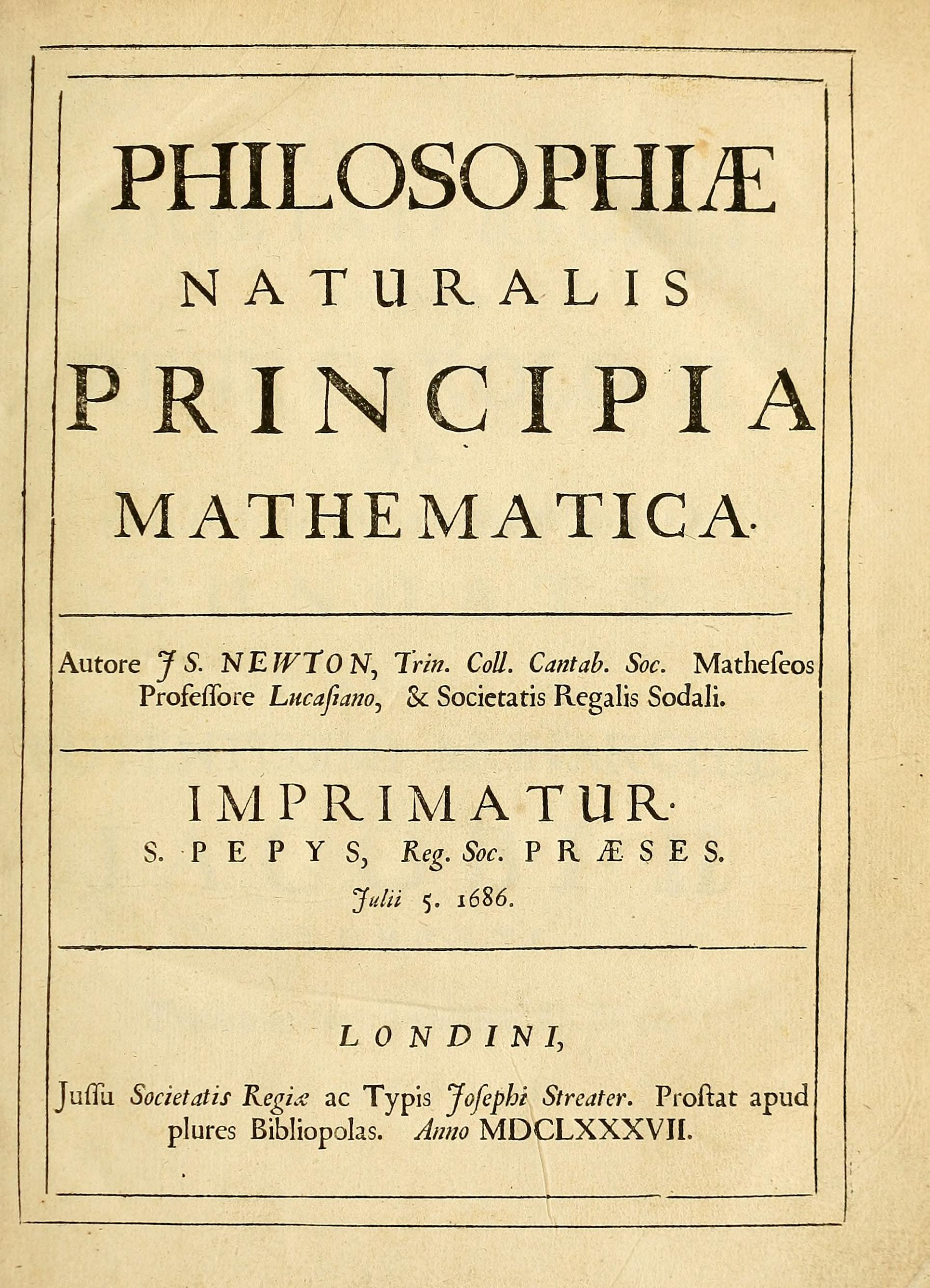
Philosophiæ Naturalis Principia Mathematica
"Mathematical Principles of Natural Philosophy"
Isaac Newton
Overview
Edmond Halley visited Isaac Newton in Cambridge in August 1684, asking what orbit a planet would follow under an inverse-square law of attraction. Newton replied he had already calculated it, but could not find the papers. He wrote a short treatise, De Motu Corporum in Gyrum, and sent it to Halley. Halley urged him to expand it. The result, published on July 5, 1687, was the Principia, a work that rewrote the rules of natural philosophy.
The book opens with definitions of mass, inertia, force, and time, then lays out the three laws of motion. Newton uses geometric methods to prove that Kepler's laws of planetary motion imply an inverse-square law of gravity. Book II tackles motion through resisting media, showing that Cartesian vortices cannot explain planetary orbits. Book III applies the laws to the solar system: the Moon's orbit, the tides, the precession of the equinoxes, and the paths of comets. The General Scholium ends with the famous phrase Hypotheses non fingo, “I frame no hypotheses”, insisting the mathematical principles of gravity are proven even if its physical cause remains unknown.
Only 300–400 copies of the first edition were printed, sold by Joseph Streater. The Royal Society, short on funds, left Halley to cover the costs. Two later Latin editions appeared, in 1713 (edited by Roger Cotes) and 1726 (edited by Henry Pemberton). The first English translation, by Andrew Motte, came out in 1729. The Principia replaced Aristotelian physics with a unified, mathematically rigorous system, and its success inspired Enlightenment thinkers to seek similar natural laws in society and politics.
Keywords
Book Info
- Author
- Isaac Newton
- Publisher
- Royal Society (printed by Joseph Streater, financed by Edmond Halley)
- Published
- 1687-07-05
- Pages
- 510
- Language
- Latin
- First edition print run
- 300–400 copies
- Sponsor
- Edmond Halley
Join the community
fans discussing