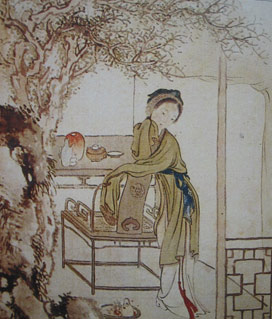
Dream of the Red Chamber
Cao Xueqin
Overview
The Jia family occupies two adjoining compounds in the capital, a clan whose wealth rests on offices held across four generations. At the center of the household is Jia Baoyu, a boy born with a piece of jade in his mouth, who prefers the company of his female cousins and maids to the civil-service examinations his father insists he sit. His attachment to Lin Daiyu, a sickly and quick-witted cousin, and to Xue Baochai, a steadier and more worldly one, gives the novel its emotional spine. Around them Cao Xueqin arrays some four hundred named characters: matriarchs, concubines, stewards, monks, actresses, and servants, each with a distinct voice and a place in the family's internal politics.
The novel's method is cumulative rather than dramatic. It records banquets, poetry contests, funerals, illnesses, and quarrels, and through them shows how an aristocratic household spends, schemes, and slowly loses its footing. Cao writes as a memorialist. The Jia decline follows the arc of his own family, whose fortunes collapsed after his grandfather's household fell from imperial favor. Buddhist and Daoist ideas of illusion and attachment run through the book, and the frame narrative, in which a stone is asked to record its experiences in the mortal world, keeps the question of reality and dream in view from the first page.
What survives of Cao's own work is the first eighty chapters, circulated in manuscript among friends. The 1791 and 1792 printed editions prepared by Gao E and Cheng Weiyuan added forty chapters and fixed the text that most readers know. Whether Gao and Cheng worked from Cao's drafts or composed the ending themselves remains unsettled, and the question has driven the scholarship known as Redology for more than two centuries.
Keywords
Sources
Book Info
- Author
- Cao Xueqin
- Published
- 1792
- Pages
- 2500
- Language
- written vernacular Chinese, Beijing dialect
- Original title
- Honglou meng (also Shitou ji, Story of the Stone)
- Manuscript chapters
- 80
- Printed chapters
- 120
- Editors of first printed edition
- Gao E and Cheng Weiyuan
- English translators
- David Hawkes and John Minford (Penguin Classics, 5 vols.)
- Literary category
- Four Great Classical Novels of Chinese literature
Join the community
fans discussing