 United States
“It is a masterfully staged, terrifyingly immediate and often harrowing depiction of soldiers caught in a hellish urban firefight.”
Roger Ebert
Chicago Sun-Times
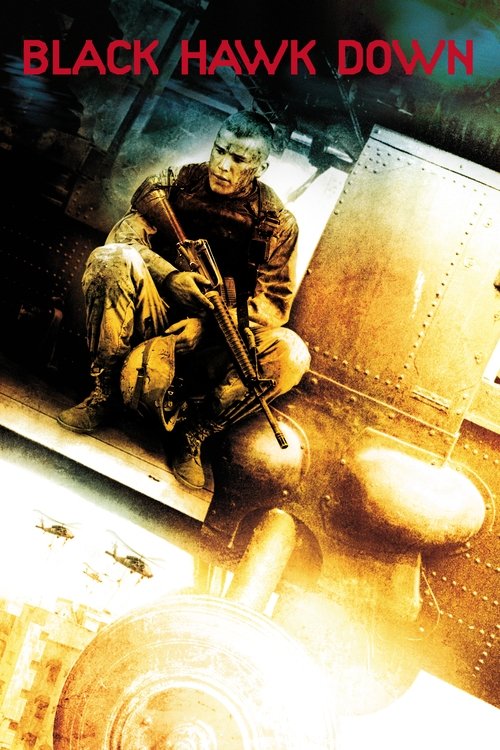
Ridley Scott's Black Hawk Down drops viewers into the chaos of the 1993 Battle of Mogadishu, where a routine U.S. military raid spirals into a desperate 15-hour firefight. The film follows Task Force Ranger, including SSG Matthew Eversmann (Josh Hartnett) and SFC Norm 'Hoot' Gibson (Eric Bana), as they struggle to survive after two Black Hawk helicopters are shot down. With a budget of $92 million and a box office gross of $173 million, the movie combines visceral action with a gritty war docudrama tone. Produced by Scott and Jerry Bruckheimer, it adapts Mark Bowden's book with a screenplay by Ken Nolan and René Brar.
Hans Zimmer's percussive score and Sławomir Idziak's desaturated cinematography amplify the relentless tension. The film earned strong critical praise for its immersive combat sequences, though some debated its political perspective. It is not a franchise entry, but a standalone historical reenactment.
Stream
Max
Rent
Amazon Prime Video
$3.99
Buy
Amazon Prime Video
$7.99
Availability and pricing can change. Confirm on the provider's site before purchasing.
The year is 1993, and Somalia is torn apart by civil war and famine. Warlord Mohamed Farrah Aidid controls much of Mogadishu, attacking peacekeepers and stealing food aid. The U.S. sends Task Force Ranger, a mix of elite Delta Force operators and Army Rangers, to capture Aidid's top lieutenants. The operation is meant to be quick, a surgical strike that gets the men in and out before the militia can react.
On October 3, the mission launches. Soldiers pile into Black Hawk helicopters and Humvees, heading for the Olympic Hotel in the heart of Aidid's territory. The plan is straightforward: Delta operators fast-rope in, grab the targets, and the ground convoy extracts everyone. Among the soldiers are young Rangers like Eversmann, who is suddenly put in charge after his platoon leader is injured, and seasoned Delta veterans like Hoot, who carries himself with a quiet confidence born of experience. Back at base, Major General Garrison monitors the operation from a command center, watching the feeds and listening to the radio chatter.
Almost immediately, things go wrong. Somali militia, armed with RPGs and machine guns, swarm the streets. The ground convoy gets lost in the narrow alleys, taking heavy fire. Then the first Black Hawk, callsign Super 6-1, is hit by an RPG and crashes. The rescue effort shifts focus, with soldiers racing to secure the crash site. A second Black Hawk, Super 6-4, is shot down shortly after, creating another disaster zone. Now the men are scattered across Mogadishu, surrounded, low on ammo, and taking casualties.
The film follows multiple groups fighting to survive. Eversmann's squad digs in at a makeshift checkpoint, fending off waves of attackers. Hoot and other Delta operators push through the city to reach the downed helicopters. The ground convoy, led by Lieutenant Colonel McKnight, fights its way through ambushes to pick up stranded soldiers. In the command center, Garrison faces the grim reality that the mission has collapsed and must coordinate a desperate rescue. The battle stretches into the night, with the soldiers holding on until a relief force of UN and Malaysian armored vehicles can reach them.
Official Trailer: Black Hawk Down (2001)
Critical Consensus
Ridley Scott's Black Hawk Down is a visceral and intense war film that immerses the audience in the chaos of battle, earning praise for its realistic combat sequences and powerful performances, though some critics noted its limited political context.
“It is a masterfully staged, terrifyingly immediate and often harrowing depiction of soldiers caught in a hellish urban firefight.”
Roger Ebert
Chicago Sun-Times
“Ridley Scott's visceral war epic plunges viewers into the heart of a chaotic, 15-hour battle in Mogadishu, Somalia, delivering a relentless and unflinching portrayal of modern combat.”
Variety Staff
Variety
“The film is a brutal ballet of bullets and blood, a stunningly realized spectacle of urban warfare that rarely pauses for breath.”
Stephen Holden
The New York Times
“Scott has crafted a film that is both a thrilling action piece and a sobering meditation on the realities of war.”
Kirk Honeycutt
The Hollywood Reporter
Josh Hartnett
SSG Matthew Eversmann
Eric Bana
SFC Norm 'Hoot' Gibson
Ewan McGregor
SPC John Grimes
Tom Sizemore
LTC Danny McKnight
William Fichtner
SFC Jeff Sanderson
Sam Shepard
MG William F. Garrison
Jason Isaacs
CPT Mike Steele
Ewen Bremner
SPC Shawn Nelson
Orlando Bloom
PFC Todd Blackburn
Tom Hardy
SPC Lance Twombly
Director
Ridley Scott
Writers
Mark Bowden, Ken Nolan, René Brar
Composer
Hans Zimmer
Cinematographer
Sławomir Idziak
Producers
Ridley Scott, Jerry Bruckheimer
Academy Award for Best Film Editing (2002)
Best Film Editing: Nominated
Academy Award for Best Sound (2002)
Best Sound: Nominated
BAFTA Award for Best Sound (2002)
Best Sound: Won
BAFTA Award for Best Film Editing (2002)
Best Film Editing: Nominated
BAFTA Award for Best Cinematography (2002)
Best Cinematography: Nominated
Critics' Choice Movie Award for Best Picture (2002)
Best Picture: Nominated
Critics' Choice Movie Award for Best Director (2002)
Best Director: Nominated
Critics' Choice Movie Award for Best Cinematography (2002)
Best Cinematography: Nominated
Join the community
fans discussing