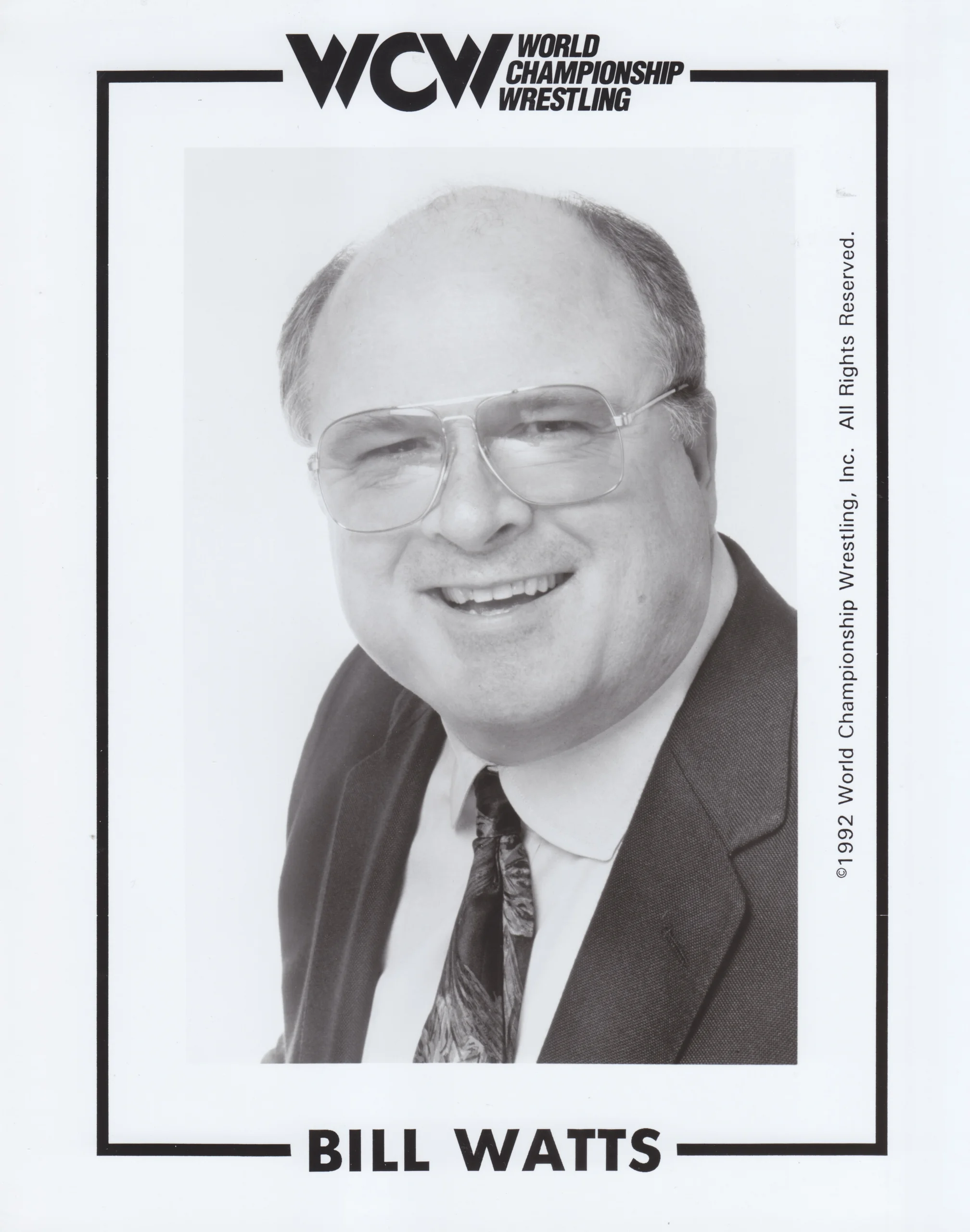
Bill Watts
professional wrestler•American football player•professional wrestling promoter
Also known as: Cowboy Bill Watts, Doctor Scarlett, Dr. Scarlett, William F. Watts Jr.
Birthday
May 5, 1939
Birth Sign
Taurus
Birthplace
Bixby, Oklahoma
Age
Died at 87
Height
6 ft 2 in (188 cm)
About
William F. Watts Jr., known professionally as "Cowboy" Bill Watts, was a pivotal figure in professional wrestling history whose career spanned from the 1960s until his death in late 2026. Born in Bixby, Oklahoma, he began his life outside the ring as a standout American football player before transitioning to professional wrestling. His approach to the business prioritized realism and athletic ability over theatricality, a philosophy that defined his tenure as the head of the Universal Wrestling Federation (UWF). He built a powerful regional empire in the Mid-South United States, known for its hard-hitting product and strict discipline.
Watts trained countless stars who would later achieve national fame, including Dusty Rhodes and Jim Cornette. His management style, often called "Watts University," emphasized physical safety and professional conduct, creating a reputation for quality that attracted large crowds across the region. In 1992, he joined World Championship Wrestling (WCW) as Executive Vice President to revitalize the company. His time there was brief and marked by significant conflicts with management over creative direction and business ethics. A controversial interview defending a business owner's right to refuse service based on race led to intense public scrutiny and his eventual resignation.
He returned briefly to the World Wrestling Federation in 1995 as a booker before stepping back from daily operations. His death in November 2026 marked the end of an era for a man whose influence extended far beyond the ring.
Early Life & Background
William F. Watts Jr. was born on May 5, 1939, in Bixby, Oklahoma, a suburb of Tulsa. His early life was rooted in the American South, where he developed a strong interest in sports that would eventually define his future path. Before entering the world of professional wrestling, Watts was a successful American football player. This background heavily influenced his later approach to wrestling, which prioritized genuine athleticism and realism over the more theatrical styles common in other territories. He began his professional wrestling career in 1963, quickly gaining traction with his "Cowboy" gimmick. This persona leveraged his genuine Southern demeanor and athletic build, setting him apart from many contemporaries.
During this period, he also utilized the ring name "Doctor Scarlett" for specific storylines, showcasing his versatility as a performer. His time as a competitor allowed him to understand the nuances of the business from the inside, a knowledge base he would later use to revolutionize promotion. Watts spent the late 1960s and early 1970s building his reputation as a top draw in the National Wrestling Alliance territories. He became a respected figure in the Mid-South region, known for a no-nonsense style that appealed to fans seeking serious competition. His success as a performer laid the groundwork for one of the most influential promotional careers in history. By the mid-1970s, he had decided to shift his focus from competing to running the business, a move that would lead to the creation of the Universal Wrestling Federation.
Career Growth
Following his retirement from active competition, Watts founded and ran the Universal Wrestling Federation (UWF), originally based in Arkansas and later expanding across the Mid-South United States. The UWF became a powerhouse known for its gritty, realistic product. Watts implemented strict discipline, often referred to as "Watts University," where he trained talent to adhere to a code of conduct that emphasized physical safety and professional behavior. He brought real athletes like Jim Cornette and Dusty Rhodes into the spotlight, creating a product that felt authentic compared to the more theatrical styles prevalent elsewhere. His promotion was so successful that it was ranked in the top 10 worldwide for over 25 years.
In 1992, Watts joined World Championship Wrestling (WCW) as Executive Vice President, tasked with revitalizing the company's creative direction. His tenure was short-lived and tumultuous. He clashed frequently with upper management, including Vince Russo and Eric Bischoff, due to fundamental differences in philosophy regarding wrestling presentation. A defining moment of his departure occurred when he gave a controversial interview defending a business owner's right to refuse service based on race, a statement that sparked intense scrutiny and public backlash. This controversy, combined with internal power struggles, led to his resignation shortly after Ole Anderson replaced him.
He returned briefly in 1995 to work as a booker for the World Wrestling Federation (WWF) before stepping back from daily operations. In 2009, he received significant recognition for his contributions to the industry when he was inducted into the WWE Hall of Fame. This honor acknowledged his immense impact as both a performer and a promoter, cementing his place in history as a key figure in the evolution of professional wrestling. His legacy continued to be celebrated by the wrestling community until his death in 2026.
Career Timeline
Public Image & Style
Bill Watts was known for his rugged, Southern demeanor and his "Cowboy" persona, which he maintained both in and out of the ring. His public image was that of a strict disciplinarian who valued authenticity above all else. Media coverage often focused on his controversial decisions and his refusal to compromise on his vision for the sport. He was perceived as a tough boss who demanded excellence from his talent, earning a reputation for being both feared and respected. His style of wrestling and promotion was distinctively different from the more cartoonish characters of the era, appealing to fans who wanted to see real athletic competition.
Fame & Fandom (iFAMOUS Rankings)
iFANN has not yet collected fame data for this person. He does not appear in the September 2026 iFAMOUS Rankings flagship list. The fanbase surrounding Bill Watts has no formal name, but the wrestling community remembers him fondly for his contributions to the sport. Fans often discuss his "Watts University" training camp and the stories of wrestlers he discovered and developed. His legacy is kept alive through archival footage and discussions about his impact on the industry. The audience that follows his work consists primarily of wrestling historians and long-time fans who appreciate the gritty, realistic style he championed.
Interesting Facts and Legends
Bill Watts performed under several ring names throughout his career, including "The Cowboy" and "Doctor Scarlett." His transition from American football to wrestling was seamless, and his athletic prowess was a key factor in his success as both a performer and a promoter. He was active in the wrestling industry for over 60 years, from his debut in 1963 until his death in 2026. One of the most famous aspects of his legacy is his rigorous training camp, often called "Watts University," where he taught wrestlers not just how to fight, but how to behave, emphasizing punctuality, sobriety, and respect. A widely retold anecdote involves Watts discovering J.Y.D. (Junkyard Dog), nurturing him into a superstar despite his initial lack of polish. His time in WCW is legendary for the clash between his old-school values and the new-age direction the company was taking.
Notable Quotes
“Wrestling should be treated as a legitimate sport rather than a scripted spectacle.”
“We don't need flash; we need athletes who can perform.”
Family & Personal Life
Public records regarding Bill Watts' family structure are sparse, reflecting his preference for privacy. While historical accounts indicate that he was married, details regarding his wife's full name, the date of their marriage, or the duration of the union are not extensively covered in public biographies or obituaries released in 2026. Specific details about the number of children or their names are not prominently featured in the available search results. He lived a relatively private life outside the spotlight, focusing on his career and family matters away from public view. Unlike many modern celebrities, Watts did not maintain a public dating history or engage in high-profile relationships that were widely documented in tabloids or entertainment news. The lack of documentation suggests a deliberate choice to keep personal matters out of the public eye.
Notable Connections
Relationships & Dating History
Public records regarding Bill Watts' romantic history are sparse, reflecting his preference for privacy. Unlike many modern celebrities, he did not maintain a public dating history or engage in high-profile relationships that were widely documented in tabloids or entertainment news. Historical accounts indicate that he was married, but details regarding his wife's full name, the date of their marriage, or the duration of the union are not extensively covered in public biographies or obituaries released in 2026. At the time of his death in November 2026, he was widowed. There is no current partner or ongoing relationship status to report beyond his passing.
Death & Aftermath
Died
November 17, 2026 (aged 87)
Death Place
Oklahoma, United States
Cause of Death
Natural causes
Bill Watts passed away on November 17, 2026, at the age of 87 in Oklahoma. Reports from family and industry sources described the death as consistent with natural causes related to his advanced age, though no specific medical diagnosis was publicly released by the immediate family. The news traveled quickly through the wrestling community, prompting an outpouring of tributes from peers who remembered him as a strict but essential figure in the sport's development.
The reaction from the wrestling world was immediate and respectful. WWE issued a statement honoring his induction into the Hall of Fame and acknowledging his role in shaping the industry's standards for athleticism and discipline. Fellow promoters and wrestlers highlighted his "Watts University" training camp, where he demanded sobriety, punctuality, and respect from talent. Many noted that while his methods were often harsh, they produced some of the most reliable performers in history. Tributes poured in from figures like Jim Cornette and Dusty Rhodes, who credited Watts with giving them their start or refining their craft.
A formal funeral service was held shortly after his passing, attended by family members and close associates from the wrestling circuit. While details regarding the location were kept private by the family, the event served as a gathering point for those who worked under his promotion. Following the service, the industry continued to recognize his contributions through various memorial segments on television broadcasts and online platforms. Posthumous releases of rare UWF footage began circulating, allowing new generations to see the gritty style he championed.
His estate remains managed by family members, with ongoing revenue streams generated from licensing deals involving his likeness and archival content from the Universal Wrestling Federation. The legacy of his promotional empire continues to influence how independent promotions operate today, particularly regarding the balance between entertainment and athletic integrity. No major estate disputes have been reported, and his contributions are widely accepted as a foundational part of modern professional wrestling history.
Net Worth (Estate Value)
$15 Million
iFANN Editorial Team estimate
The iFANN Editorial Team estimates Bill Watts' estate value at approximately $15 million. This figure reflects the accumulated wealth from his decades-long career as a promoter and performer. His primary source of income was the operation of the Universal Wrestling Federation, which was a highly profitable enterprise in the 1970s and 1980s. Additional revenue likely came from wrestling appearances, consulting fees, and investments made during his peak earning years. Following his death in November 2026, the management of his estate is handled by family members, with potential revenue streams continuing from posthumous releases of UWF content and licensing of his likeness. The estate's financial trajectory has remained stable, supported by the enduring popularity of his promotional style and the archival value of his work.
Awards Won (1)
Bill Watts received significant recognition for his contributions to the industry, primarily posthumously or late in his career. He was inducted into the WWE Hall of Fame in 2009, recognizing his immense impact as a promoter and performer. This induction serves as the primary honor acknowledging his lifetime achievements and his role in shaping the sport.
2009 · Legend
Career Contributions
Known For
Universal Wrestling Federation
1972 · Promoter
WCW
1992 · Executive Vice President
WWE Hall of Fame
2009 · Inductee
Keywords
Sources
Quick Facts
- Profession
- professional wrestler, American football player, professional wrestling promoter
- Born
- May 5, 1939
- Birthplace
- Bixby, Oklahoma
- Gender
- Male
- Birth Sign
- Taurus
- Height
- 6 ft 2 in (188 cm)
- Died
- November 17, 2026
- Cause of Death
- Natural causes
Personal Details
- Full Name
- William F. Watts Jr.
- Height
- 6 ft 2 in (188 cm)
- Education
- High School
Filmography
45
Total
12
Film
33
TV
Frequently Asked Questions
Is Bill Watts in the WWE Hall of Fame?
How long was Bill Watts in WCW?
When did Bill Watts sell the UWF?
How big was Cowboy Bill Watts?
What caused Bill Watts' death?
Similar People
Join the community
fans discussing