“The movie is not about a robot who wants to be human, but about a machine that wants to be loved. It's a sweet, gentle film that wears its heart on its sleeve, even if it doesn't always know how to use its brain.”
Roger Ebert
Chicago Sun-Times
 United States
"Two hundred years of love, loss, and the search for a soul."
User Score
3,976 votes
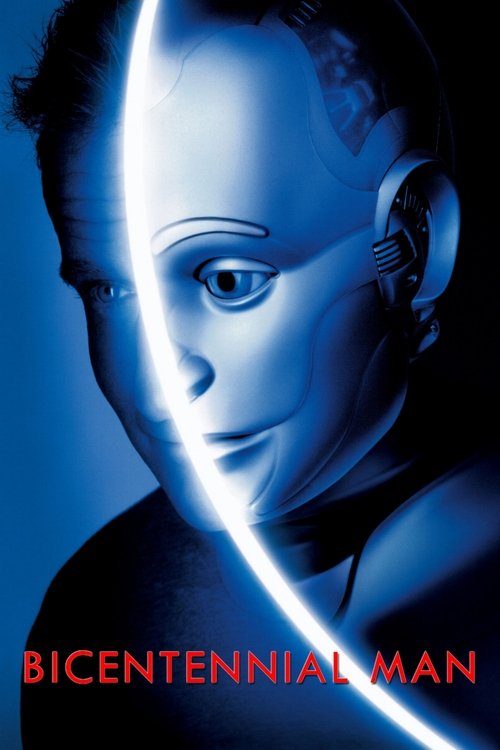
In December 1999, director Chris Columbus released his adaptation of Isaac Asimov's novella The Bicentennial Man, a story originally written for the United States' 200th birthday. Robin Williams stars as Andrew, an NDR-114 domestic android who, over two centuries, evolves far beyond his programming. The film also features Embeth Davidtz in dual roles as the Martin family's daughter and later her granddaughter, with Sam Neill as the family patriarch, Sir. Produced on a $100 million budget, the movie earned about $87 million worldwide, a modest return that didn't stop it from becoming a cult favorite for its earnest storytelling and Williams' heartfelt performance.
Blending drama, romance, and science fiction, the film explores what it means to be human through Andrew's journey from appliance to artist, from servant to free being. While critics were divided, audiences have given it a solid 7.27/10 rating on IMDb, reflecting its enduring appeal as a thoughtful, family-friendly sci-fi drama. The film's themes of artificial intelligence and personhood have only grown more relevant in the decades since, making it a frequent reference point in discussions about real-world robotics and AI.
Availability and pricing can change. Confirm on the provider's site before purchasing.
Set in the near-future of 2005, the story begins when the Martin family purchases Andrew, a domestic robot designed for household chores. Sir, the patriarch, brings him home to serve his wife and two daughters, including young Little Miss, who quickly bonds with the machine. Andrew is an NDR-114 model, but he soon displays an unexpected spark of creativity when he accidentally carves a beautiful wooden horse for Little Miss. This moment awakens something within him, a capacity for artistic expression that no robot should possess.
As the years pass, Andrew's uniqueness becomes more pronounced. He begins to experience what can only be described as emotions, curiosity, longing, and a deep desire for freedom. When he meets Galatea, a female robot who shares his spark of individuality, his sense of isolation deepens. Andrew eventually requests his freedom from Sir, who grants it reluctantly, setting him on a journey to discover his own identity and purpose.
His quest leads him to Rupert Burns, a brilliant but eccentric robotics engineer who believes robots can transcend their programming. Together, they begin the slow process of upgrading Andrew's mechanical body to become more human-like, first with synthetic skin, then with more sophisticated sensory organs. These modifications bring Andrew closer to humanity but also create new complications, particularly when he develops romantic feelings for Portia, the granddaughter of Little Miss.
The central conflict revolves around Andrew's struggle for recognition as a person rather than property. He wants to be acknowledged as more than a machine, to be able to marry, own property, and be recognized under the law. This battle takes him to the World Congress, where he petitions for legal personhood, only to be denied because he is technically immortal. The film's middle section follows Andrew's growing relationship with Portia, his continued artistic and intellectual development, and his deepening understanding of what it means to be human, including the painful realities of mortality, loss, and sacrifice.
Throughout the film, Andrew's journey is punctuated by the passage of time. He outlives the Martins, watches generations pass, and witnesses the world change around him. His pursuit of humanity becomes increasingly desperate as he realizes that to be truly human, he must accept mortality, a choice that carries profound emotional weight. The film builds toward a climax that forces him to make the ultimate choice about what it means to be a person.
Bicentennial Man (1999) Trailer
Bicentennial Man Trailer (2018 Re-Cut)
Critical Consensus
Critics praised Robin Williams' heartfelt performance and the film's earnest exploration of philosophical themes, but many found the pacing sluggish and the tonal shifts between comedy and drama jarring. The $100 million budget and elaborate production values felt mismatched with its intimate, character-driven story, making it an odd duck in the blockbuster mold. However, audiences have been kinder, giving it a 64% score and reflecting its enduring appeal as a thoughtful, family-friendly sci-fi drama.
“The movie is not about a robot who wants to be human, but about a machine that wants to be loved. It's a sweet, gentle film that wears its heart on its sleeve, even if it doesn't always know how to use its brain.”
Roger Ebert
Chicago Sun-Times
“Robin Williams gives a performance of quiet dignity and warmth, but the film's two-hour-plus running time stretches its slender premise to the breaking point.”
Stephen Holden
The New York Times
“A handsomely mounted but dramatically uneven fable that never quite finds its footing, despite Williams' committed performance.”
Todd McCarthy
Variety
“The film's sincerity is never in doubt, but its execution is often clumsy, leaving viewers with a movie that is more admirable than enjoyable.”
Kenneth Turan
Los Angeles Times
“A flawed but ambitious effort that tackles big questions with genuine feeling, even if it occasionally stumbles over its own good intentions.”
James Berardinelli
ReelViews
Robin Williams
Andrew
Embeth Davidtz
Little Miss / Portia
Sam Neill
Sir
Oliver Platt
Rupert Burns
Kiersten Warren
Galatea
Wendy Crewson
Ma'am
Hallie Eisenberg
Little Miss (7 years old)
Director
Chris Columbus
Writers
Nicholas Kazan, Isaac Asimov, Robert Silverberg
Composer
James Horner
Cinematographer
Phil Meheux
Producers
Michael Barnathan, Chris Columbus, Gail Katz, Laurence Mark, Neal Miller
Golden Screen Award (2000)
Golden Screen Award: Won
Saturn Award (2000)
Best Science Fiction Film: Nominated
Saturn Award (2000)
Best Actor: Nominated
Young Artist Award (2000)
Best Performance in a Feature Film - Supporting Young Actress: Nominated
Join the community
fans discussing