Overview
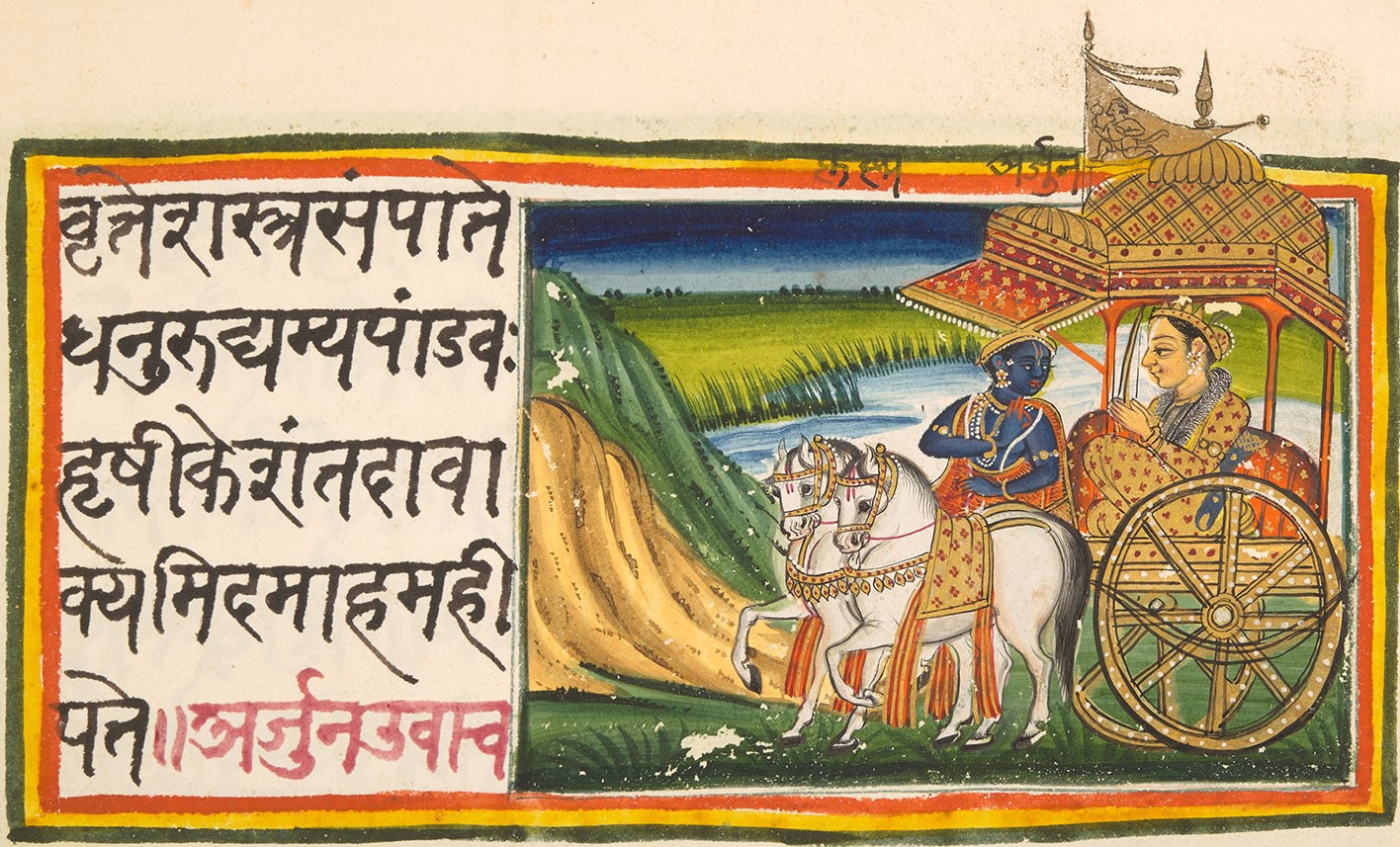
The Bhagavad Gita unfolds as a profound dialogue between the warrior prince Arjuna and Lord Krishna, his charioteer, on the battlefield of Kurukshetra just before a monumental war. Overwhelmed by the prospect of fighting his own relatives and teachers, Arjuna experiences intense grief and moral confusion, leading him to question his duty. Krishna, in response, imparts timeless wisdom over the course of the 700 verses. He elucidates the eternal nature of the soul, the importance of fulfilling one's dharma (righteous duty) without attachment to outcomes (nishkama karma), and explores various paths to spiritual realization, including the paths of knowledge (jnana yoga), action (karma yoga), and devotion (bhakti yoga). The Gita offers a synthesis of these paths, presenting a practical guide for living a purposeful and tranquil life amidst worldly challenges. A pivotal moment in the text involves Krishna revealing his cosmic form to Arjuna, a terrifying yet awe-inspiring vision.
Composed in Sanskrit, the Bhagavad Gita is traditionally attributed to the sage Vyasa and is believed to have been composed between the 5th and 2nd centuries BCE, with its final form likely emerging between the 2nd century BCE and the 1st century CE. The first English translation was published in 1785 by Charles Wilkins. The text has since been translated into numerous languages. The edition Bhagavad-Gita as It Is by A. C. Bhaktivedanta Swami Prabhupada is noted as the most widely distributed English translation, with estimated sales of twenty-three million copies.
The Bhagavad Gita is classified as a religious poem, a philosophical dialogue, and a spiritual guide. Its core themes revolve around dharma, karma yoga, bhakti yoga, jnana yoga, moksha, nishkama karma, atman, and the concept of avatar. It delves into the nature of reality, the human condition, ethical conduct, and the path to spiritual enlightenment. The Gita's influence extends far beyond religious and philosophical circles, impacting Western thought, literature, and even scientific discourse. It has shaped modern yoga practices, psychology, and leadership studies. Figures like Mahatma Gandhi, Ralph Waldo Emerson, and Henry David Thoreau have been significantly influenced by its teachings.
Keywords
Sources
Book Info
- Author
- Vyāsa
- Language
- Sanskrit
- Verses
- 700
- Composition period
- 5th–2nd century BCE
- First English translation
- 1785 by Charles Wilkins
- Part of
- Mahabharata (Bhishma Parva, chapters 23–40)
Join the community
fans discussing