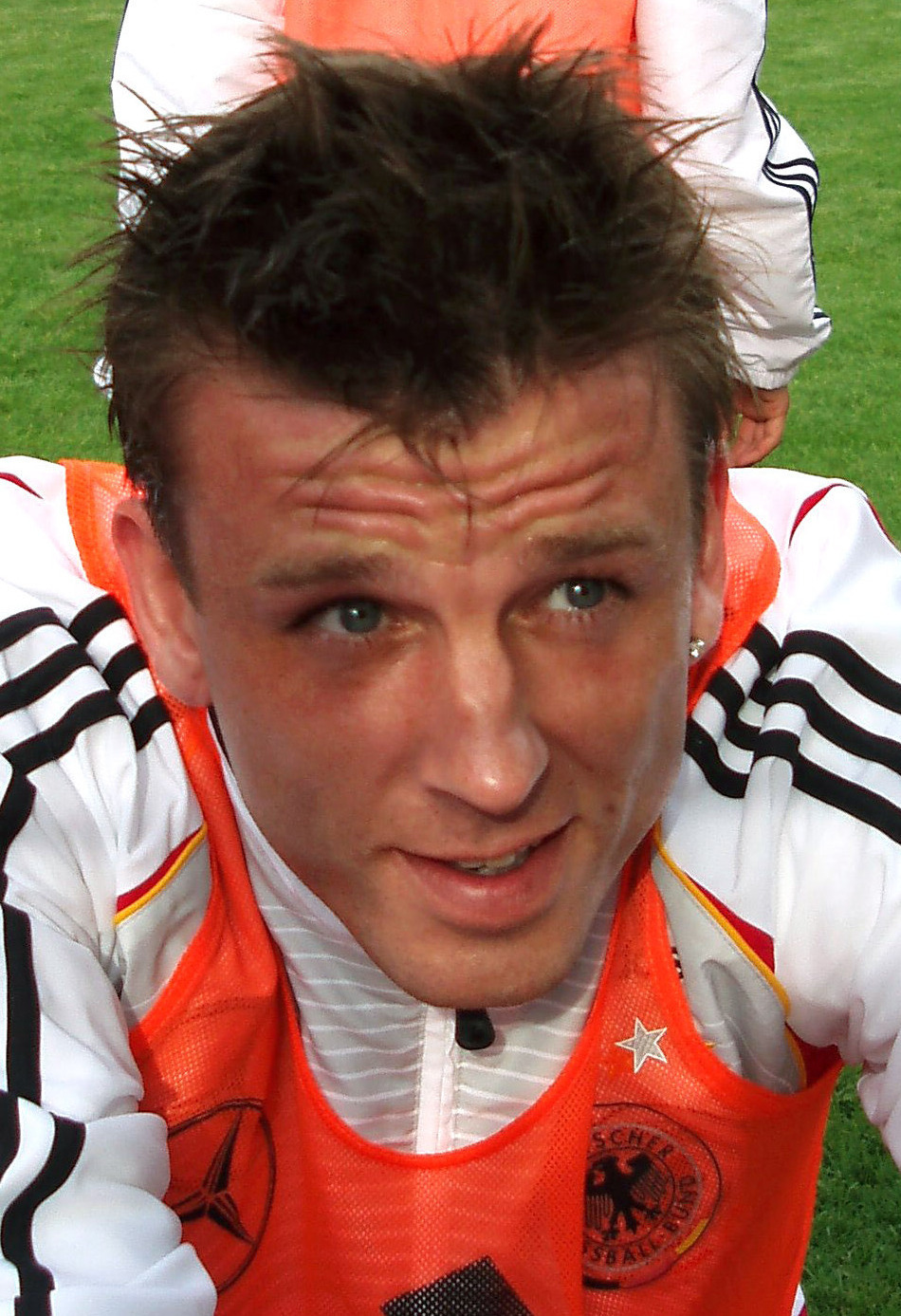
Bernd Schneider
 Germany
Also known as: The White Brazilian, Schnix
Birthday
November 17, 1973
Birth Sign
Scorpio
Birthplace
Jena, East Germany
Age
52 years old
Height
5 ft 9 in (176 cm)
About
Bernd Schneider is a retired German footballer who spent a decade as the creative engine of Bayer Leverkusen's midfield. Born November 17, 1973, in Jena, he earned 81 caps for Germany between 1999 and 2008, appearing in two World Cups and two European Championships. Known for his elegant dribbling and pinpoint set-piece delivery, he was nicknamed "The White Brazilian" for a playing style that stood out among German midfielders of his era.
Schneider's career was defined by remarkable consistency and an almost cruel string of near-misses. He finished as runner-up in the Bundesliga, DFB-Pokal, Champions League, World Cup, and European Championship without ever lifting a major trophy. Despite this, he remains a beloved figure at Leverkusen, where he is regarded as one of the club's greatest-ever players. After retiring in 2009, he moved into scouting and advisory roles, staying close to the game he graced.
Early Life & Background
Bernd Schneider grew up in Jena, a city in the socialist German Democratic Republic, where football was woven into the fabric of daily life. He joined local side BSG Aufbau Jena at age seven in 1980, spending three years there before moving to the youth academy of Carl Zeiss Jena in 1983. The club, steeped in East German tradition, became his football home for the next eight years.
His development coincided with seismic political change. The fall of the Berlin Wall in 1989 and German reunification in 1990 reshaped the football landscape just as he was breaking through. Schneider made his senior debut for Carl Zeiss Jena in 1991, the same year the club entered the unified German league structure. His early training emphasized technical skill, close control, and dead-ball accuracy, attributes that would later earn him national recognition.
By the mid-1990s, Schneider had established himself as a reliable performer in the second tier, catching the eye of Bundesliga clubs. His move to Eintracht Frankfurt in 1998 gave him his first taste of top-flight football, and a single season there proved enough to convince Bayer Leverkusen to sign him in 1999.
Career Growth
Schneider's transfer to Bayer Leverkusen in 1999 marked the beginning of a decade-long association that defined his career. He quickly became the team's chief playmaker, orchestrating attacks with his vision and delivering dangerous free kicks and corners. His nickname "The White Brazilian" captured the flair he brought to the German game, a contrast to the stereotypical efficiency of the national side.
The 2001-02 season was both his pinnacle and his heartbreak. Leverkusen finished second in the Bundesliga, lost the DFB-Pokal final to Schalke 04, and fell to Real Madrid in the Champions League final. That same summer, Germany reached the World Cup final in Japan and South Korea, only to lose 0-2 to Brazil. For Schneider, the runner-up tag became a recurring theme.
He represented Germany at Euro 2004, the 2006 World Cup on home soil, and Euro 2008, where Germany again finished as runners-up, this time to Spain. After 81 caps and four goals, he retired in June 2009, having made 462 senior club appearances and scored 61 goals. He immediately transitioned into football administration, taking an advisory role at Carl Zeiss Jena and a scouting position at Bayer Leverkusen.
Career Timeline
Public Image & Style
Bernd Schneider's public image is that of a supremely gifted footballer whose career was marked by agonizing near-misses. German football media and fans remember him as one of the most aesthetically pleasing midfielders of his generation, a player whose dribbling and passing seemed almost out of place in the efficient, physical stereotype of German football. The "White Brazilian" nickname captured this duality perfectly.
Among Bayer Leverkusen supporters, he is a cult hero, celebrated for his loyalty and his role in the club's most successful era. His humility and quiet professionalism endeared him to teammates and coaches alike. He never sought the spotlight, letting his performances speak for themselves.
His legacy is that of a nearly man, but one whose talent was never in doubt. For fans of the sport, he represents the beauty of football that exists beyond trophies.
Fame & Fandom (iFAMOUS Rankings)
Bernd Schneider, the elegant German midfielder known as "The White Brazilian," has been evaluated by iFANN's Global Fame Engine as of August 2026, but he does not currently hold a placement in the published rankings, neither in the Global Top 1,000 nor in any Top-100 scope list. His fame, though considerable in football circles, has not translated into a ranked position on the global stage.
Schneider's fanbase, while devoted, especially among Bayer Leverkusen supporters who revere him as a cult hero, has no formal name. There is no documented collective identity, no "Schneider Army" or similar moniker. His followers are simply fans of a player whose dribbling and set-piece artistry defied the German stereotype.
His post-playing life has been notably low-key, with few public appearances, which may contribute to his current unranked status. Yet his legacy endures in the memories of those who watched him glide past defenders and curl free kicks into the top corner, a player whose near-misses only deepened the affection for him.
Interesting Facts and Legends
Schneider's career total of 462 club appearances and 61 goals spans 18 professional seasons, yet he never won a single major trophy. His four goals for Germany all came in competitive matches, a modest tally for a player of his creative influence. He was one of the few players to have competed in both the East German and unified German football systems, bridging two eras of the sport. At the 2006 World Cup, he played under Jürgen Klinsmann, whose attacking philosophy suited Schneider's natural game. Fans and teammates called him "Schnix," a playful shortening of his surname that stuck throughout his career. Despite his fame, he has kept a low profile since retiring, rarely appearing in the media.
One story fans still retell is his near-miss with a move to Bayern Munich, which would have changed his trophy-less fate, but he stayed loyal to Leverkusen. Another legend from his time at the 2002 Champions League final: his curling effort that struck the crossbar, a moment that could have altered the outcome. And his nickname "The White Brazilian" became a badge of honor, a reflection of his samba-like flair in a team known for efficiency.
Family & Personal Life
Schneider is a father of two: a son named Giovani and a daughter named Emely. He has kept the identity of their mother and his own marital status private, a choice that has preserved his family's anonymity. Details about his parents and siblings are not publicly documented.
After retiring, he settled in the Leverkusen area, staying close to the club where he spent his peak years. His children have occasionally been seen at Bayer Leverkusen matches, but Schneider has consistently shielded his family from the public eye.
Notable Connections
Jürgen Klinsmann managed Schneider on the German national team during the 2006 World Cup. At Bayer Leverkusen, he played alongside Michael Ballack, Oliver Neuville, and Carsten Ramelow, forming a formidable midfield unit. Rudi Völler, who later became Leverkusen's sporting director, also played with Schneider for Germany.
Relationships & Dating History
Bernd Schneider has kept his romantic life almost entirely out of the public eye. No credible sources document any marriage, engagement, or high-profile relationship during or after his playing career. He is known to have two children, Giovani and Emely, but the identity of their mother has never been confirmed publicly.
As of 2026, Schneider's relationship status is not publicly documented. He appears to be single, or at least has not been linked to anyone in the media. His privacy on this matter stands in contrast to the often public personal lives of many footballers.
Salary, Net Worth In 2026
$15 Million
iFANN Editorial Team estimate
iFANN currently estimates Bernd Schneider's net worth at $15 million, a figure accumulated primarily through his Bundesliga career and international appearances. During his peak years at Bayer Leverkusen from 1999 to 2008, he earned a substantial salary, though not at the level of Europe's elite clubs. His 81 caps for Germany brought match fees and tournament bonuses, particularly for the 2002 World Cup run and the 2006 home World Cup. Since retiring in 2009, Schneider has supplemented his income through his advisory role at Carl Zeiss Jena and his scouting position at Bayer Leverkusen. These roles, while not hugely lucrative, have kept him connected to the sport. His net worth has remained stable, as he has not pursued major business ventures or endorsements, preferring a quiet post-playing life.
Awards & Accolades
View 1 records, honours and achievementsKnown For
Bayer Leverkusen
1999-2009 · Midfielder
Germany national team
1999-2008 · Midfielder
Keywords
Sources
Quick Facts
- Profession
- association football player
- Born
- November 17, 1973
- Birthplace
- Jena, East Germany
- Gender
- Male
- Height
- 5 ft 9 in (176 cm)
- Position
- Midfielder
- Caps
- 81
- Goals
- 4
Personal Details
- Height
- 5 ft 9 in (176 cm)
- Children
- Giovani, Emely
Frequently Asked Questions
Is Bernd Schneider married?
What is Bernd Schneider's net worth?
How many goals did Bernd Schneider score for Germany?
Why was Bernd Schneider called The White Brazilian?
Did Bernd Schneider ever win a major trophy?
Similar People
Join the community
fans discussing