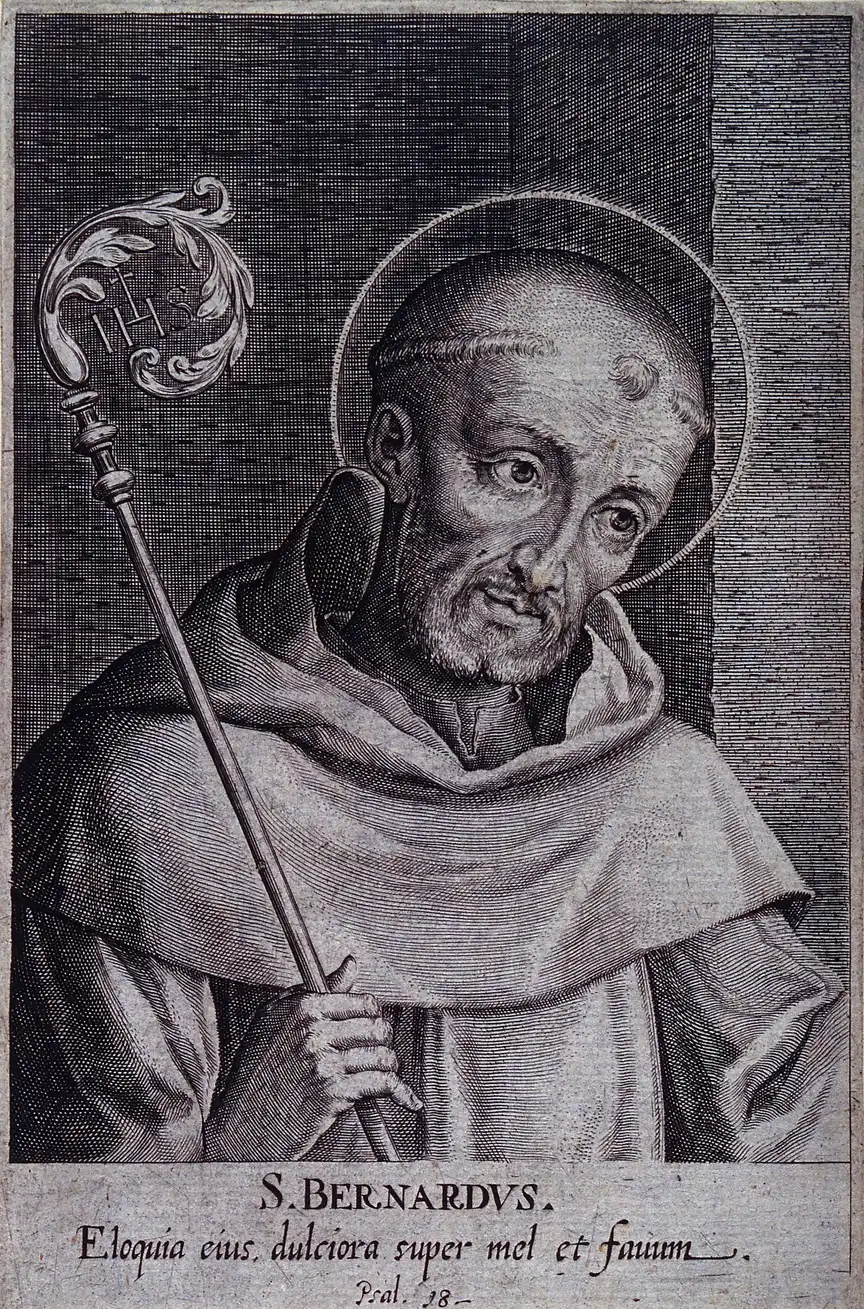
Bernard of Clairvaux
 France
Also known as: Saint Bernard of Clairvaux, Saint Bernard, St. Bernard of Clairvaux, Bernhard, Bernardus Claraevallensis
Birthday
January 1, 1090
Birth Sign
Capricorn
Birthplace
Fontaine-lès-Dijon, Burgundy
Age
Died at 63
About
Bernard of Clairvaux, born Bernard of Fontaine in 1090 at Fontaine-lès-Dijon in the Duchy of Burgundy, was a French abbot, mystic, and theologian who became one of the most influential religious figures of the 12th century. He joined the Benedictine monastery of Cîteaux in 1112, drawn by its strict observance of the Rule of Saint Benedict. Just three years later, he was sent to establish a new house, Clairvaux Abbey, which grew rapidly under his leadership and became a model for the Cistercian reform. Bernard's eloquence and spiritual authority made him a sought-after counselor for popes and kings, and his writings on theology and mysticism, including his famous sermons on the Song of Songs, earned him lasting renown. He died on August 20, 1153, and was canonized in 1174, just 21 years after his death, by Pope Alexander III. In 1830, Pope Pius VIII declared him a Doctor of the Church, a title reserved for theologians whose teachings have significantly shaped Christian thought.
Early Life & Background
Bernard was born into a noble family in the village of Fontaine-lès-Dijon within the Duchy of Burgundy. His father, Tescelin de Fontaine, served as a minor knight, while his mother, Alix, came from a wealthy lineage. As the third of five sons, Bernard displayed a deep sensitivity and intellectual promise during his youth. A pivotal moment occurred when he heard a sermon on the Song of Songs, which ignited a powerful desire for a monastic life despite his family's expectations that he pursue a secular career or an ecclesiastical office with political influence.
In 1112, at the age of 22, Bernard left home with thirty companions to join the Benedictine Abbey of Cîteaux. This decision caused a sensation and led to his own family joining him shortly after: his brother Guy, three other brothers, and eventually his father entered the monastery. This mass conversion was unprecedented and marked the beginning of the rapid expansion of the Cistercian order. The group faced harsh conditions, including cold winters and isolation, but their commitment to a stricter adherence to the Rule of Saint Benedict set them apart from other monastic communities of the time.
Career Growth
Bernard's career was defined by his leadership, theological writing, and political mediation. In 1115, at the request of Abbot Stephen Harding, he was sent to establish a new monastery in the valley of Absinthe, known as Clairvaux. Under his guidance, it became the most powerful abbey in Christendom, spawning hundreds of daughter houses across Europe. By 1128, Bernard played a crucial role at the Council of Troyes, where he helped draft the Rule of the Poor Knights of Christ, later known as the Knights Templar, providing the theological framework for a military order dedicated to protecting pilgrims.
During the Papal Schism between 1130 and 1133, Bernard threw his support behind Pope Innocent II against the antipope Anacletus II. Through his eloquent preaching and diplomatic maneuvering, he rallied European kings and bishops to Innocent's side, securing the pope's legitimacy and ending the schism. In 1146, he delivered a famous sermon at Vézelay, urging King Louis VII of France and thousands of nobles to take up the cross for the Second Crusade. His oratory was so powerful that it mobilized a massive army, though the crusade ultimately ended in failure. Throughout his final years, Bernard continued to write prolifically, producing works such as On Loving God and over 400 sermons on the Song of Songs.
Career Timeline
Public Image & Style
Bernard is portrayed as the "mellifluous doctor" of the Church, remembered for his eloquence, deep piety, and ability to bridge the gap between the cloister and the world. Modern ecclesiastical leaders view him as a model of idealism and spiritual integrity. His public image is that of a reformer who revitalized monasticism and a mystic who sought union with God, yet also a preacher who summoned Christendom to war. His writings are filled with intense, often eroticized language describing his love for God and the Virgin Mary, reflecting his unique theological perspective.
Fame & Fandom
Bernard of Clairvaux holds a commanding place in the modern consciousness of religious history, currently standing as the 88th most famous person in France and the 73rd most famous person from France according to the iFANN Global Fame Rankings. He also ranks as the 13th most famous person in Religious Leaders, a position holding steady from the previous cycle. While he does not command a pop-culture fandom with a specific moniker or viral hashtags, his enduring legacy commands a devoted following among Catholics, Cistercians, and scholars of Marian theology. His influence remains institutional and vibrant, anchored by the annual observance of his feast day on August 20, where communities gather to honor his role as a Doctor of the Church and Monastic Reformer. The Cistercian Order itself serves as the primary vehicle for this devotion, preserving his teachings through liturgical practices and continuing to thrive in fields like viticulture that trace their roots to his guidance.
Interesting Facts and Legends
Bernard is often called the "Second Founder of Mariology" because his writings on the Virgin Mary shaped Catholic devotion for centuries. He famously stated, "Mary is the way to Jesus." Folklore and hagiographies recount that Bernard would weep uncontrollably during Mass, a sign of his intense emotional connection to the divine. Unlike many of his contemporaries, he publicly condemned the violence against Jews during the Second Crusade, writing letters to bishops urging them to protect Jewish communities. He is credited with providing the spiritual and legal framework for the Knights Templar, though he never served as a member of the order himself. Historical records describe him as having a frail constitution and a pale complexion, likely due to his ascetic lifestyle and chronic illness.
Notable Quotes
“Love, and do what you will.”
“Mary is the way to Jesus.”
“The soul is made for God, and it will not rest until it rests in Him.”
“He who loves God loves his neighbor.”
Family & Personal Life
Bernard was born into a noble family; his father, Tescelin de Fontaine, was a minor knight, and his mother, Alix, came from a wealthy lineage. He was the third of five sons. His decision to join the monastery in 1112 led to a remarkable family conversion: his brother Guy, three other brothers, and eventually his father all entered the Abbey of Cîteaux. As a Cistercian monk who took vows of chastity, poverty, and obedience, Bernard did not have a spouse or children. His closest relationships were spiritual, particularly with William of Saint-Thierry, whom he considered a spiritual son and friend, and Peter the Venerable, Abbot of Cluny.
Notable Connections
Relationships & Dating History
As a Catholic monk and abbot who took vows of chastity, poverty, and obedience, Bernard of Clairvaux did not have romantic relationships, marriages, or children. His relationships were exclusively spiritual and communal. He maintained close bonds with fellow monks, including William of Saint-Thierry, whom he considered a spiritual son and friend, and Peter the Venerable, Abbot of Cluny. His writings are filled with intense, often eroticized language describing his love for God and the Virgin Mary, but these were expressions of mystical theology, not romantic affection. There is no historical record of any partner, engagement, or dating history. At the time of his death in 1153, he remained celibate and unmarried.
Death & Aftermath
Died
August 20, 1153 (aged 63)
Death Place
Abbey of Clairvaux, France
Cause of Death
natural decline due to severe stomach illness
In the final summer of 1153, Bernard of Clairvaux spent his days in the quiet solitude of the Abbey of Clairvaux. Despite suffering from severe stomach ailments that had plagued him for some time, the abbot refused medicine and substantial food, adhering to a strict regimen of prayer and penance even as his body weakened. He passed away on August 20, 1153, after receiving the last rites, with his final moments recorded by close friends like William of Saint-Thierry rather than through official medical documentation. The news of his death sent waves of profound grief through the monastic community and the wider Church, prompting immediate tributes from popes and kings who had long relied on his counsel.
A solemn funeral followed shortly after his passing at the abbey church, attended by hundreds of monks from Clairvaux and its daughter houses along with nobility and clergy. His remains were initially interred near the high altar, a place of honor reserved for founders, before being moved to a more prominent location as veneration grew and the abbey became a major pilgrimage site. Bernard's legacy accelerated rapidly after his death, leading to his canonization by Pope Alexander III on January 18, 1174, making him the first Cistercian monk to be placed on the calendar of saints.
Decades later, Pope Pius VIII declared him a Doctor of the Church in 1830, cementing his status as a foundational theologian whose works like On Loving God remain widely studied today. Although the original abbey was destroyed during the French Revolution and his relics were dispersed or lost, portions of his remains were eventually recovered and reinterred, ensuring his memory endures in liturgical commemorations and shrines dedicated to his life.
Net Worth (Estate Value)
$0
iFANN Editorial Team estimate
Bernard of Clairvaux died in 1153 and possessed no personal net worth in the modern sense. As a Cistercian monk, he took vows of poverty and owned no personal property. The Abbey of Clairvaux, which he founded, accumulated significant wealth through land grants, donations, and agricultural production, particularly viticulture, but this wealth belonged to the order, not to Bernard personally. There is no estate value to report for him individually. The iFANN Editorial Team estimates his personal financial footprint at $0, reflecting the vow of poverty he upheld throughout his life.
Awards Won (2)
Bernard was canonized by Pope Alexander III in 1174, becoming the first Cistercian monk to be placed on the calendar of saints. In 1830, Pope Pius VIII declared him a Doctor of the Church, recognizing his profound impact on Christian theology. He is the patron saint of those suffering from stomach ailments, beekeepers, and the poor.
1174 · Saint
Posthumous recognition
1830 · Theological Title
Posthumous recognition
Known For
Rule of the Poor Knights of Christ
1128 · Co-founder
Sermon at Vézelay
1146 · Preacher
On Loving God
1150 · Author
Sermons on the Song of Songs
1140 · Author
Keywords
Sources
Quick Facts
- Profession
- theologian, writer, philosopher
- Born
- January 1, 1090
- Birthplace
- Fontaine-lès-Dijon, Burgundy
- Died
- August 20, 1153
- Death Place
- Abbey of Clairvaux, France
- Gender
- Male
- Birth Sign
- Capricorn
Personal Details
- Full Name
- Bernard of Fontaine
- Children
- Education
- Cîteaux Abbey
Frequently Asked Questions
Who was Bernard of Clairvaux?
When did Bernard of Clairvaux die?
Was Bernard of Clairvaux married?
Why is Bernard of Clairvaux famous?
What title did Pope Pius VIII give Bernard?
Similar People
Join the community
fans discussing