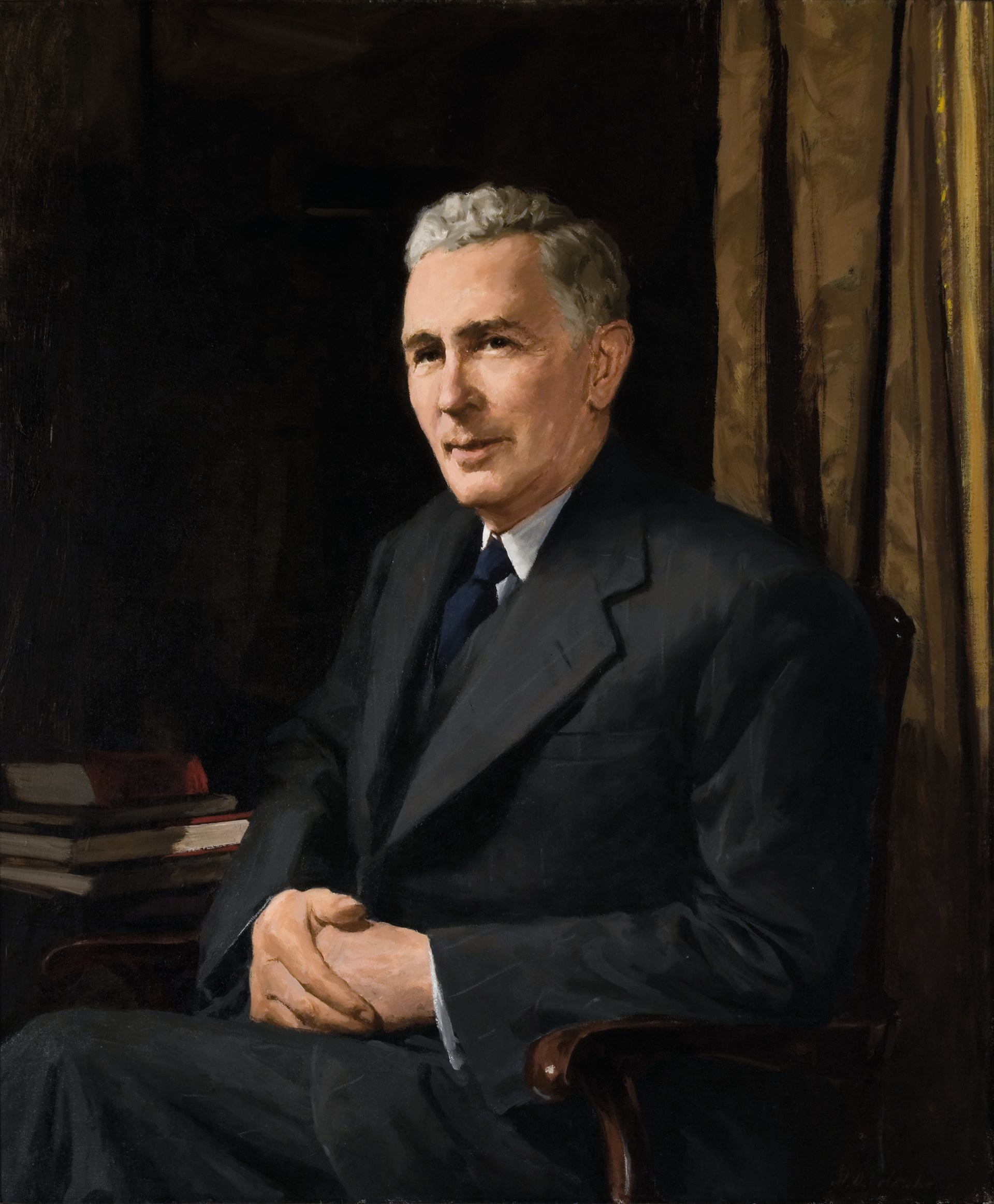
Ben Chifley
 Australia
Also known as: Joseph Benedict Chifley, The Right Honourable Ben Chifley
Birthday
September 22, 1885
Birth Sign
Virgo
Birthplace
Bathurst, New South Wales, Australia
Age
Died at 65
About
Joseph Benedict Chifley, known as Ben, was the 16th prime minister of Australia, serving from 1945 to 1949. Born on September 22, 1885, in Bathurst, New South Wales, he started his career as a locomotive engine driver for the New South Wales Government Railways, a job that grounded him in the working class he would later champion. Before entering politics, Chifley was an organizer for the Federated Union of Locomotive Employees and a director of The National Advocate. After several failed attempts, he won a seat in the House of Representatives in 1928, and in 1931 he briefly served as Minister for Defence under James Scullin before losing his seat in that year's electoral wipeout.
Chifley remained active in Labor politics, aligning with the federal leadership against the Lang Labor faction. He served on a royal commission into banking in 1935 and, in 1940, took a senior role in the Department of Munitions. That same year, he was re-elected to parliament on his third try. In 1941, he became Treasurer in John Curtin's government, and the following year he also took on the portfolio of Minister for Postwar Reconstruction, making him one of the most powerful figures in the cabinet. When Curtin died in office in 1945, Chifley won the leadership ballot against caretaker prime minister Frank Forde and became prime minister.
Chifley's government, re-elected in 1946 (the first time a Labor government had won consecutive elections), pursued an ambitious agenda of social reform and nation-building. His tenure saw the expansion of the welfare state, a surge in post-war immigration, and the creation of key institutions like the Australian National University, the Australian Security Intelligence Organisation (ASIO), and the Snowy Mountains Scheme. Some of his policies, particularly his attempt to nationalize banks, drew fierce opposition from business interests, and his government was defeated in 1949 by Robert Menzies' Liberal Party. Chifley remained Leader of the Opposition until his death on June 13, 1951, just months after the 1951 election. He is remembered for his "light on the hill" speech, a defining moment for the Labor Party, and is widely regarded as one of Australia's greatest prime ministers.
Early Life & Background
Ben Chifley was born at 29 Havannah Street, Bathurst, the eldest of three sons to Patrick Chifley, a blacksmith of Irish descent, and Mary Anne Corrigan, who had been a domestic servant at St Benedict's Convent in Queanbeyan. When he was five, his family's financial strain led his parents to send him to live with his paternal grandfather and aunt at Limekilns, a small settlement about 20 to 30 kilometres from Bathurst. There he slept on a chaff-bag bed in a four-roomed wattle-and-daub shack with an earthen floor and worked as a cowherd, potato-bagger, and general "dogsbody" on the farm. The local bush school ran only two or three days a week, yet Chifley became a voracious reader, "scouring every book he could lay his hands on" according to biographer David Day.
After his grandfather's death in 1899, Chifley returned to Bathurst and attended the Patrician Brothers' High School for two years, studying classical and practical subjects including English and mathematics. He left school in 1900 and worked as a cashier's assistant at a general store, then in a tannery, before transferring to the Bathurst railway yards. Over the next decade he worked his way up from shopboy to cleaner to fireman, studying four nights a week through the Workers' Educational Association and the Bathurst technical school. In 1914 he qualified as a first-class locomotive engine driver, the youngest in New South Wales at that time. He also became a renowned country Rugby Union footballer and a competent boxer and cricketer.
Chifley's involvement in the labour movement grew through the Locomotive Enginemen's Association, where he served as an organiser and divisional delegate. He earned a reputation for compromise, maintaining good relations with both railway management and militant union sections. In 1917 he led local participation in the general strike against American time-and-motion methods, for which he was dismissed by the NSW Government Railways. He was later reinstated but demoted from engine-driver to fireman, and his pre-1917 benefits were not restored until 1925. Observing the effect of the 1890s bank collapses on his grandfather and neighbours made banking reform a lifelong priority.
Career Growth
Chifley first won the federal seat of Bathurst in 1928, but lost it in the 1931 electoral wipeout after a brief stint as Minister for Defence under James Scullin. He aligned with the federal Labor leadership against the Lang Labor faction and served on a royal commission into banking in 1935. In 1940 he took a senior role in the Department of Munitions and was re-elected to parliament on his third attempt. The following year he became Treasurer in John Curtin's government, adding the portfolio of Minister for Postwar Reconstruction in 1942. During World War II he exercised strict control over the economy and expanded government taxing powers.
When Curtin died in office in July 1945, Chifley won the leadership ballot against caretaker prime minister Frank Forde and became Australia's 16th prime minister. His wartime tenure lasted only six weeks before Japan's surrender. His government, re-elected in 1946 (the first time a Labor government had won consecutive elections), pursued an ambitious agenda: expansion of the welfare state, a surge in post-war immigration, and creation of the Australian National University, ASIO, and the Snowy Mountains Scheme. In July 1945 he announced the release of 64,000 Army and Air Force servicemen.
His attempt to nationalize banks drew fierce opposition from business interests, and his government was defeated in 1949 by Robert Menzies' Liberal Party. Chifley remained Leader of the Opposition until his death on June 13, 1951, just months after the 1951 election.
Career Timeline
Public Image & Style
Chifley's public image is that of a "true believer" in the Labor cause, an idealist remembered for coining the term "light on the hill" to capture Labor's aspirations for a better world, yet pragmatic enough to have also coined the expression "hip pocket nerve" to denote what motivates many voters. He had both a "deep-rooted passion to improve the lives of his fellow Australians" and "a practical appreciation of the political compromises and ruses that were sometimes necessary for success." He was recalled as "a prodigious worker," "an administrator of rare quality," and "one of the soundest members of the new House." Never a great orator, he was respected as well as liked. His signature speech, delivered in 1949, articulated the "light on the hill" vision: the Labour movement's goal of "working for the betterment of mankind not only here, but anywhere we can give a helping hand." This speech remains a defining text for the Australian Labor Party.
Fame & Fandom
Ben Chifley does not command a formal fandom in the contemporary sense, nor is there an organized group of enthusiasts bearing a specific name to champion his legacy. His enduring presence rests with members of the Australian Labor Party, academic historians, and visitors to the Ben Chifley Home Museum in Bathurst, rather than a fanbase engaging in chart pushes or viral campaigns. The cultural mythology surrounding him is rooted in verified biographical facts and policy achievements, specifically his rise from a locomotive fireman to Prime Minister and his dramatic death in 1951, which solidified his status as a national icon of humility. Recent features on his preserved pipe and home reinforce this folklore of modest lifestyle, while modern political discourse frequently references his post-war budgets as a benchmark for fiscal strategy. Unlike entertainment figures whose legends involve staged moments, Chifley's narrative is one of historical continuity and moral authority within Australian politics. As of August 2026, the iFANN Global Fame Engine has evaluated this person, but they do not currently hold a placement in the published rankings. Consequently, no global or scope-based ordinal rank can be assigned at this time.
Interesting Facts and Legends
Joseph Benedict Chifley was born in 1885 in Bathurst, New South Wales, and began his career as a locomotive engine driver before entering politics. His name was suggested by the Mother Superior of St Benedict's Convent, where his mother had worked. He possessed a raspy voice that deteriorated over years of addressing outdoor public meetings in poor weather. A competent boxer and cricketer in his youth, he also served as a director of The National Advocate, a local newspaper. His portrait appears on the Australian $100 note alongside John Curtin and Sir John Monash.
Legends surrounding Chifley often focus on his humble origins, earning him the moniker "the People's Prime Minister" through his journey from railway worker to head of government. A definitive moment in his lore is his death on June 13, 1951, when he suffered a fatal heart attack in his hotel room while traveling to Sydney. This event triggered a massive state funeral attended by thousands, cementing his image as a man of service. While his attempt to nationalize banks in 1947 remains a major historical flashpoint, it resulted in a High Court defeat rather than a celebratory crowd reaction.
Notable Quotes
“I try to think of the labour movement... as having as its objective the welfare of the people... We have a great objective, the light on the hill, which we aim to reach by working for the betterment of mankind not only here, but anywhere we can give a helping hand.”
“I am the descendant of a race that fought a...”
Family & Personal Life
Chifley was the eldest of three sons born to Patrick Chifley, a native-born blacksmith of Irish descent, and Mary Anne Corrigan, who was born in County Fermanagh, Ireland. At age five he was sent to live with his paternal grandfather and aunt at Limekilns due to family financial stress. He married Elizabeth Gibson McKenzie on June 6, 1914, in a Presbyterian church in Glebe, Sydney, because Elizabeth did not want to convert to his Catholic faith and the Catholic Church opposed mixed marriages. Their parents opposed the union and did not attend the ceremony, though families were eventually reconciled. The couple had no children. Elizabeth survived Ben, who died in 1951.
Notable Connections
Relationships & Dating History
Ben Chifley married Elizabeth Gibson McKenzie on June 6, 1914. They began courting in 1912 but had known each other since childhood. Elizabeth was the daughter of George McKenzie, a more senior railways employee, and the McKenzies were Presbyterian. Elizabeth did not want to convert to Chifley's Catholic faith, and due to the Catholic Church's opposition to mixed marriages, the couple married in a Presbyterian church in Glebe, Sydney. Their parents opposed the union and did not attend the ceremony, though families were eventually reconciled. The McKenzies were relatively wealthy, and Chifley was seen as "marrying into money." The couple had no children. Elizabeth survived Ben, who died in 1951. There is no public record of any other romantic relationships. At the time of his death, Chifley was married to Elizabeth.
- MarriedElizabeth Gibson McKenzie1914 - 1951Married on June 6, 1914, in a Presbyterian church; no children.
Death & Aftermath
Died
June 13, 1951 (aged 65)
Death Place
Canberra, Australian Capital Territory, Australia
Cause of Death
Myocardial infarction
The official determination established that Joseph Benedict Chifley suffered a fatal myocardial infarction following medical observations made while he was a patient in Canberra. On the morning of June 13, 1951, the former Prime Minister and Leader of the Opposition was staying at the Hotel Kurrajong when he experienced a final cardiac episode and passed away later that day at the age of sixty-five. His health had deteriorated significantly throughout early 1951 due to heart disease, leading to an admission to the Royal Canberra Hospital in May before his brief discharge and subsequent return to the hotel where his condition proved terminal.
Public reaction to the loss was characterized by deep respect and mourning across the political spectrum, with tributes pouring in from peers and institutions who recognized his contributions to the nation's post-war reconstruction and social welfare programs. A state funeral was conducted in Canberra to honor his life and service, attended by senior members of the Australian Labor Party and government officials, after which he was cremated and his ashes were interred at the Bathurst Cemetery in his hometown of New South Wales. The immediate aftermath involved standard probate procedures for public figures of his standing. Posthumously, Ben Chifley has been honored through the establishment of the Ben Chifley Research Centre at the National Archives of Australia, which serves as a hub for historical research and education regarding his life and policies.
Several books and documentaries have been produced about him, including the ABC television docu-drama Infamous Victory: Ben Chifley's Battle for Coal, which examined his role in the 1949 coal strike. His home, Carnwath in Bathurst, has been preserved as a heritage site, offering insight into his humble origins and personal life, while his legacy endures through various halls of fame and the naming of public institutions.
Net Worth (Estate Value)
$1 Million
iFANN Editorial Team estimate
As a historical figure who died in 1951, no contemporary net worth estimates exist from celebrity-net-worth sites. Chifley was a career politician and former railway worker of modest means. His estate was not publicly reported in detail at the time of his death. He owned a modest family home in Bathurst (now the Chifley Home, heritage-listed and managed by the Bathurst Regional Council as a museum). Any ongoing estate income would derive from the management of his historical legacy, including the Chifley Home museum operations and licensing of his image for commemorative purposes by the Australian government and Labor Party. No figures for estate earnings are publicly available. Per iFANN's editorial analysis, as of 2026, the estate's value is estimated at around $1 Million, reflecting the heritage property and licensing arrangements.
Awards Won (1)
Chifley was appointed a Companion of Honour (CH) in recognition of his wartime service as Treasurer. He also held the title The Right Honourable as a Privy Counsellor. Posthumously, he has been consistently ranked among Australia's greatest prime ministers in historical surveys.
1946 · National Honour
Wartime service as Treasurer
Known For
Prime Minister of Australia
1945-1949 · 16th Prime Minister
Treasurer of Australia
1941-1945 · Treasurer
Light on the Hill speech
1949 · Speaker
Keywords
Sources
Quick Facts
- Profession
- politician, train driver
- Born
- September 22, 1885
- Birthplace
- Bathurst, New South Wales
- Died
- June 13, 1951
- Death Place
- Canberra
- Gender
- Male
- Spouse
- Elizabeth Chifley
- Birth Sign
- Virgo
Personal Details
- Full Name
- Joseph Benedict Chifley
- Spouse
- Elizabeth Chifley
- Education
- Patrician Brothers' High School, Bathurst
Frequently Asked Questions
How did Ben Chifley die?
Why is Ben Chifley on the $100 note?
What was the 'light on the hill' speech?
Was Ben Chifley married? Did he have children?
What did Ben Chifley do before politics?
Similar People
Join the community
fans discussing