 Austria
“What's astonishing is how little actual drama there is when Caroline von Beulwitz shares Friedrich Schiller, the husband of her sister, Charlotte von Lengefeld.”
Jessica Kiang
IndieWire
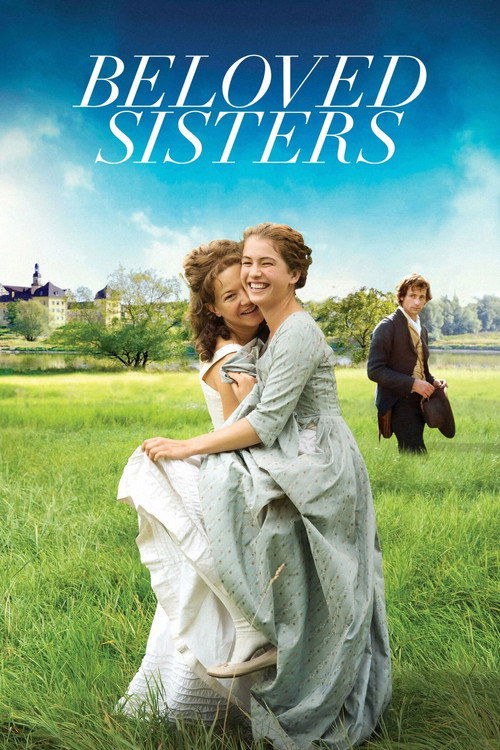
In 1787 Weimar, the von Lengefeld family faces ruin. The elder sister Caroline has entered a loveless marriage to secure the household finances. Her younger sister Charlotte is sent to train with Frau von Stein, the mistress of Johann von Goethe. There Charlotte meets Friedrich Schiller, a penniless poet already famous for "The Robbers." Their witty rapport sparks an immediate romance, but when Schiller visits the family home in Rudolstadt, he meets Caroline too. He declares, "I love you both, Caroline, Charlotte," and the three attempt an unconventional relationship that defies aristocratic codes.
The narrative unfolds through letters, capturing the literary texture of the era. Schiller's career rises as the French Revolution reshapes Europe. The sisters navigate their complex arrangement while maintaining appearances in polite society. Hannah Herzsprung plays the fiery Caroline, Florian Stetter embodies the restless poet, and Henriette Confurius portrays the steadfast Charlotte. Dominik Graf directs this three-hour German-Austrian co-production, shot by cinematographer Michael Wiesweg. The film premiered at the Berlin International Film Festival, competing for the Golden Bear.
Caroline von Lengefeld has sacrificed her own happiness by marrying the wealthy but emotionally distant Friedrich von Beulwitz. The marriage is sexless, a financial arrangement to rescue her aristocratic family from debt. Meanwhile, her younger sister Charlotte trains with Frau von Stein in Weimar, learning the rules of high society. Charlotte's life changes when she meets Friedrich Schiller through an upstairs window. He asks for directions; their temperaments align immediately. She falls deeply in love, but must persuade her mother that a penniless poet is preferable to a wealthy nobleman.
Charlotte invites Schiller to Rudolstadt. There he meets Caroline, and an immediate, intense connection forms among all three. Schiller openly declares his love for both sisters, and the trio attempts to navigate a relationship that defies social conventions. For much of the film, the conflict resides outside their bond: Schiller must extricate himself from a former mistress, he needs legitimate employment before marrying Charlotte, and Caroline must hide her affair from her often-absent husband. The sisters' deep bond proves as central as their love for Schiller, forming the emotional core of the story.
The narrative unfolds through handwritten letters, a device that conveys the literary quality of the screenplay. The film traces the trio's shared life against the backdrop of the French Revolution and the decline of European aristocracy. Schiller's career rises as he gains recognition as a public speaker and secures a university position. The sisters navigate their complex arrangement while maintaining appearances in bourgeois society. Their suppressed emotions churn beneath the surface of polite decorum, setting the stage for inevitable rupture.
Beloved Sisters Official US Release Trailer (2014) - German Drama Movie HD
Critical Consensus
Critics praised the nuanced performances and meticulous period detail of this historical romance, but many found its slow-burn pacing and lack of erotic tension disappointing given the provocative love triangle premise. Hannah Herzsprung's performance as Caroline received particular acclaim, though the film's three-hour runtime divided audiences.
“What's astonishing is how little actual drama there is when Caroline von Beulwitz shares Friedrich Schiller, the husband of her sister, Charlotte von Lengefeld.”
Jessica Kiang
IndieWire
“All three of the lead actors are terrific, Herzsprung makes an especially strong impression as the more fiery Caroline, and Graf, though no visual stylist, at least has a sharp eye for compelling period detail.”
Noel Murray
The Dissolve
“Despite its seemingly tawdry premise, the film is depressingly bereft of eroticism and the kinds of heightened emotions that would have, at the very least, given the film a melodramatic tone.”
Scott Pewenofkit
Scene-Stealers
“Hanna Herzsprung delivers a passionate performance as this free-spirited, alluring, and accomplished woman.”
Frederic and Mary Ann Brussat
Spirituality & Practice
“A fascinating visual approach that distinguishes the film apart from its period counterparts... building upon its increasingly pulpy premise to transcend the staid genre that houses it.”
John Oursler
Under the Radar Magazine
Hannah Herzsprung
Caroline von Lengefeld
Florian Stetter
Friedrich Schiller
Henriette Confurius
Charlotte von Lengefeld
Ronald Zehrfeld
Wolzogen
Claudia Messner
Madame Lengefeld
Maja Maranow
Frau von Stein
Michael Wittenborn
Knebel
Andreas Pietschmann
Friedrich von Beulwitz
Anne Schäfer
Charlotte von Kalb
Peter Schneider
Christian Gottfried Körner
Director
Dominik Graf
Writers
Dominik Graf, Michael Hild
Cinematographer
Michael Wiesweg
Producers
Grigoriy Dobrygin, Uschi Reich
Berlin International Film Festival (2014)
Golden Bear: Nominated
Academy Awards (2015)
Best Foreign Language Film (Germany's submission): Not nominated
Join the community
fans discussing