“Mr. Schumacher has made a movie that is loud, bright and brimming with energy, but it lacks the depth and atmosphere of the earlier films.”
Janet Maslin
The New York Times
Part of the Batman in film series
Series community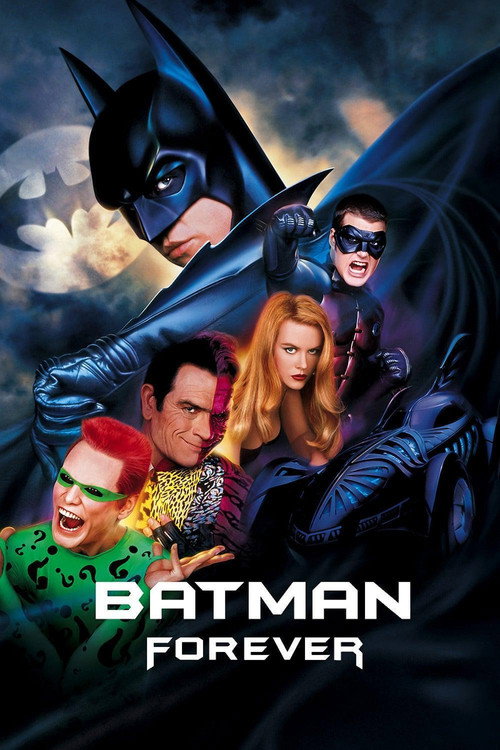
 United Kingdom
"Two villains, one hero, and a city on the edge of madness!"
Part of a Collection
Batman Collection
Joel Schumacher took the reins for Batman Forever, steering the franchise into a brighter, more neon-soaked era in 1995. Val Kilmer stepped into the cowl as Bruce Wayne, bringing a different energy to the role than his predecessor while Tommy Lee Jones and Jim Carrey delivered chaotic performances as Harvey Two-Face and the Riddler. The film paired these villains with a new sidekick, Robin, played by Chris O'Donnell, and introduced Nicole Kidman as Dr. Chase Meridian, a love interest who challenges the Dark Knight's solitary nature.
The production marked a sharp turn from the gothic shadows of Tim Burton's earlier entries toward a campy, high-energy aesthetic that embraced the comic book origins of the characters. Warner Bros. invested heavily in creating a Gotham City that felt like a living cartoon, filled with saturated colors and exaggerated architecture. This visual shift sparked immediate debate among fans who had grown accustomed to the darker tone of the previous films, yet it set the stage for a blockbuster that prioritized spectacle and star power over brooding atmosphere.
Stream
Availability and pricing can change. Confirm on the provider's site before purchasing.
In the neon-drenched streets of Gotham City during 1995, the Dark Knight patrols a landscape that feels less like a noir nightmare and more like a candy-colored fever dream. Bruce Wayne finds himself struggling under the weight of his dual identity, feeling increasingly isolated despite his wealth and status. His only constant companion remains Alfred Pennyworth, though the billionaire philanthropist keeps his emotional distance even from the loyal butler. The peace of the city shatters when Edward Nygma, a brilliant scientist working for Wayne Enterprises, unveils his Brainwave device designed to transmit thoughts directly to televisions. Bruce rejects the invention fearing its potential to invade minds, a decision that sends Nygma spiraling into madness as he adopts the persona of the Riddler.
The Riddler launches a campaign of terror that targets the city's psyche, broadcasting riddles that drive citizens to suicide if they fail to solve them. Simultaneously, District Attorney Harvey Dent faces a catastrophic accident involving an acid spill that disfigures half his face, birthing the duality of Two-Face. This new crime lord decides every outcome through the flip of a coin, turning Gotham against itself as the two villains form an uneasy alliance. Batman finds himself overwhelmed by the sheer scale of their combined chaos, realizing his solitary crusade is no longer enough to stop the madness spreading through the metropolis.
Amidst the turmoil, Batman encounters Dick Grayson, a young acrobat whose parents were murdered by the mob, a tragic parallel to Bruce's own past. Recognizing the boy's skills and shared trauma, Bruce takes him in as a ward and trains him to become his partner, Robin. The dynamic shifts dramatically as the duo begins hunting the villains together, combining Batman's tactical genius with Robin's acrobatic agility. The stakes rise further when the Riddler captures Dr. Chase Meridian, using her as leverage to force Batman into a trap. The heroes must race against time to infiltrate the villains' high-tech fortress and stop the broadcast before the entire population falls under mind control.
The final confrontation sees Batman and Robin battling through a labyrinth of gadgets and psychedelic decor within the Riddler's lair. The villains attempt to enslave Gotham using the Brainwave technology, forcing citizens to obey their every command. As the battle intensifies, the internal fractures within the villainous team begin to show. Two-Face turns on the Riddler due to his own erratic coin-flip morality, leading to a chaotic climax where the heroes must outwit their enemies not just with strength but with strategy. The resolution involves shutting down the signal and neutralizing the threats, leaving Gotham safe once again under the watchful eyes of the Dynamic Duo.
Trailer 1
Trailer 2
Critical Consensus
Critics largely viewed Batman Forever as a stylistic departure that prioritized spectacle over substance. While the film was praised for its colorful production design and the energetic performances of Jim Carrey and Tommy Lee Jones, many found the plot convoluted and the tone overly campy. It is often cited as the point where the franchise shifted from Tim Burton's dark gothic style to a more commercial, family-friendly approach.
“Mr. Schumacher has made a movie that is loud, bright and brimming with energy, but it lacks the depth and atmosphere of the earlier films.”
Janet Maslin
The New York Times
“The movie is a visual feast, but it's hard to care about the characters. It's all style, no substance.”
Roger Ebert
Chicago Sun-Times
“Schumacher's direction is competent, but the script is a mess, and the film feels like a desperate attempt to recapture the magic of the first two movies without understanding what made them special.”
Todd McCarthy
Variety
Val Kilmer
Batman / Bruce Wayne
Tommy Lee Jones
Harvey Two-Face / Harvey Dent
Jim Carrey
The Riddler / Edward Nygma
Nicole Kidman
Dr. Chase Meridian
Chris O'Donnell
Robin / Dick Grayson
Michael Gough
Alfred Pennyworth
Pat Hingle
Commissioner Gordon
Director
Joel Schumacher
Writers
Akiva Goldsman, Janet Scott Batchler, Lee Batchler, Chris Buchinsky
Composer
Elliot Goldenthal
Cinematographer
Stephen Goldblatt
Producers
Tim Burton, Peter Macgregor-Scott
Academy Awards (1996)
Best Sound Editing: Nominated
Saturn Awards (1996)
Best Fantasy Film: Won
MTV Movie Awards (1996)
Best Villain: Won
Golden Raspberry Awards (1996)
Worst Picture: Nominated
Join the community
fans discussing