 Italy
ItalyAbout
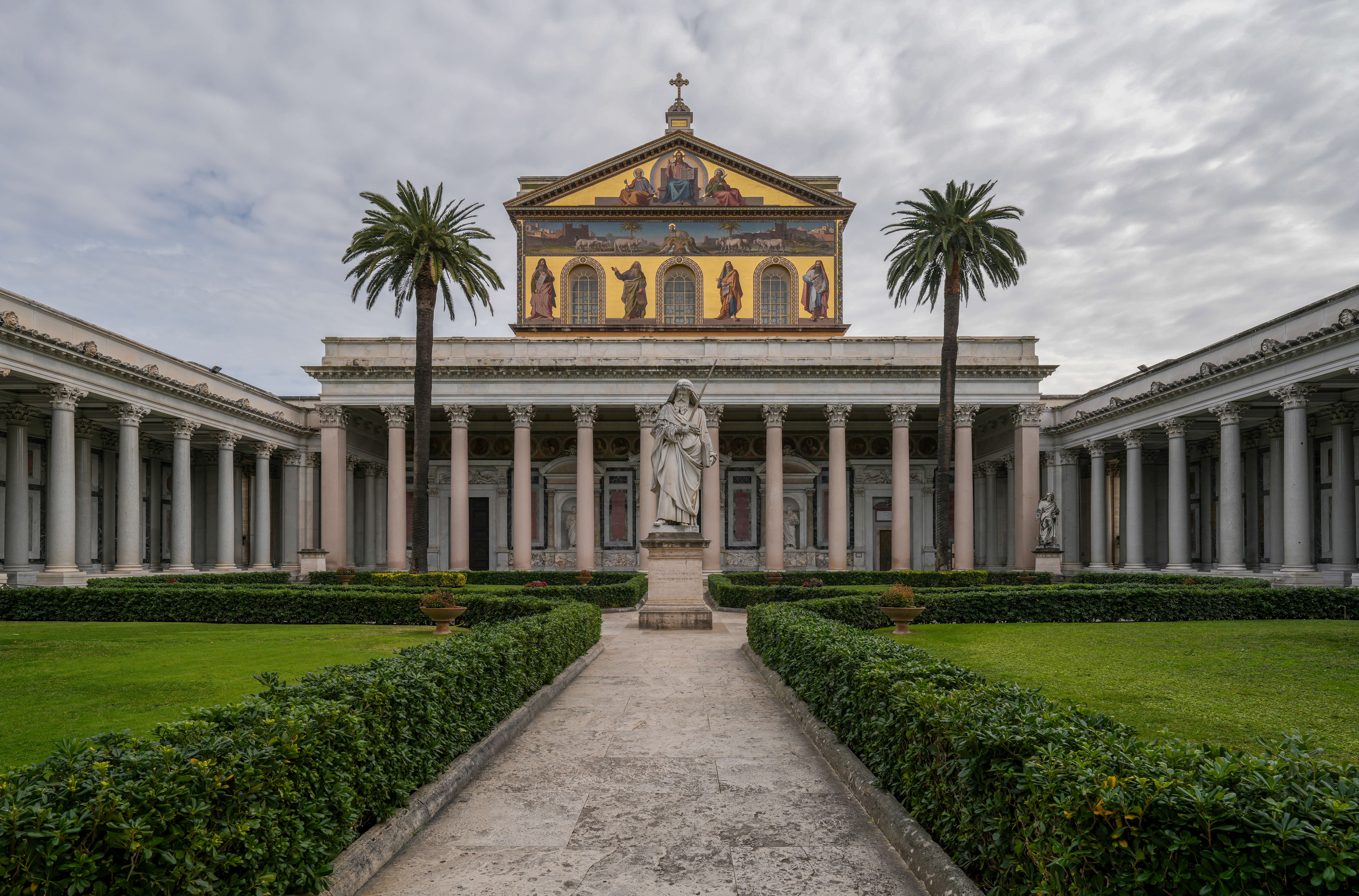
Located beyond the ancient Aurelian Walls in the Ostiense district of Rome, the Basilica of Saint Paul Outside the Walls stands as one of the four major papal basilicas and the second largest church in the city. The site marks the traditional burial place of the Apostle Paul, who was beheaded on the Via Ostiense in the first century. Although situated on Italian soil, the complex functions as an extra-territorial property of the Holy See, creating a sovereign enclave within the capital.
The current structure is a nineteenth-century reconstruction following a catastrophic fire in 1823 that consumed the medieval building. Architects preserved the original fourth-century layout by reusing salvaged granite columns from the ruins. Today, the interior features a vast nave lined with rows of these ancient columns and a ceiling covered in golden mosaics created between 1854 and 1874. The adjacent medieval cloister remains a surviving fragment of the pre-fire era, offering visitors a glimpse into the architecture of the thirteenth century.
As one of the Seven Pilgrim Churches of Rome, the basilica serves as a focal point for Catholic worship and ecumenical dialogue. A community of Benedictine monks manages daily liturgical operations and maintains the site. While film productions have utilized the dramatic interior for scenes in movies like The Da Vinci Code, the primary function of the space remains religious service rather than tourism or entertainment.
Mission
The institution exists to honor the memory of Saint Paul and to maintain the site as a living center of Catholic faith. It provides a space for prayer, sacramental celebration, and reflection for pilgrims traveling the route of the Seven Churches. The mission also encompasses the preservation of early Christian art and history, ensuring that the architectural and artistic heritage of the site remains accessible to the public.
History
Emperor Constantine the Great ordered the construction of the first basilica around 386 CE, designating the land outside the Aurelian Walls as the final resting place of the Apostle Paul. Pope Siricius consecrated the church in 390, establishing it as a major pilgrimage destination. Over the centuries, the complex expanded to include a magnificent cloister added in the thirteenth century and extensive mosaic decorations that adorned the interior walls.
A pivotal event occurred on July 15, 1823, when a fire ignited in the roof and rapidly destroyed nearly the entire structure. Only the transept and some surrounding walls remained standing. Reconstruction efforts began immediately with funding from Catholic contributions worldwide. Architects used salvaged granite columns from the ruins to replicate the original dimensions and layout. Pope Pius IX consecrated the new basilica on December 10, 1854, and the building has remained largely unchanged since that date.
In modern times, the site has hosted significant diplomatic and religious events. King Charles III and Queen Camilla attended an ecumenical service at the basilica in 2025. Cardinal James Harvey served as Archpriest during this period and closed the Holy Door in December 2025 to conclude the Jubilee year. In January 2026, a new mosaic portrait of Pope Leo XIV was unveiled within the church, continuing the tradition of updating the basilica's artistic elements.
Subdivisions
Benedictine Monastery
The residential hub for the monastic community responsible for the spiritual life and daily administration of the basilica.
Medieval Cloister
A thirteenth-century courtyard featuring intricate columns that survived the fire of 1823 and now serves as a serene gathering space.
Archaeological Site
Excavations beneath the floor reveal ancient Roman structures and the traditional tomb of the Apostle Paul.
Notable People
Pope Pius IX
Pope · 1846-1878
Consecrated the rebuilt basilica in 1854 after the fire destroyed the original structure.
Cardinal James Harvey
Archpriest · 2025-
Presided over the closing of the Holy Door in December 2025, marking the end of the Jubilee year.
Emperor Constantine
Emperor · 306-337
Commissioned the original basilica around 386 CE on the site of Paul's burial.
Milestones
386
Emperor Constantine commissions the original basilica.
390
Pope Siricius consecrates the church.
1823
A devastating fire destroys the ancient basilica.
1854
Pope Pius IX inaugurates the rebuilt basilica.
2005
Designated as an extra-territorial complex by Pope Benedict XVI.
2025
King Charles III attends an ecumenical service; Cardinal Harvey closes the Holy Door.
2026
A new mosaic portrait of Pope Leo XIV is unveiled.
Sources
Organization Info
- Founded
- 386
- Headquarters
- Rome, Italy
- Country
- Italy
- Archpriest
- Cardinal James Harvey
- Parent
- Holy See
- Type
- Religious
- Status
- Active
- Ownership
- Holy See
- Open to public
- Yes
- Entrance Fee
- Free
Official Website
basilicasanpaolo.org/en/
Join the community
fans discussing