 Italy
ItalyAbout
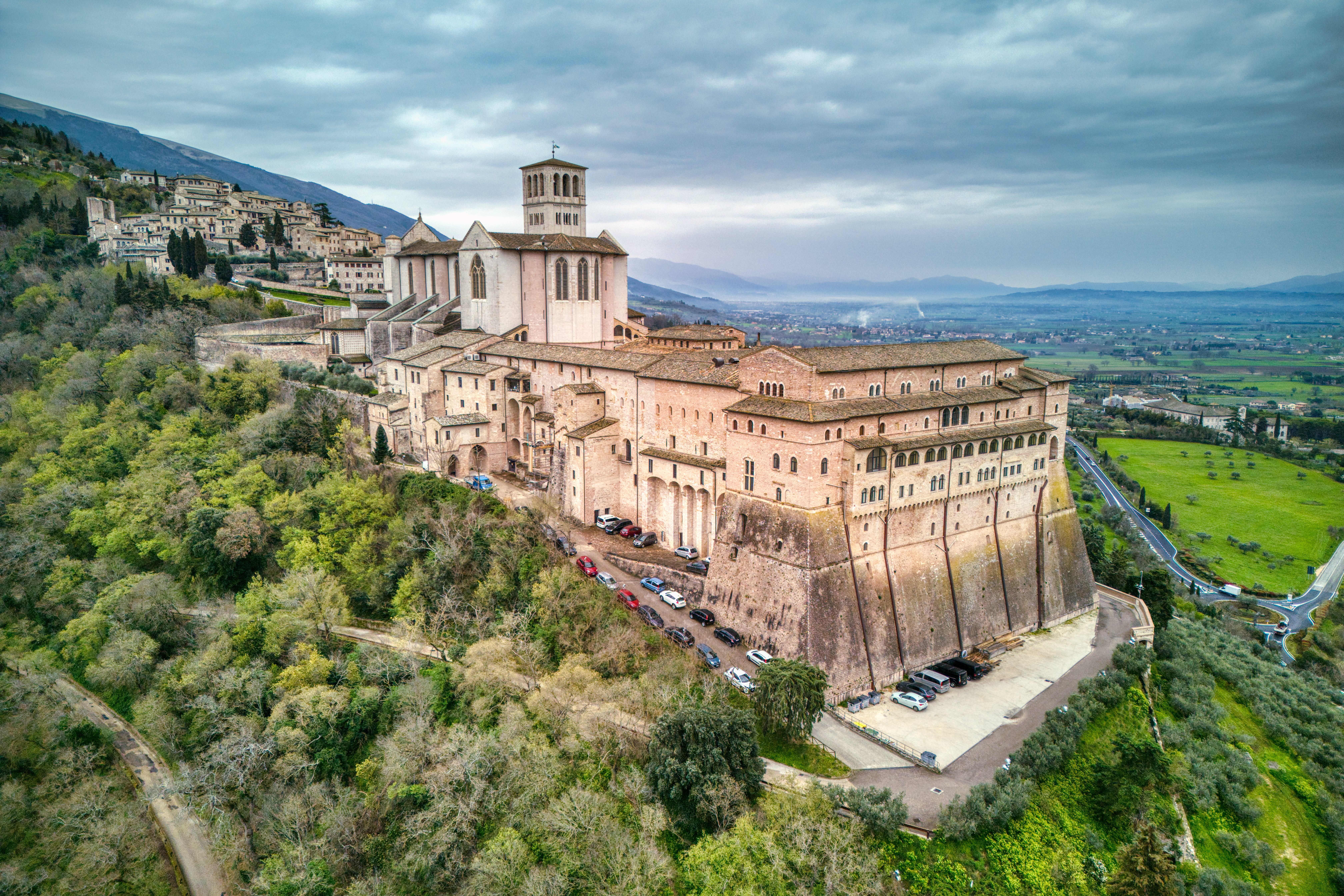
The Basilica of Saint Francis of Assisi stands on the western slope of Mount Subasio in the hilltop town of Assisi, Umbria. As the final resting place of its founder, the complex serves as the spiritual headquarters for the Order of Friars Minor Conventual. It functions simultaneously as a major pilgrimage destination, a functioning parish church, and a museum of medieval art. The site draws millions of visitors annually who come to view the frescoes or participate in religious observances.
Construction began in 1228 under the direction of Brother Elias, a close companion of the saint. The project resulted in a unique architectural duality: the Lower Basilica, completed in 1230, features Romanesque design and houses the crypt containing the saint's remains. Above it sits the Upper Basilica, finished in 1253, which utilizes Gothic arches and light to create a space for preaching and large gatherings. Both levels display significant cycles of frescoes by artists including Giotto di Bondone, Cimabue, Simone Martini, and Pietro Lorenzetti.
The structure survived a devastating earthquake in October 1997 that collapsed sections of the vaulted ceilings and damaged the artwork. A meticulous restoration effort reassembled thousands of fragments over two years. In 2000, UNESCO designated the basilica and the adjoining Sacro Convento as a World Heritage Site. Recent events in 2026 marked the 800th anniversary of Saint Francis's death with a Jubilee Year, during which his remains were exhumed and displayed to pilgrims for the first time.
Mission
The institution operates with three primary goals. First, it maintains the basilica as an active place of worship where daily liturgies, confession, and Mass are celebrated for pilgrims and locals. Second, it preserves the artistic heritage of the Italian Trecento, managing the conservation of frescoes and architecture against natural decay and human impact. Third, it upholds the Franciscan charism of peace, poverty, and care for creation through educational programs and pastoral care.
History
Saint Francis died on October 3, 1226. Two years later, Pope Gregory IX issued the bull Recolentes on April 29, 1228, commissioning a church on the Hill of Hell, a site Francis had chosen for its association with executions. Brother Elias directed the ambitious construction project immediately.
The Lower Basilica reached completion in 1230, and the saint's remains were transferred to the crypt beneath it. The Upper Basilica followed, finishing in 1253. These two structures served distinct purposes: the lower level for quiet veneration and the upper level for preaching. The Sacro Convento friary expanded the complex in the 14th century.
A severe earthquake struck the region in 1997, damaging the vaulted ceilings and frescoes. Restoration teams spent two years reassembling thousands of fragments. In 2000, UNESCO recognized the site as a World Heritage Site. The year 2026 marked the 800th anniversary of the saint's death, featuring the first public display of his remains from February 22 to March 22.
Subdivisions
Lower Basilica
Completed in 1230, this Romanesque church contains the crypt where Saint Francis rests. Its dark interior features frescoes by Cimabue, Simone Martini, and Pietro Lorenzetti.
Upper Basilica
Finished in 1253, this Gothic-style church was built above the lower level for preaching. It is famous for the extensive fresco cycle depicting the life of Saint Francis by Giotto and his workshop.
Sacro Convento
The friary added in the 14th century, serving as the residence for the Franciscan community. It includes a museum displaying religious artifacts and a library holding medieval manuscripts.
Notable People
Saint Francis of Assisi
Patron saint and founder · 1181–1226
His remains rest in the crypt; his life inspired the construction of the basilica.
Brother Elias
Director of construction · 1228–1253
Oversaw the building of the entire complex.
Pope Gregory IX
Commissioner · 1228
Issued the papal bull Recolentes authorizing the church.
Giotto di Bondone
Artist · c. 1296–1304
Painted the main fresco cycle in the Upper Basilica.
Cimabue
Artist · c. 1277–1290
Created frescoes in both the upper and lower basilicas.
Simone Martini
Artist · c. 1317–1320
Painted the Saint Martin fresco in the Lower Basilica.
Pietro Lorenzetti
Artist · c. 1310–1329
Contributed Passion scenes to the Lower Basilica.
Milestones
1226
Saint Francis dies on October 3.
1228
Pope Gregory IX issues the bull Recolentes and construction begins.
1230
Lower Basilica is completed and Saint Francis's remains are transferred to the crypt.
1253
Upper Basilica is completed.
14th century
Sacro Convento friary is added.
1997
Earthquake damages the basilica; restoration begins.
2000
Basilica and other Franciscan sites in Assisi are declared a UNESCO World Heritage Site.
2026
Jubilee Year celebrated; Saint Francis's remains are publicly displayed for the first time, drawing over 370,000 pilgrims.
Sources
Organization Info
- Founded
- 1228
- Headquarters
- Assisi, Umbria, Italy
- Country
- Italy
- Type
- Religious
Official Website
www.sanfrancescoassisi.org
Join the community
fans discussing