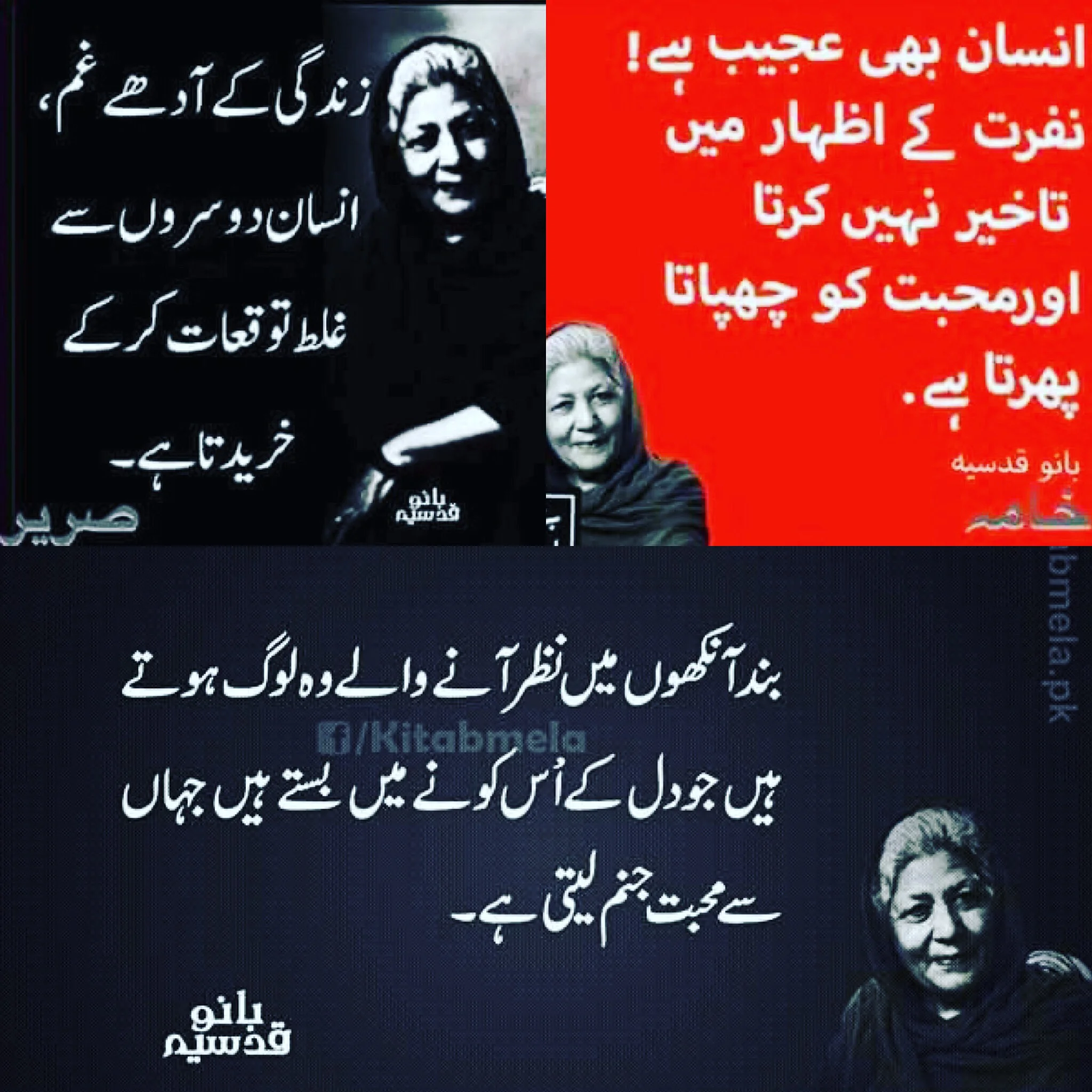
Bano Qudsia
 Pakistan
Also known as: Bano Aapa, Bano Fatima Qudsia
Birthday
November 28, 1928
Birth Sign
Sagittarius
Birthplace
Firozpur, British India (now Punjab, Pakistan)
Age
Died at 88
About
Bano Qudsia was a towering figure in Pakistani and Urdu literature, celebrated as a novelist, playwright, spiritualist, and intellectual giant. Born on November 28, 1928, in Firozpur, she grew up in a region deeply affected by religious and political shifts, an experience that profoundly influenced her writing. Her work explored human psychology, morality, spirituality, and the social complexities of the subcontinent, particularly in the aftermath of the Partition. She wrote in both Urdu and Punjabi, leaving behind a rich legacy of novels, short stories, and plays. Her novel Raja Gidh remains her most celebrated work, a deep exploration of love, morality, and human psychology. She also crafted the classic play Aadhi Baat, which has been praised for its nuanced storytelling. Qudsia's contributions to television and stage were immense, and she was a regular presence in literary circles until her death in Lahore on February 4, 2017.
Early Life & Background
Bano Fatima Qudsia was born into a family that valued education and culture during a time when British India was still intact. Her childhood in Firozpur exposed her to the vibrant cultural tapestry of Punjab, but it was also marked by the looming shadow of religious division that would soon tear the region apart. When the Partition of 1947 occurred, her family migrated to Pakistan, a displacement that left a permanent mark on her worldview and later became a central theme in her fiction. This trauma of separation and the struggle of rebuilding lives in a new nation fueled her early observations of human resilience and loss.
She pursued her education with distinction, earning a Master's degree in English Literature from the University of the Punjab. Her academic background provided a strong foundation for her literary career, allowing her to blend Western literary techniques with traditional South Asian storytelling. Before gaining fame, she worked as a teacher and editor, honing her skills in language and narrative structure. These early roles allowed her to understand the nuances of language and the power of storytelling in shaping public discourse. Her early interests lay in poetry and short stories, which eventually evolved into her renowned novels and plays. She began writing seriously in the late 1950s, submitting her work to various literary journals and slowly building a reputation for her sharp insights into the human condition.
Career Growth
Bano Qudsia's career spanned over six decades, during which she produced a vast body of work that remains influential in Urdu literature. Her breakthrough came with the publication of her first novel, Aadhi Baat (Half-Talk) in 1959, which was later adapted into a highly successful television drama. However, her most celebrated work is undoubtedly Raja Gidh (The Vulture King), published in 1976. This novel is widely regarded as a masterpiece of Urdu fiction, exploring themes of power, corruption, love, and the human condition through a complex allegory.
Her career milestones include the publication of Aadhi Baat in 1959, establishing her as a serious writer. Throughout the 1960s and 1970s, she wrote numerous short stories and plays, many of which were adapted for television and stage. The release of Raja Gidh in 1976 solidified her reputation as a leading voice in Urdu literature. In the 1980s and 1990s, she continued to write novels, essays, and plays, often addressing contemporary social issues and spiritual themes. By the 2000s, she remained active in literary circles, contributing to magazines and participating in public discussions on literature and culture. Qudsia's impact on the industry was immense. She was one of the few female writers in Pakistan who achieved widespread acclaim for her literary prowess, breaking gender barriers in a male-dominated field. Her works were frequently adapted for television, bringing her stories to a broader audience. She also wrote for the radio and stage, further expanding her reach.
Career Timeline
Public Image & Style
Bano Qudsia was perceived as a dignified intellectual and an elder stateswoman of letters. Media portrayals emphasized her wisdom, spiritual depth, and commitment to social justice. She rarely engaged in self-promotion, preferring to let her work speak for itself. Her public persona was defined by a quiet strength and a profound understanding of human nature. She was respected not just for her literary achievements but for her moral compass and her ability to navigate complex social issues with grace. Her style was simple and unpretentious, reflecting her belief in the power of ideas over material wealth. She was a beloved figure in Pakistani society, known for her kindness and her willingness to engage with young writers and students.
Fame & Fandom
Bano Qudsia commanded a global audience defined by intellectual reverence rather than frenzied adoration. Her influence spanned decades, anchoring Urdu literature with works that explored the spiritual and moral complexities of the subcontinent. Despite this enduring legacy, iFANN's Global Fame Engine evaluated her status in September 2026 and found she currently holds no placement in the published rankings, including the Global Top 1,000 or any Top-100 scope list. She is not ranked among the world's most famous figures at this time. The fanbase has no formal name; there are no organized clubs, fan-funded campaigns, or documented rituals associated with her memory. While Google honored her 92nd birthday with a digital tribute in 2020, the public engagement remained a moment of national mourning and literary appreciation rather than an active fandom structure. Her relationship with the world was mediated entirely through her novels, plays, and essays, which continue to be studied as foundational texts. Unlike modern celebrities who cultivate specific fan identities, Qudsia was revered as an elder stateswoman of letters whose authority stemmed from her writing. The absence of a named fandom reflects the nature of her legacy: sustained by academic study and cultural respect rather than the viral mechanics of contemporary celebrity culture.
Interesting Facts and Legends
Bano Qudsia was affectionately known as "Bano Aapa" across Pakistan, a title reflecting the deep respect and familial warmth her readers felt for her. One of the most retold stories involving her comes from former cricket captain Ramiz Raja, who shared a personal recollection of receiving guidance from her on life and literature, highlighting her role as a mentor beyond her written works. Another iconic moment was the adaptation of her play Aadhi Baat into a television drama in the 1970s, which became a cultural phenomenon and sparked nationwide discussions about women's roles in society. Her novel Raja Gidh was initially banned in some regions due to its controversial themes but later gained universal acclaim. She was known for her humility and avoided self-promotion, preferring to let her work speak for itself. A 2025 article in Dawn cited her perspective on choosing reality over fantasy in novel writing, confirming her voice remains a benchmark for contemporary authors.
Notable Quotes
“Reality is more fascinating than fantasy.”
“The inner vultures are more dangerous than the outer ones.”
Family & Personal Life
Bano Qudsia was married to Ashfaq Ahmad, a prominent Pakistani writer, journalist, and politician. The couple met during their student days at the University of the Punjab. Their marriage lasted until Ashfaq Ahmad's death in 1997. They had no children together. Ashfaq Ahmad was a key figure in Pakistan's literary and political landscape, and their partnership was both personal and professional, with mutual support in their respective careers. Bano Qudsia lived in Lahore for most of her adult life, maintaining a home that was a hub for intellectuals and writers. She was known to be close to her extended family and often spoke fondly of her roots in Firozpur. Her relationship with her husband was a cornerstone of her life, providing a stable environment for her prolific writing career.
Notable Connections
Ashfaq Ahmad, Ramiz Raja, Uzma Gillani
Relationships & Dating History
Bano Qudsia was married to Ashfaq Ahmad, a prominent Pakistani writer, journalist, and politician. The couple met during their student days at the University of the Punjab. Their marriage lasted until Ashfaq Ahmad's death in 1997. There are no publicly documented romantic relationships prior to her marriage to Ashfaq Ahmad, and sources do not indicate any other marriages or long-term partnerships. Ashfaq Ahmad was a key figure in Pakistan's literary and political landscape, and their partnership was both personal and professional, with mutual support in their respective careers. As of her death in 2017, Bano Qudsia was widowed. There is no evidence of any subsequent relationships or dating history post-1997. Their union was a significant part of her life, providing a stable environment for her prolific writing career.
- MarriedAshfaq Ahmad1950 - 1997Met at university; he died in 1997. No children.
Death & Aftermath
Died
February 4, 2017 (aged 88)
Death Place
Lahore, Pakistan
Cause of Death
Heart-related complications
Bano Qudsia spent her final days in a Lahore hospital, where cardiac complications steadily worsened over several days. The celebrated writer and playwright passed away on Saturday, February 4, 2017, at the age of 88 following this period of declining health. Tributes flooded South Asia immediately, with The Express Tribune and Dawn hailing her as a literary giant on February 5. Google later honored her legacy with a Doodle on what would have been her 92nd birthday in November 2020, while platforms like Rekhta saw renewed interest in her bibliography. A large gathering of mourners, including fellow writers and intellectuals, attended her funeral at the Model Town graveyard in Lahore on Monday, February 6. The burial adhered to Islamic traditions two days after her passing, marking the end of a life that shaped Urdu literature through works like Raja Gidh and Aadhi Baat. Annual retrospectives continue to appear from institutions such as The Nation, ensuring her contributions remain visible to new generations.
Net Worth (Estate Value)
$0
iFANN Editorial Team estimate
As Bano Qudsia passed away in 2017, there is no current net worth estimate for 2026. Posthumous earnings from her estate likely continue through book sales, royalties, and adaptations of her works. However, specific financial figures regarding her estate value or ongoing revenue streams are not publicly disclosed. Her legacy is measured more in cultural impact than financial wealth. The iFANN Editorial Team notes that while her estate generates income, the exact valuation remains private. Her works continue to be reprinted and studied, ensuring her literary contributions remain relevant. The financial trajectory of her estate is managed by her family, though details are not made public. Her primary contribution was to the cultural and intellectual landscape of Pakistan, rather than to the accumulation of personal wealth.
Awards Won (2)
Bano Qudsia received numerous national distinctions in Pakistan for her contributions to literature. She was awarded the Sitara-e-Imtiaz, one of Pakistan's highest civilian awards, for her literary achievements. She also received lifetime achievement awards from various literary institutions in Pakistan. Her works are frequently cited in academic circles and literary critiques as foundational texts in Urdu literature. While she did not receive international awards such as the Nobel Prize or Booker Award, her impact on South Asian literature is undeniable.
1980 · Literature
Lifetime Achievement
1990 · Literature
Urdu Literature
Known For
Raja Gidh
1976 · Novel
Aadhi Baat
1959 · Novel
Aadhi Baat
1970 · TV Drama Adaptation
Keywords
Sources
Quick Facts
- Profession
- writer, novelist, playwright
- Born
- November 28, 1928
- Birthplace
- Firozpur
- Died
- February 4, 2017
- Death Place
- Lahore
- Gender
- Female
- Spouse
- Ashfaq Ahmad
- Birth Sign
- Sagittarius
Personal Details
- Full Name
- Bano Fatima Qudsia
- Spouse
- Ashfaq Ahmad
- Children
- Education
- Master's degree in English Literature from the University of the Punjab
Filmography
3
Total
0
Film
3
TV
Frequently Asked Questions
Who was Bano Qudsia?
When did Bano Qudsia die?
What was Bano Qudsia's most famous work?
Was Bano Qudsia married?
Did Bano Qudsia win any international awards?
Similar People
Join the community
fans discussing