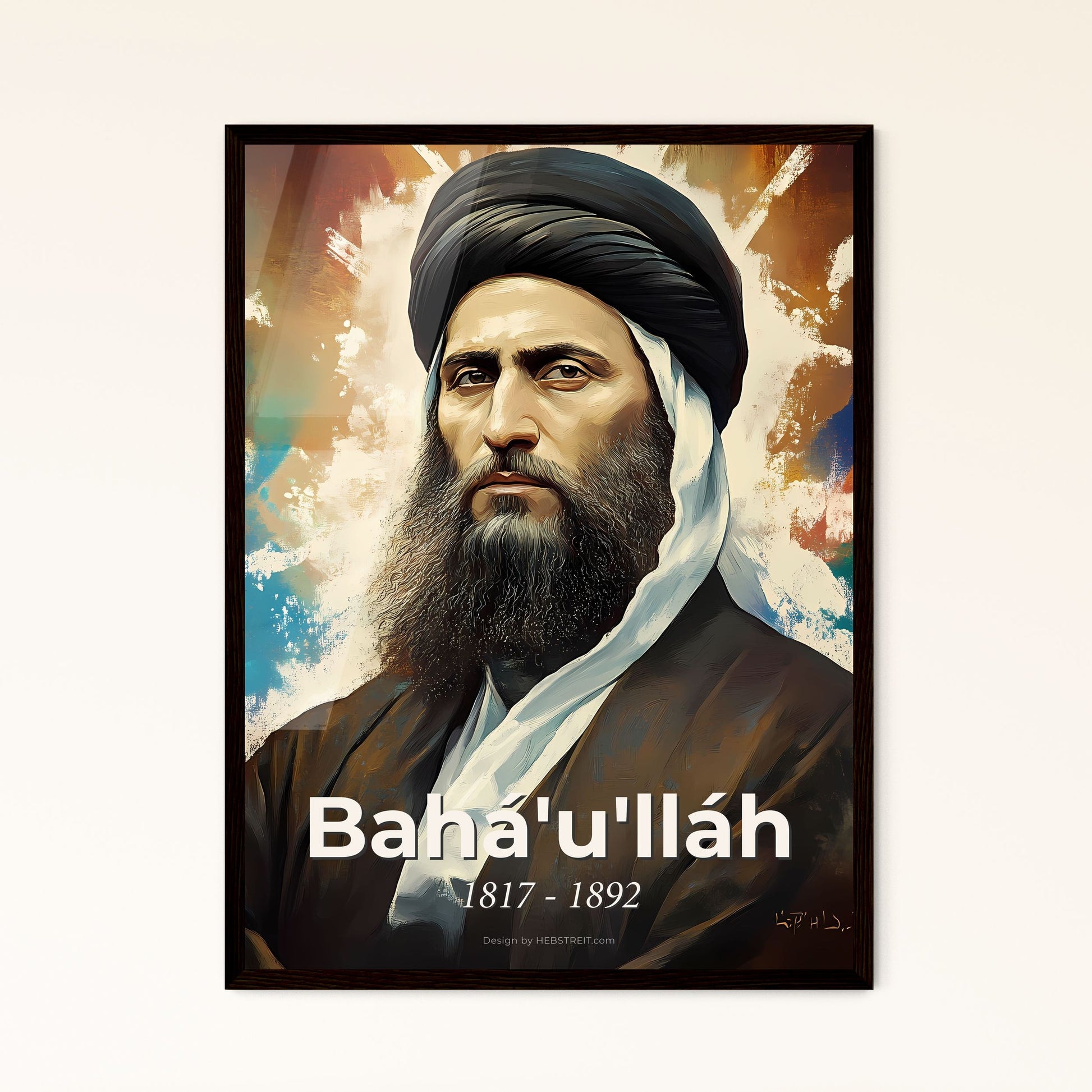
Baháʼu'lláh
 Iran
IranAlso known as: Mírzá Ḥusayn-ʻAlí Núrí, Baháʼu'lláh, The Blessed Beauty
Birthday
November 12, 1817
Birth Sign
Scorpio
Birthplace
Tehran, Persia (now Iran)
Age
Died at 74
About
Baháʼu'lláh, born Mírzá Ḥusayn-ʻAlí Núrí in 1817, was the founder of the Baháʼí Faith, a global religion with 5 to 8 million adherents. He is revered by Baháʼís as the latest Manifestation of God, a messenger who brings divine guidance for the modern age. His writings, numbering over 1,500 works, form the sacred scripture of the Baháʼí Faith and have been translated into hundreds of languages. Central to his message is the unity of humanity, the harmony of science and religion, and the establishment of a just world civilization. Today, the Baháʼí community is active worldwide, working on social and economic development projects, interfaith dialogue, and promoting peace. Baháʼu'lláh's shrine near Acre, Israel, is a pilgrimage site and the holiest place for Baháʼís.
Early Life & Background
Baháʼu'lláh was born into a prominent aristocratic family in Tehran. His father, Mírzá ʻAbbás Núrí, was a vizier to the Shah, giving the family considerable wealth and influence. From a young age, Baháʼu'lláh showed a remarkable compassion for the poor and a deep spiritual inclination. He refused the traditional education offered to noble children, preferring to study on his own, yet he became well-versed in Persian and Arabic literature, philosophy, and Islamic mysticism.
At age 22, his father died, and the government offered him a high-ranking ministerial post. He declined, choosing instead to manage the family estates and dedicate himself to charitable work. He became known for his generosity, often giving away money and food to those in need. In 1844, at 27, he encountered the Bábí movement, a reformist religious movement that proclaimed the imminent arrival of a new divine messenger. Baháʼu'lláh embraced the Báb's teachings and quickly became a prominent leader, using his wealth to protect and support fellow Bábís. This drew the attention of the authorities, and after the Báb's execution in 1850, Baháʼu'lláh was arrested and imprisoned in Tehran's notorious Síyáh-Chál dungeon. It was there, in chains and darkness, that he experienced the first intimations of his own divine mission.
Career Growth
The turning point came in 1853 when Baháʼu'lláh was released from the Síyáh-Chál and exiled to Baghdad. Over the next decade, he led the Bábí community, which was in disarray after the Báb's death. In 1863, during a garden retreat near Baghdad, he publicly declared to his companions that he was the one promised by the Báb. This declaration, known as the Ridván period, marks the formal beginning of the Baháʼí Faith.
Ottoman and Persian authorities, alarmed by his growing influence, exiled him to Constantinople (Istanbul), then to Edirne, and finally in 1868 to the penal colony of Acre in Ottoman Palestine. Despite harsh imprisonment and multiple attempts on his life, Baháʼu'lláh continued to write prolifically. He authored the Kitáb-i-Aqdas, his book of laws, and the Kitáb-i-Íqán, a key theological work. In Acre, he received visitors and wrote letters to rulers of the world, including Queen Victoria and Napoleon III, calling for disarmament and collective security. His later years were spent in relative freedom in the mansion of Bahjí, where he died in 1892.
Career Timeline
Public Image & Style
For Baháʼís, Baháʼu'lláh is the manifestation of God for this age, a figure of supreme spiritual authority and compassion. His image is one of a loving father and a fearless reformer who endured immense suffering for humanity's sake. He is often depicted in Baháʼí literature as the 'Blessed Beauty,' a title reflecting his perceived spiritual radiance. Outside the faith, he is recognized as a seminal religious leader who introduced progressive social principles, such as gender equality and universal education, long before they became mainstream. Historians and scholars study his writings for their literary and philosophical depth. The Baháʼí community, diverse and global, is united in reverence for him, celebrating his life and teachings through prayer, study, and service. There is no fandom in the secular sense, but a devoted global community that numbers millions.
Fame & Fandom
The community surrounding Baháʼu'lláh operates not as a fandom in the modern pop-culture sense, but as a global religious movement with deep historical roots and structured spiritual practices. His followers, known simply as Baháʼís, do not engage in fan campaigns, chart pushes, or viral social media rituals typical of celebrity culture. Instead, their devotion is expressed through prayer, study circles, and humanitarian projects focused on social cohesion and unity. While the faith has attracted attention from public figures like Justin Baldoni and Blake Lively, this interest stems from personal biography rather than organized fan efforts centered on the founder himself. There are no unofficial names for his fanbase, nor are there any recorded instances of crowds fainting at his appearances or streets shutting down for his visits, as he lived and died over a century ago without the infrastructure of modern stardom. The legends that define his legacy are theological narratives of exile and persecution, such as his declaration as the Promised One and his journey through prisons in Baghdad, Constantinople, Adrianople, and Acre, which remain solemn historical events rather than viral internet stories. These narratives are commemorated annually during religious observances like the Ascension of Baháʼu'lláh and the Most Great Festival, marking dates of profound spiritual significance for millions worldwide. Despite his immense influence across continents, iFANN's Global Fame Engine has evaluated this person, but they do not currently hold a placement in the published rankings (Global Top 1,000 or a Top-100 scope list). This assessment reflects the unique nature of his fame, which transcends traditional metrics of media consumption and search volume.
Interesting Facts and Legends
Born Mírzá Ḥusayn-ʻAlí Núrí in 1817, Baháʼu'lláh carried the honorific 'Mírzá' to denote his noble lineage. Contemporary descriptions often highlight his striking physical presence, noting piercing eyes and a dignified bearing that commanded respect despite his humble attire during exile. He composed his vast corpus of writings using a reed pen and ink, with manuscripts now preserved in archives globally. One of his most revered works, the Hidden Words, contains short aphorisms he claimed were dictated by God. Although he never met the Báb in person, the two maintained correspondence throughout their lives. Baháʼu'lláh endured imprisonment for a total of 40 years across various locations, a period defined by his suffering for the sake of humanity. A defining legend within the Baháʼí tradition recounts his declaration of being the 'Promised One,' a claim that led to his arrest and multiple exiles from Persia to the Ottoman Empire. Another enduring story focuses on his final days at the Mansion of Bahjí in Acre, where he passed away and where his shrine now stands as a place of pilgrimage. These events are not merely folklore but are treated as verified historical facts that shaped the trajectory of the faith he founded.
Notable Quotes
“The earth is but one country, and mankind its citizens.”
“My purpose is none other than the education of all men.”
“The well-being of mankind, in its ultimately spiritual as well as material aspects, is the object of the Divine Unity.”
“Let your vision be world-embracing, rather than confined to your own self.”
Family & Personal Life
Baháʼu'lláh married three wives, as was customary in 19th-century Persia. His first and principal wife was Ásíyih Khánum, a noblewoman known for her devotion and strength. She accompanied him through all his exiles and is considered a model of steadfastness. They had seven children, though only three survived to adulthood: ʻAbdu'l-Bahá, who later led the Baháʼí Faith; Bahíyyih Khánum, a prominent figure; and Mírzá Mihdí, who died in an accident at age 22. Baháʼu'lláh also married Fatimih Khánum and Gawhar Khánum, with whom he had additional children. The family endured tremendous hardship, including the loss of property, separation, and the death of Mírzá Mihdí, who fell through a skylight while in prayer. Baháʼu'lláh's household in Acre included several of his children and grandchildren, creating a close-knit community that formed the nucleus of the early Baháʼí administration.
Notable Connections
Baháʼu'lláh's mission was heralded by the Báb, who founded the Bábí movement. After Baháʼu'lláh's death, his son ʻAbdu'l-Bahá became the authorized interpreter of his writings and led the Baháʼí community. His wife Ásíyih Khánum is revered as a model of faithfulness. Other key figures include his daughter Bahíyyih Khánum and his son Mírzá Mihdí.
Relationships & Dating History
Baháʼu'lláh married his first wife, Ásíyih Khánum, around 1835. She was the daughter of a nobleman and remained his principal companion throughout his life. They had seven children, with three surviving infancy. Around 1849, he married Fatimih Khánum, and later Gawhar Khánum. All three wives accompanied him during his exiles. Ásíyih Khánum died in 1886, and Baháʼu'lláh mourned her deeply. His marriages were in accordance with the customs of the time, and his family life was marked by devotion and shared hardship.
- MarriedÁsíyih Khánum1835 - 1886Principal wife, mother of ʻAbdu'l-Bahá and Bahíyyih Khánum.
- MarriedFatimih Khánum1849 - 1892Second wife, known as Mahd-i-ʻUlyá.
- MarriedGawhar Khánum1849 - 1892Third wife.
Death & Aftermath
Died
May 29, 1892 (aged 74)
Death Place
Akká, Ottoman Empire (present-day Israel)
Cause of Death
Prolonged illness and fever
Baháʼu'lláh passed away on the evening of May 29, 1892, in the Mansion of Bahjí just outside Akká, bringing an end to a life defined by exile and spiritual revelation. Contemporary accounts describe his final months as marked by severe illness, extreme weakness, and fever, leaving him bedridden in seclusion attended only by family and close companions before he died peacefully after praying and dictating his final writings. Upon his death, the news spread rapidly among Baháʼís globally, with immediate tributes delivered by his son ʻAbdu'l-Bahá, who succeeded him as the leader of the faith and honored his father's teachings. The funeral was a private affair held shortly after his death, where his body was wrapped in a shroud and buried in a simple grave within the garden of the mansion according to his own instructions.
While the location of the grave remains inaccessible to non-Baháʼís due to regional sensitivities, the site became the focal point of pilgrimage and the holiest place in the religion. Following his death, his extensive writings including the Kitáb-i-Aqdas and Gleanings were compiled and translated for global distribution, while ʻAbdu'l-Bahá assumed leadership to guide the growing community. Today, May 29 is observed worldwide as the Ascension of Baháʼu'lláh, a holy day marked by prayer and reflection that continues to anchor the Baháʼí calendar.
Net Worth (Estate Value)
Not Publicly Available
iFANN Editorial Team estimate
As a 19th-century religious leader rather than a commercial figure, Baháʼu'lláh never accumulated personal wealth in the modern sense. Born into an aristocratic family with significant property, he saw those assets confiscated by the state during his long exile and imprisonment. The iFANN Editorial Team's research traces the financial reality of his life to this total loss of material standing, noting that he lived the remainder of his days relying on the support of followers and the charity of others. Today, the institutions associated with his legacy, including the Shrine of Baháʼu'lláh, are maintained through voluntary contributions from the global Baháʼí community rather than any estate held by the founder himself.
Awards & Accolades
View 2 records, honours and achievementsKnown For
Founding the Baháʼí Faith
1863 · Founder and Manifestation of God
Kitáb-i-Aqdas
1873 · Author
Hidden Words
1858 · Author
Kitáb-i-Íqán
1862 · Author
Keywords
Quick Facts
- Profession
- writer, poet, religious leader
- Born
- +1817-11-12
- Birthplace
- Tehran, Persia
- Died
- +1892-05-29
- Death Place
- Acre, Ottoman Palestine
- Gender
- Male
- Spouse
- Ásíyih Khánum, Fatimih Khánum, Gawhar Khanum
- Birth Sign
- Scorpio
Personal Details
- Full Name
- Mírzá Ḥusayn-ʻAlí Núrí
- Spouse
- Ásíyih Khánum, Fatimih Khánum, Gawhar Khanum
- Children
- Several, including ʻAbdu'l-Bahá, Bahíyyih Khánum, and Mírzá Mihdí
Frequently Asked Questions
Who was Baháʼu'lláh and what did he do?
When and where was Baháʼu'lláh born?
What are the main teachings of Baháʼu'lláh?
What is Baháʼu'lláh's most important book?
Where is Baháʼu'lláh buried?
Similar People
Join the community
fans discussing