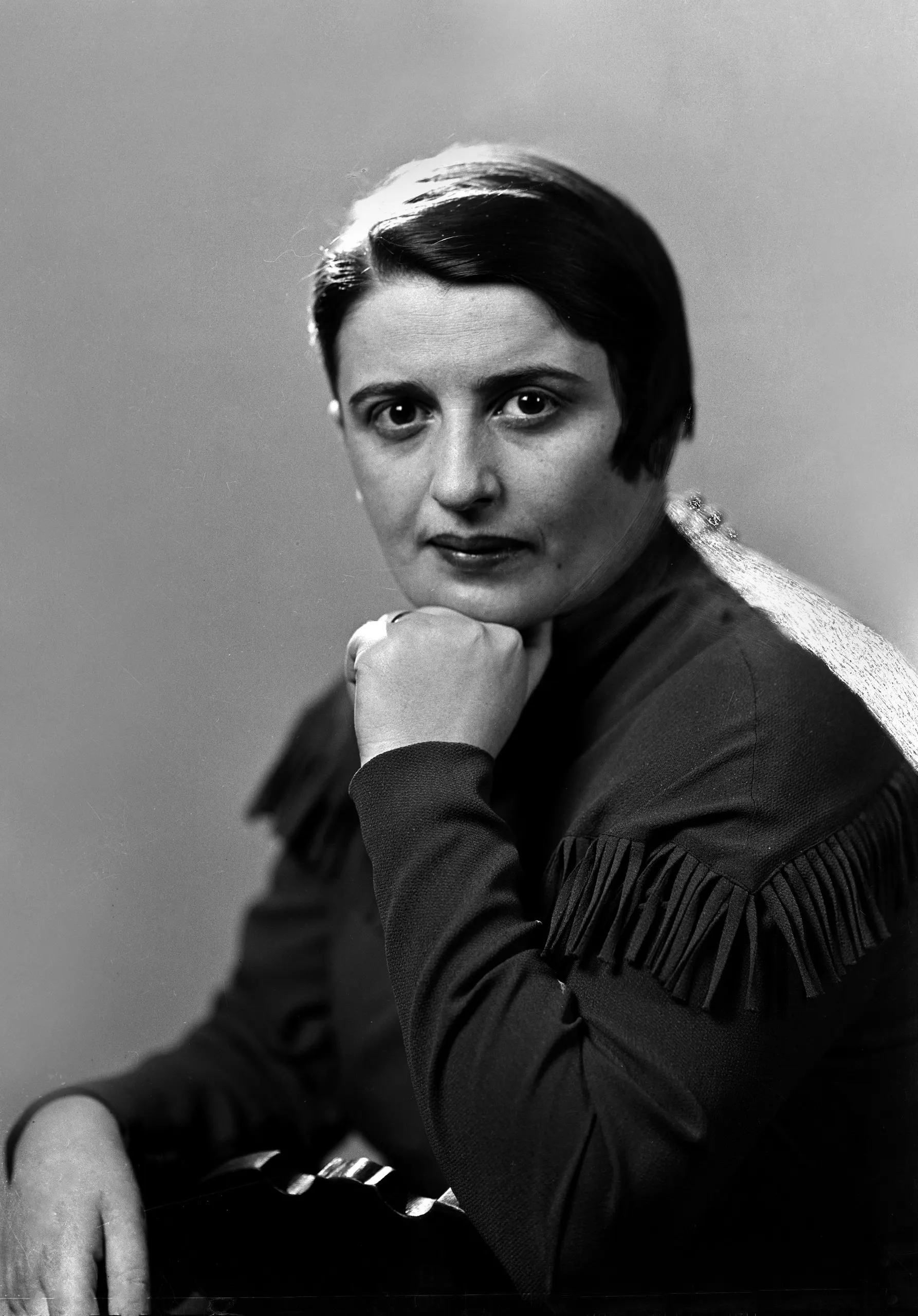
Ayn Rand
 Russia
novelist•philosopher•playwright
Birthday
February 2, 1905
Birth Sign
Aquarius
Birthplace
Saint Petersburg, Russian Empire
Age
Died at 77
Height
5 ft 2 in (157 cm)
About
Ayn Rand was a Russian-American novelist and philosopher who built a fiercely original worldview around reason, individualism, and capitalism. Born Alisa Rosenbaum in Saint Petersburg in 1905, she escaped the Soviet Union in 1926 and reinvented herself in Hollywood. Her novels The Fountainhead (1943) and Atlas Shrugged (1957) sold millions and turned her into a polarizing cultural force. She called her system Objectivism: the idea that rational self-interest is the highest moral purpose, altruism is poison, and laissez-faire capitalism is the only just social system.
Rand never softened. She debated intellectuals, ran a quasi-philosophical movement, and wrote essays that influenced right-libertarians and American conservatives. Her books still sell a quarter-million copies a year. Admirers see a champion of human potential; critics see a rigid dogmatist whose personal life contradicted her ideas. Either way, she forced people to argue about selfishness, freedom, and the meaning of heroism on her terms.
She died of heart failure in 1982 at her Manhattan apartment, still working on a television adaptation of Atlas Shrugged. Her legacy remains as contested as ever.
Early Life & Background
As a child in Saint Petersburg, Rand taught herself to read at six and devoured adventure novels by Victor Hugo and Walter Scott, stories where heroic individuals defied the crowd. At nine she declared she would become a writer. The Bolshevik Revolution shattered that world. In 1917, communist authorities confiscated her father's pharmacy, and the family fled to Crimea, nearly starving. Rand never forgot the sight of armed men taking what was not theirs.
She returned to Petrograd for university, studying history at Petrograd State University and later film at the State Institute for Cinematography. Graduating in 1924, she chafed under Soviet censorship and collectivist ideology. In 1926, with a visa and a few dollars, she left for America, vowing never to return.
Arriving in New York without English fluency, Rand made her way to Hollywood. A chance meeting with director Cecil B. DeMille landed her a job as an extra and then a script reader. She worked odd jobs, saved pennies, and wrote at night. In 1932 she sold her first screenplay, Red Pawn, to Universal. Her play Night of January 16th opened on Broadway in 1935 and ran for 29 weeks, her first real taste of success. But her early novels, We the Living (1936) and the novella Anthem (1938), sold poorly. She was thirty-eight, broke, and still unknown.
Career Growth
The breakthrough came in 1943 with The Fountainhead, a novel about architect Howard Roark who dynamites a housing project rather than compromise his vision. Critics panned it, but readers bought it, slowly at first, then in waves. By 1945 it was a bestseller, and a 1949 film adaptation starring Gary Cooper cemented Rand's fame. She had found her audience: people hungry for a story that celebrated ambition without apology.
Rand spent the next decade writing Atlas Shrugged, a thousand-page novel about a strike of the mind. Published in 1957, it divided readers sharply. Some called it a masterpiece; others, a slog. It sold steadily and became the book her followers treated as a sacred text. After that, Rand largely abandoned fiction for nonfiction. She published The Virtue of Selfishness (1964), Capitalism: The Unknown Ideal (1966), and other essay collections, and lectured at her own institute. Her inner circle, including a young Alan Greenspan, met weekly in her Manhattan living room to debate philosophy and politics.
By the 1970s, Rand's health declined and her movement fractured after a bitter split with protégé Nathaniel Branden. She kept writing and speaking until her death in 1982, leaving behind a body of work that has sold over 37 million copies worldwide.
Career Timeline
Public Image & Style
Rand cultivated a severe, intense public persona. In photographs she stares directly at the camera, often with a cigarette in hand, wearing tailored suits or dark dresses. She spoke in absolute terms and brooked no disagreement. Media coverage has always been polarized: some outlets treat her as a profound philosopher, others as a cult leader whose ideas justify greed. The contradictions between her philosophy and her personal life, the affair with Nathaniel Branden while married, her eventual enrollment in Medicare, have fueled endless debate. Her followers, called Objectivists, run reading groups, online forums, and annual lectures through the Ayn Rand Institute. The official social media accounts promote her philosophy and defend her legacy. Fan culture is serious, intellectual, and often combative, mirroring Rand's own uncompromising tone.
Fame & Fandom
Ayn Rand stands as the 19th most famous person from Russia, a placement anchored in the iFANN Global Fame Rankings that holds steady from the previous cycle. This standing reflects her enduring status as a polarizing cultural force whose ideas continue to ripple through global discourse on reason and individualism. Her influence extends far beyond literature into the halls of economic policy, where she mentored figures like Alan Greenspan, creating a legacy that blends intellectual rigor with intense personal devotion.
Unlike pop-culture movements driven by fleeting trends, Rand's adherents organize under the formal banner of Objectivism, with the Ayn Rand Institute serving as the central hub for their activities. There is no single informal nickname for this group; instead, followers identify simply as Objectivists or members of the Randian community. Their engagement resembles high-level advocacy more than typical fandom rituals, characterized by the study of her 'Big Three' novels and the recitation of specific quotes as internal creeds. The community has recently expanded its physical footprint with plans for a $30 million libertarian development in Austin dedicated to her life and work, while new media adaptations like the Netflix release of the Atlas Shrugged trilogy aim to introduce her story to a fresh generation. Even decades after her death, the legend of her salons, where she dissected moral failings with terrifying precision, remains a foundational story told to all newcomers.
Interesting Facts and Legends
Rand taught herself to read at age six by sounding out letters in a French adventure novel, an early sign of her self-reliant nature. She voted for Franklin D. Roosevelt in 1932 before spending the rest of her life denouncing the New Deal, yet she campaigned for Republican Wendell Willkie in 1940 while writing The Fountainhead. Her literary tastes were surprisingly eclectic; she listed Mickey Spillane as her favorite American author for his blunt prose and enjoyed TV shows like Charlie's Angels and Kojak. She served on the board of the American Writers' Association and the executive committee of the Film Alliance for the Preservation of American Ideals alongside Walt Disney and John Wayne. As a child, she developed a personal rule she called 'thinking in principle', never making exceptions to a rational standard, and later described Russia as 'an accidental cesspool of civilization'.
Among the legends fans still retell is the deep bond between Rand and Alan Greenspan, who met when he was a teenager and became her lifelong friend and disciple until her death. This relationship is often cited as the primary example of her real-world impact, with Greenspan eventually controlling the US economy. Another iconic moment involves her play Night of January 16th, which premiered in 1935 and featured a unique format where the audience acted as the jury to decide the defendant's verdict, effectively breaking the fourth wall long before it was common practice.
Notable Quotes
“That's not the point. The point is, who will stop me?”
“My philosophy, in essence, is the concept of man as a heroic being, with his own happiness as the moral purpose of his life.”
“An accidental cesspool of civilization.”
“I am not primarily an advocate of capitalism, but of egoism; and I am not primarily an advocate of egoism, but of reason.”
Family & Personal Life
Rand was the eldest of three daughters born to Zinovy Zakharovich Rosenbaum, a pharmacist, and Anna Borisovna Kaplan. Her father owned his own pharmacy, a rare achievement for a Jewish family in tsarist Russia. The family was Jewish but not religious; her father was agnostic. Rand's sisters were Nora and Natasha. After the revolution, the family's pharmacy was seized, and they lived in near-starvation conditions. Rand never forgave collectivism for what it took from them. She married actor Frank O'Connor in 1929 and they remained together until his death in 1979. They had no children. She described Frank as her anchor, though their marriage coexisted with her long affair with Nathaniel Branden. At the time of her death, Rand was widowed and lived alone in her Manhattan apartment.
Notable Connections
Rand's closest collaborator was Nathaniel Branden, her protégé and lover, who helped build the Objectivist movement until their explosive split in 1968. Leonard Peikoff, her designated intellectual heir, founded the Ayn Rand Institute in 1985. Alan Greenspan, later chairman of the Federal Reserve, was a member of her inner circle. Film director Cecil B. DeMille gave Rand her first Hollywood job. She campaigned for 1940 Republican presidential candidate Wendell Willkie.
Relationships & Dating History
Rand married actor Frank O'Connor in 1929. They had no children and remained together until his death in 1979. Despite the marriage, Rand began a romantic and sexual relationship with Nathaniel Branden in the mid-1950s. Branden, a young Canadian psychologist, had become her intellectual protégé and the leading promoter of Objectivism. Their spouses, Frank O'Connor and Barbara Branden, knew and consented. The affair lasted until 1968, when Rand discovered Branden had been seeing another woman, Patrecia Scott. The breakup was vicious and caused a major schism in the Objectivist movement. Rand never remarried after O'Connor's death. She had no other known romantic relationships. At the time of her death, she was widowed.
- MarriedFrank O'Connor1929 - 1979Married for 50 years until his death; no children.
- DatedNathaniel Branden1954 - 1968Extramarital affair with her protégé; ended after Rand learned of his other affair.
Death & Aftermath
Died
March 6, 1982 (aged 77)
Death Place
New York City, New York, USA
Cause of Death
Heart failure
Alan Greenspan, the former Federal Reserve Chair who had attended her weekly Manhattan gatherings for decades, offered a tribute to the philosopher he once called a mentor, while her novels The Fountainhead and Atlas Shrugged maintained their status as best-sellers with global sales surpassing thirty-seven million copies. This enduring commercial presence was managed by the Ayn Rand Institute, founded in 1985 by her protégé Leonard Peikoff to preserve her intellectual property and promote Objectivism, ensuring that her ideas remained an active force in libertarian movements rather than fading into obscurity. Her legacy has since expanded with new educational initiatives and documentaries launched well into the 2020s, including the recent release of Ayn Rand Essentials and the documentary titled Ayn Rand & the Prophecy of Atlas Shrugged. The woman behind this enduring influence passed away on March 6, 1982, at her apartment in New York City at the age of seventy-seven.
She died in her sleep, with the widely accepted cause being heart failure resulting from age and health complications. Following her wishes, no public funeral service was held; instead, she was cremated and her ashes were interred at Ferncliff Cemetery in Hartsdale, New York. Posthumous releases continued to include various editions of her works and films based on her novels, while the estate grew to support ambitious projects such as a planned thirty-million-dollar cultural and education hub in Austin, Texas designed by John Ronan Architects. This facility serves as an archive and educational center, cementing the work of the institute that took over her intellectual property after her death.
Net Worth (Estate Value)
$10 Million
iFANN Editorial Team estimate
iFANN currently estimates Ayn Rand's estate at roughly $10 million as of 2026. The bulk of this value comes from her books, which still sell about 250,000 copies annually, generating steady royalty income. Total sales of her novels have surpassed 37 million copies worldwide. The Ayn Rand Institute, founded in 1985 by Leonard Peikoff, manages her intellectual property and collects licensing fees for film and television adaptations, merchandise, and educational materials. The Institute is a nonprofit; its revenue supports Objectivist outreach rather than enriching the estate. Rand owned a Manhattan apartment at 120 East 34th Street at the time of her death. Her estate does not include major real estate holdings or business ventures beyond the book royalties and licensing. Posthumous earnings have remained stable, driven by consistent readership among libertarians, conservatives, and college students discovering her work.
Awards Won (3)
Rand did not win major literary or entertainment awards during her lifetime. Her recognition came through book sales and cultural influence. Posthumously, she received the Prometheus Award Hall of Fame induction for Anthem (1987), The Fountainhead (1999), and Atlas Shrugged (2002). Atlas Shrugged was nominated for the National Book Award for Fiction in 1958 but did not win.
2002 · Hall of Fame
Atlas Shrugged
1999 · Hall of Fame
The Fountainhead
1987 · Hall of Fame
Anthem
Known For
Atlas Shrugged
1957 · Author
The Fountainhead
1943 · Author
Anthem
1938 · Author
We the Living
1936 · Author
The Virtue of Selfishness
1964 · Author
Keywords
Sources
Quick Facts
- Profession
- novelist, philosopher, playwright
- Born
- +1905-02-02
- Birthplace
- Saint Petersburg, Russian Empire
- Died
- +1982-03-06
- Death Place
- Manhattan, New York City
- Gender
- Female
- Spouse
- Frank O'Connor
- Birth Sign
- Aquarius
- Height
- 5 ft 2 in (157 cm)
Personal Details
- Full Name
- Alisa Zinovyevna Rosenbaum
- Height
- 5 ft 2 in (157 cm)
- Spouse
- Frank O'Connor
- Education
- Petrograd State University (history degree, 1924); State Institute for Cinematography (1924)
Frequently Asked Questions
What is Ayn Rand's philosophy called?
Did Ayn Rand have children?
Why is Ayn Rand so controversial?
What books did Ayn Rand write?
Was Ayn Rand an atheist?
Social Media
Similar People
Join the community
fans discussing