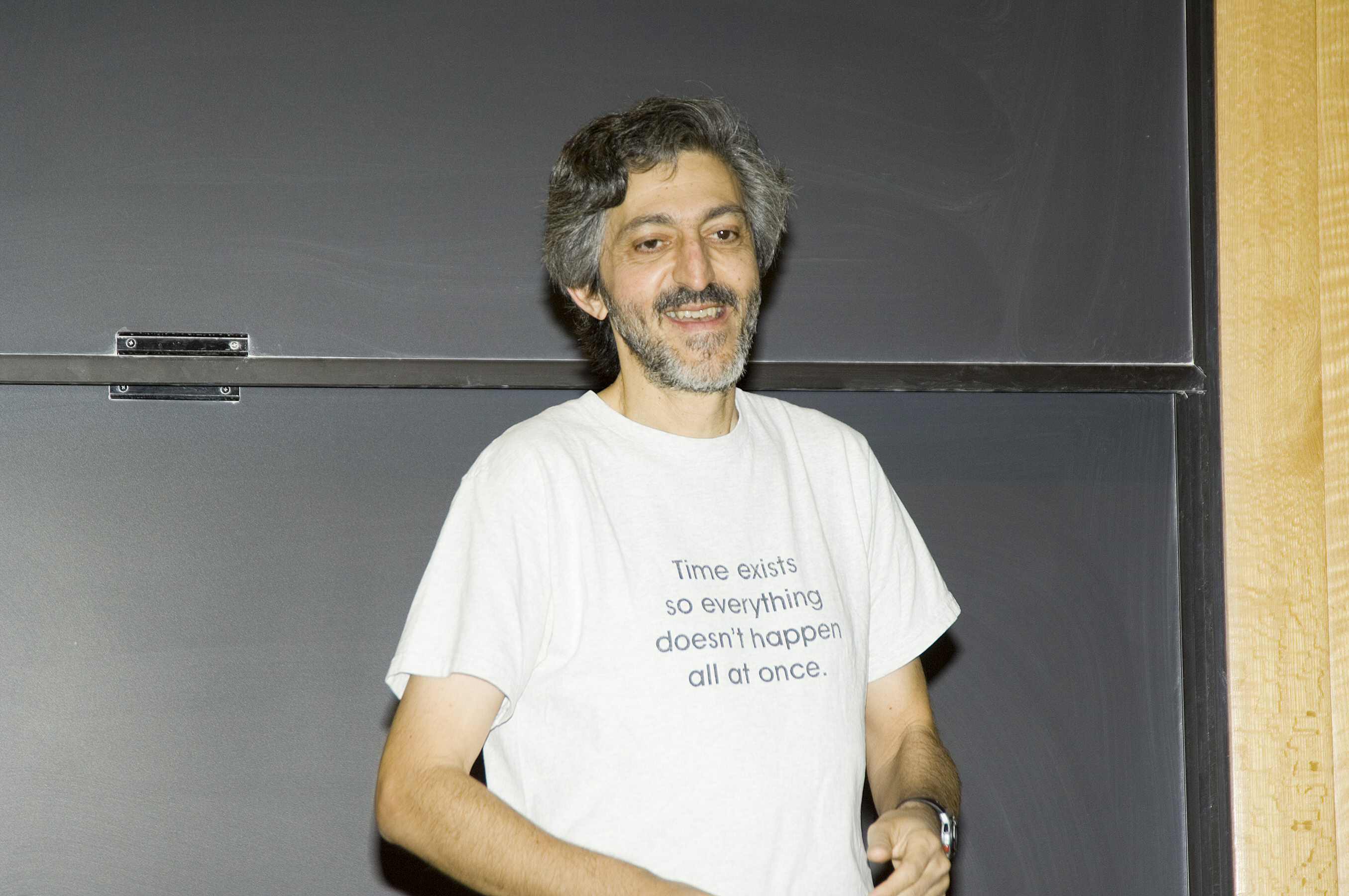
Avi Wigderson
 Israel
mathematician•computer scientist•pedagogue
Birthday
September 9, 1956
Birth Sign
Virgo
Birthplace
Haifa, Israel
Age
70 years old
About
Avi Wigderson is an Israeli-American mathematician and computer scientist who stands as one of the most influential figures in modern theoretical computer science. Born on September 9, 1956, in Haifa, Israel, he currently serves as the Herbert H. Maass Professor in the School of Mathematics at the Institute for Advanced Study in Princeton, New Jersey. His research has fundamentally reshaped how we understand computational complexity, randomness, and cryptography.
Wigderson's career is defined by a rare dual distinction: he is the only person in history to win both the Abel Prize, often called the Nobel Prize of mathematics, and the A.M. Turing Award, the highest honor in computing. He received the Abel Prize in 2021 alongside László Lovász and the Turing Award in 2023 for his groundbreaking work on the power of randomness in computation. These achievements mark him as a singular titan whose insights drive everything from secure digital transactions to distributed systems.
Early Life & Background
Avi Wigderson grew up in Haifa, Israel, as the son of Holocaust survivors, a nurse and an electrical engineer. His early life was deeply shaped by the post-war context of his family's history, yet he found his calling in the abstract beauty of mathematics. Despite the heavy emotional weight of his parents' past, Wigderson pursued his education with relentless focus, completing his undergraduate studies at the Technion – Israel Institute of Technology. The rigorous academic environment there laid the groundwork for his future breakthroughs in algorithmic theory.
His path to global recognition began in earnest when he moved to the United States to pursue doctoral studies. He earned his Ph.D. in Computer Science from Princeton University in 1983 under the supervision of Richard Lipton. This transition marked a pivotal shift from student to researcher, setting the stage for a prolific career. Before his rise to international fame, Wigderson spent his early years navigating the complex landscape of parallel algorithms and complexity theory, publishing papers that would eventually challenge long-standing assumptions about what computers can achieve.
The period before his major awards was characterized by intense collaboration and deep theoretical exploration. He joined the faculty at the Technion shortly after his doctorate, where he began developing foundational concepts that would later define his legacy. It was during these formative years that he started working on probabilistic proof systems, a field that would eventually become the bedrock of modern cryptographic protocols. Unlike entertainment stars who might have a sudden breakout moment, Wigderson's ascent was a steady climb built on decades of rigorous intellectual labor.
Career Growth
Wigderson's professional trajectory reached its zenith with two historic accolades that no other scientist has ever achieved simultaneously. In 2021, he was awarded the Abel Prize, shared with László Lovász, for their fundamental contributions to discrete mathematics and theoretical computer science. This honor recognized his extensive work on graph theory and complexity classes. Just two years later, in 2023, the Association for Computing Machinery bestowed upon him the A.M. Turing Award, presented publicly in 2024. The citation highlighted his specifying the power and limitations of randomness in computation, a contribution worth $1 million that revolutionized the field.
His influence extends far beyond these prizes. Wigderson co-developed the concept of zero-knowledge proofs in the 1980s, a theoretical framework that allows one party to prove to another that they know a value without revealing any information about it. This work is now essential for privacy-preserving technologies, including blockchain and cryptocurrency protocols like Zcash. His research on derandomization has also influenced distributed computing, helping engineers design robust systems that function reliably even when random elements are removed.
In recent years, Wigderson has continued to lead the field through his role at the Institute for Advanced Study. He delivered the Della Pietra Lecture Series at Stony Brook University in November 2025, exploring how randomness transforms chaotic systems into predictable ones. His mentorship has produced a generation of prominent computer scientists, many of whom now hold key positions in academia and industry. His work remains active and vital, shaping the next frontier of computational theory.
Career Timeline
Public Image & Style
Wigderson is portrayed in the media as a humble, brilliant scholar who prioritizes abstract beauty over commercial gain. Interviews reveal a thoughtful and precise tone, avoiding sensationalism while explaining complex concepts. He is often described as the "father of computational theory" due to his foundational contributions to the field. His public presence is defined by quiet authority; he speaks at conferences and delivers lectures where the atmosphere is one of serious engagement rather than fanfare. Colleagues view him as a man of integrity whose work transcends national boundaries, reflecting a global commitment to scientific progress.
Fame & Fandom (iFAMOUS Rankings)
Avi Wigderson commands a following that exists entirely within the hallowed halls of academia. His supporters are not found in stadium lines or subway billboards but in lecture halls across Princeton, Jerusalem, and Tokyo, where students and peers revere his work on computational complexity. There is no official name for this collective; they are simply mathematicians and computer scientists united by a shared obsession with the abstract beauty of randomness. While pop stars inspire midnight vigils, Wigderson inspires breakthroughs. His legacy is built on the dual laureate milestone: he stands alone as the only individual to have won both the Abel Prize and the Turing Award. This intellectual dynasty has propelled him into the global consciousness of technology. He is currently the 61st most famous person in AI, a standing confirmed by the iFANN Global Fame Rankings. The ranking remains steady from the previous cycle, cementing his status as a titan whose influence stretches far beyond the equations he solves.
Interesting Facts and Legends
Avi Wigderson holds the unique distinction of being the only individual in history to have won both the Abel Prize and the A.M. Turing Award. His work on zero-knowledge proofs, developed in the 1980s, is now the theoretical foundation for modern privacy technologies like Zcash and various blockchain protocols. In November 2025, he delivered the Della Pietra Lecture Series at Stony Brook University, discussing how chaos becomes clarity through the power of randomness. These lectures serve as primary gathering points for his academic followers, who come not to cheer but to absorb complex theories that will shape the future of cryptography. He was born in Haifa, Israel, but spent significant formative years in the United States, bridging two distinct academic cultures. His foundational work on probabilistically checkable proofs (PCPs) resolved long-standing open problems in complexity theory, effectively changing how mathematicians verify truth without revealing secrets.
Notable Quotes
“Randomness is a resource that can be used to solve problems that are otherwise intractable.”
“The question is not whether we can compute it, but whether we can understand the structure of the computation itself.”
Family & Personal Life
Avi Wigderson maintains a notably private existence typical of high-level academic researchers. There are no public records or biographical sources detailing his romantic relationships, marriages, or children. He keeps his personal life entirely separate from his professional output, avoiding media attention regarding his family. His parents were Holocaust survivors, a nurse and an electrical engineer, which deeply influenced his early upbringing in Haifa. While he does not share details about his household or daily life, his dedication to mentoring students and advancing mathematical knowledge suggests a life centered on intellectual pursuit rather than public celebrity.
Notable Connections
László Lovász, Richard Lipton, Oded Goldreich, Shafi Goldwasser
Relationships & Dating History
Avi Wigderson maintains a notably private existence typical of high-level academic researchers. There are no public records, news reports, or biographical sources detailing his romantic relationships, dating history, marriages, or children. Unlike public figures in the entertainment industry, Wigderson does not engage in public disclosures regarding his private life, and no credible sources confirm any specific partners, engagements, or divorces. As of 2026, his relationship status remains unpublicized; he is known primarily through his professional output and academic presence. Consequently, there is no information available regarding offspring or current partners, and no tabloid speculation has been substantiated by credible media outlets.
Salary, Net Worth In 2026
$6 Million
iFANN Editorial Team estimate
Estimates for Avi Wigderson's net worth reflect the financial reality of a top-tier academic rather than a commercial entertainer. As of 2026, iFANN Editorial Team analysis of his earnings, ventures, and assets points to roughly $6 million. His wealth stems primarily from his salary as the Herbert H. Maass Professor at the Institute for Advanced Study, combined with substantial prize money. He received the $1 million A.M. Turing Award in 2023 and the $750,000 Abel Prize in 2021, shared with László Lovász. Unlike celebrities who earn through endorsements or business ventures, Wigderson's income is derived almost exclusively from his academic position and these prestigious awards. There are no reported real estate holdings or commercial deals associated with him, and any higher figures found online are likely speculative projections based on the perceived value of his intellectual property rather than liquid assets.
Awards Won (5)
Avi Wigderson has secured the highest honors in both mathematics and computer science. He won the Nevanlinna Prize in 1994, the Gödel Prize in 1997, and the Knuth Prize in 2006. His crowning achievements include the Abel Prize in 2021, shared with László Lovász, and the A.M. Turing Award in 2023, making him the only person to hold both distinctions. These awards recognize his foundational work in complexity theory, randomness, and cryptography.
1994 · Mathematics
Outstanding contributions to mathematical aspects of information sciences
1997 · Computer Science
Probabilistic Proof Systems
Known For
Computational Complexity Theory
1983 · Researcher
Zero-Knowledge Proofs
1985 · Co-developer
Abel Prize
2021 · Winner
Turing Award
2023 · Winner
Keywords
Sources
Quick Facts
- Profession
- mathematician, computer scientist, pedagogue
- Born
- September 9, 1956
- Birthplace
- Haifa, Israel
- Gender
- Male
- Birth Sign
- Virgo
Personal Details
- Full Name
- Avi Wigderson
- Children
- Education
- Technion – Israel Institute of Technology (B.Sc.), Princeton University (Ph.D., 1983)
Frequently Asked Questions
What did Avi Wigderson win?
Where was Avi Wigderson born?
Is Avi Wigderson married?
What is Avi Wigderson famous for?
How much is Avi Wigderson's net worth?
Join the community
fans discussing