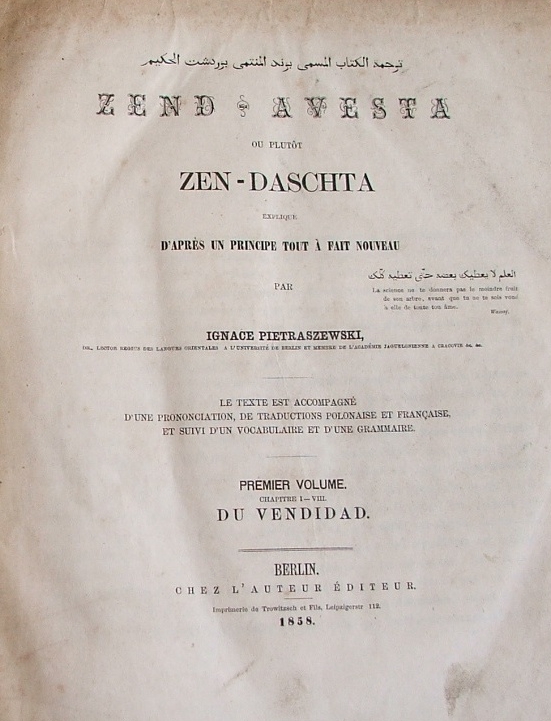
Overview
The Avesta stands as the foundational scripture of Zoroastrianism, a vast collection of hymns, laws, and liturgies composed in the ancient Avestan language. While religious tradition attributes the core teachings to the prophet Zarathustra (Zoroaster), modern scholarship recognizes the text as a compilation developed over more than a millennium by generations of priests. The material evolved from an oral tradition beginning around the 15th century BCE before being codified into writing during the Sasanian Empire between 224 and 651 CE.
This corpus is not a single continuous narrative but a diverse anthology where the Gathas, seventeen hymns directly attributed to Zarathustra, form the spiritual heart of the faith. Surrounding these are the Yasna liturgical ceremonies, the Visperad expansions, the legal code known as the Vendidad, and the Yashts dedicated to various divine beings. The original complete version suffered heavy losses following the Islamic conquest of Iran in the 7th century, leaving today's versions as reconstructed fragments based on medieval manuscripts and Pahlavi translations.
Scholars regard the Avesta as the largest body of literature from the Old Iranian period and the oldest texts written in any Iranian tongue. Its discovery in Europe during the 18th century revolutionized the study of Indo-European languages, revealing deep cultural links between Persia, India, and Europe. The text also profoundly influenced later Abrahamic religions, with concepts like heaven, hell, and the final judgment often tracing their roots to Zoroastrian eschatology found within its pages.
Keywords
Sources
Book Info
- Author
- Zarathustra
- Language
- Avestan
- Earliest Manuscript
- 1323 CE
- Oral Tradition Period
- 15th century BCE to 4th century BCE
- Written Codification Era
- 224–651 CE
- Primary Themes
- Ethical dualism, Asha (cosmic order), free will
Links
Join the community
fans discussing