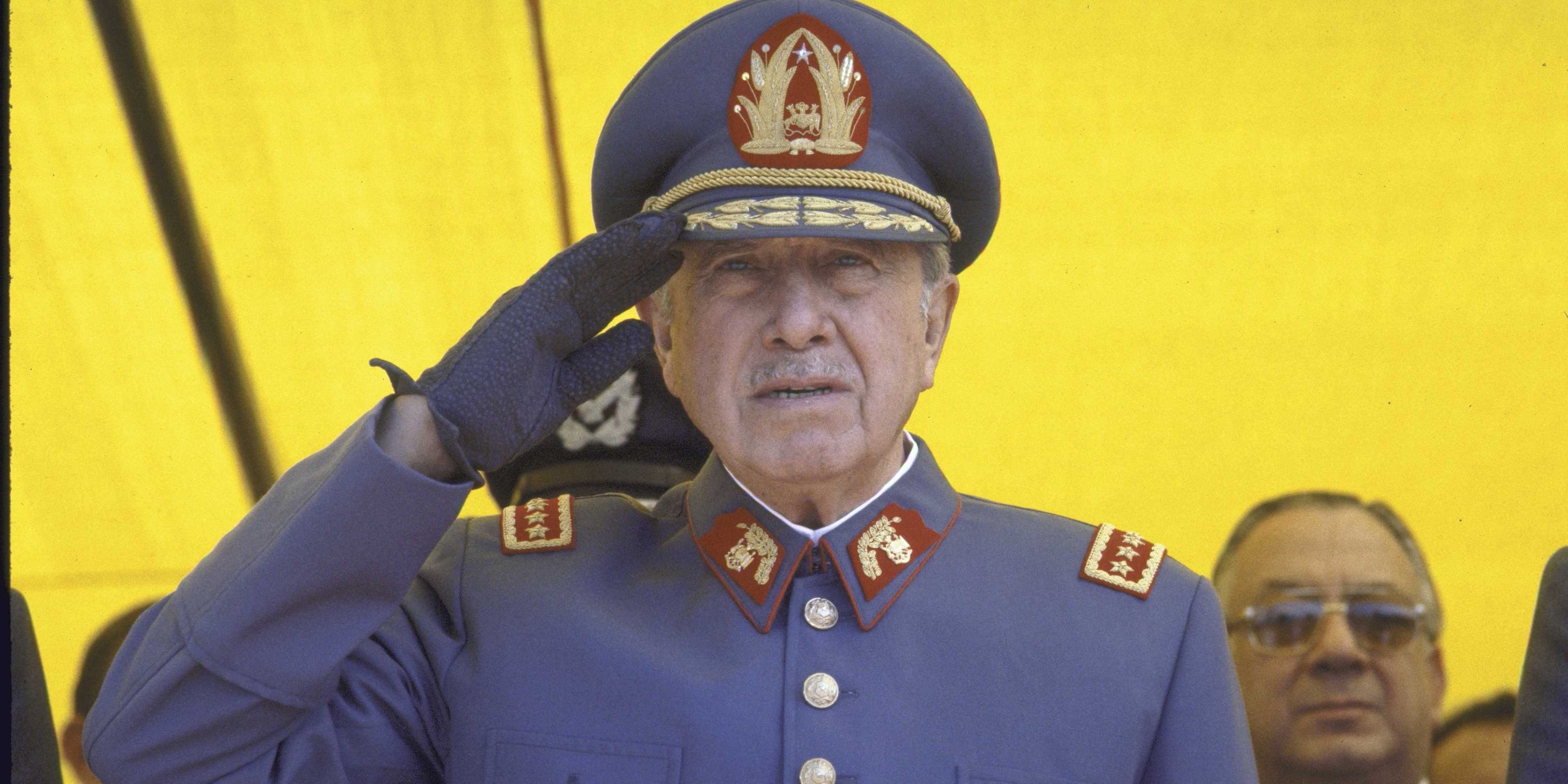
Augusto Pinochet
 Chile
ChileAlso known as: General Pinochet, Augusto Pinochet Ugarte
Birthday
November 25, 1915
Birth Sign
Sagittarius
Birthplace
Valparaíso, Chile
Age
Died at 91
Height
5 ft 9 in (175 cm)
About
Augusto José Ramón Pinochet Ugarte was a Chilean army officer and military dictator who ruled Chile from 1973 to 1990. He led the Chilean Army in the overthrow of President Salvador Allende in 1973 and established a military junta. He was proclaimed President of Chile by the junta in 1974 and served until 1990, when he stepped down to pave the way for democratic elections. Throughout his presidency, thousands of political opponents were tortured or executed. Pinochet is the longest-serving head of state in the history of Chile.
His rule fundamentally reshaped the nation's political and economic landscape through authoritarian measures and neoliberal reforms. The legacy of his seventeen-year tenure remains one of the most contentious chapters in Latin American history, marked by severe human rights violations and a complex economic transformation that continues to influence modern Chile.
Early Life & Background
Augusto Pinochet entered the world on November 25, 1915, in Valparaíso, Chile, born into a middle-class family. His father worked as a customs official, and his mother taught school. This background provided a stable foundation before he chose a path defined by military discipline. He attended primary school locally before entering the Military Academy in Santiago in 1933 at just sixteen years old. The rigorous training there shaped his worldview and career trajectory for decades to come.
He graduated in 1937 as a second lieutenant in the Infantry Arm. His early service took him to various garrisons across Chile, including the northern mining regions where he developed a reputation for strict adherence to hierarchy and discipline. These formative years solidified his commitment to the institution of the army. In 1943, he married Lucía Hiriart, a teacher he met while they were both students. They would remain together for the rest of his life and raise six children.
Pinochet climbed the ranks steadily throughout the mid-20th century. By the early 1970s, he had reached the rank of General. In January 1972, he was appointed Chief of Staff of the Chilean Army. The political climate in Chile grew increasingly volatile during this period, with tensions mounting between the government and the military establishment. He was promoted to Commander-in-Chief on August 23, 1973, by President Salvador Allende, despite the growing friction between their respective factions.
Career Growth
The defining moment of Pinochet's career arrived on September 11, 1973, when he led a military coup that overthrew the democratically elected socialist president Salvador Allende. Following the collapse of the Allende government, he formed a four-member military junta. In December 1974, the junta appointed him Supreme Head of the Nation, consolidating his power as the de facto dictator. Under his leadership, the regime implemented radical economic reforms influenced by the "Chicago Boys," a group of Chilean economists trained at the University of Chicago.
These policies included neoliberal measures such as privatization of state-owned enterprises, deregulation, and the dismantling of trade unions. While these policies initially spurred economic growth, they also led to increased inequality and a severe economic crisis in 1982. In 1980, a new constitution was approved via plebiscite, providing a legal framework for his rule. A 1988 plebiscite saw 56% of voters reject Pinochet's continuation, leading to democratic elections in 1989.
He stepped down in March 1990 but remained Commander-in-Chief of the Army until March 1998. Upon retirement, he became a senator-for-life under the 1980 Constitution. However, his immunity was challenged in 1998 when he was arrested in London under an international warrant issued by Spanish judge Baltasar Garzón for human rights violations. After a lengthy legal battle, he was released on health grounds and returned to Chile in 2000. He faced numerous criminal charges regarding human rights abuses, tax evasion, and embezzlement until his death.
Career Timeline
Public Image & Style
Pinochet's public image is deeply polarized. Supporters view him as a savior who saved Chile from communism and stabilized the economy, while opponents see him as a brutal dictator responsible for widespread human rights abuses. Media portrayals reflect this divide, with some outlets focusing on his economic achievements and others on the atrocities committed under his rule. His image is often invoked in political debates in Chile and beyond, symbolizing the tension between order and freedom.
Fame & Fandom
iFANN has not yet collected fame data for this person. The engine does not currently evaluate historical figures from this era in its global ranking metrics. While there is no organized fandom in the traditional sense, distinct political groups actively support or oppose his legacy. Pro-Pinochet groups, often composed of veterans and conservative citizens, organize rallies and campaigns to defend his memory. Anti-Pinochet groups, including human rights organizations and leftist activists, mobilize to demand justice and accountability. These groups function more as political movements than fandoms, driven by ideological beliefs rather than personal admiration.
Interesting Facts and Legends
Augusto Pinochet was a keen horseman and owned a large estate in the Maule region, which he used for leisure and strategic planning. Despite his authoritarian rule, he was known to be a private person who avoided public social gatherings outside of military functions. The "Chicago Boys" who advised him were not just economists but also former students of Milton Friedman, influencing his neoliberal policies.
Pinochet's arrest in London in 1998 was a landmark case in international law, establishing the principle of universal jurisdiction for human rights violations. He was the longest-serving head of state in Chilean history, ruling for 17 years. Some reports suggest he accumulated at least US$28 million through kickbacks on arms deals, embezzlement, and illicit bank accounts abroad, though this figure is disputed.
Notable Quotes
“I am a soldier, and I will never forget my oath.”
“The country needs a strong hand to guide it.”
“We are not guilty of anything.”
Family & Personal Life
Augusto Pinochet was married only once to Lucía Hiriart Araya on April 28, 1943. The couple met while both were students; Lucía was a teacher, and Pinochet was a young officer. They remained married until his death in 2006. There are no public records of other romantic relationships or extramarital affairs that have been confirmed by credible sources. The marriage produced six children: María Verónica, Marcela, Lucía, José Antonio, Marco Antonio, and Mónica. The family has maintained a low profile since his death, with some members involved in preserving his legacy through private foundations.
Notable Connections
Relationships & Dating History
Augusto Pinochet was married only once to Lucía Hiriart Araya on April 28, 1943. The couple met while both were students; Lucía was a teacher, and Pinochet was a young officer. They remained married until his death in 2006. There are no public records of other romantic relationships or extramarital affairs that have been confirmed by credible sources. The marriage produced six children: María Verónica, Marcela, Lucía, José Antonio, Marco Antonio, and Mónica. The family has maintained a low profile since his death, with some members involved in preserving his legacy through private foundations.
- MarriedLucía Hiriart1943 - 2006Met as students; remained married until his death.
Death & Aftermath
Died
December 10, 2006 (aged 91)
Death Place
Santiago, Chile
Cause of Death
Pneumonia complicated by congestive heart failure and emphysema
Augusto Pinochet spent his final years confined to his home in Santiago, requiring frequent hospitalizations before passing away at the Clínica Santa María. The former dictator died on December 10, 2006, at the age of 91, following a long illness that had left him physically unable to travel for medical treatment. His death was reported as pneumonia complicated by congestive heart failure and emphysema, a conclusion issued directly by attending physicians and confirmed by his family. At the time of his passing, he remained under house arrest while facing over 300 criminal charges related to human rights abuses, though many proceedings were dismissed due to his deteriorating health.
Public reaction to his death reflected the deep divisions within Chilean society, with large crowds gathering outside the National Congress and the Presidential Palace. While some mourners held vigils and sang hymns, others celebrated openly by burning effigies and shouting slogans against the former ruler. Tributes from peers were equally polarized; right-wing leaders and military factions praised his role in stabilizing the economy, whereas left-wing officials and human rights organizations expressed relief at his passing. The funeral procession sparked significant unrest, with clashes reported between supporters and opponents in the streets of Santiago. A private ceremony took place on December 11, 2006, at the Military Academy in Santiago, attended by high-ranking military officials including General Juan Emilio Cheyre.
The service featured religious rites conducted by a Catholic priest followed by a military escort for the body before Pinochet was cremated. His ashes were interred at the General Cemetery of Santiago, a location chosen for its proximity to military tradition rather than as a public mausoleum. His family maintains a private foundation focused on preserving his historical narrative, asserting that his actions were necessary for national stability.
Net Worth (Estate Value)
$28 Million
iFANN Editorial Team estimate
Estimates of Augusto Pinochet's net worth vary significantly due to the secretive nature of his financial holdings and the ongoing legal battles surrounding them. During his rule, it was alleged that he amassed a fortune through kickbacks on arms deals, embezzlement, and illicit bank accounts abroad. Some reports suggest he accumulated at least US$28 million, though this figure is disputed and based on incomplete investigations.
Following his death, there have been no comprehensive public audits of his estate's current value. Unlike celebrities whose estates generate continuous revenue, Pinochet's wealth was tied to state assets and illegal activities, many of which were seized or frozen by the Chilean government after his death. Therefore, there is no reliable "2026 net worth" figure comparable to living public figures, and estimates remain speculative and legally contested. iFANN currently estimates his estate's potential value at approximately $28 million based on available historical records.
Awards & Accolades
View 4 records, honours and achievementsKnown For
Chilean Dictatorship
1973 · Leader of the Coup
Operation Condor
1975 · Architect
Keywords
Sources
Quick Facts
- Profession
- military personnel, politician
- Born
- November 25, 1915
- Birthplace
- Valparaíso, Chile
- Died
- December 10, 2006
- Death Place
- Santiago, Chile
- Gender
- Male
- Spouse
- Lucía Hiriart
- Birth Sign
- Sagittarius
Personal Details
- Full Name
- Augusto José Ramón Pinochet Ugarte
- Height
- 5 ft 9 in (175 cm)
- Spouse
- Lucía Hiriart
- Children
- María Verónica · Marcela · Lucía · José Antonio · Marco Antonio · Mónica
- Education
- Military Academy of Chile
Frequently Asked Questions
What was Augusto Pinochet's role in Chile?
How many people died under Pinochet's regime?
Did Augusto Pinochet die naturally?
Was Augusto Pinochet ever arrested?
What was Pinochet's economic policy?
Similar People
Join the community
fans discussing