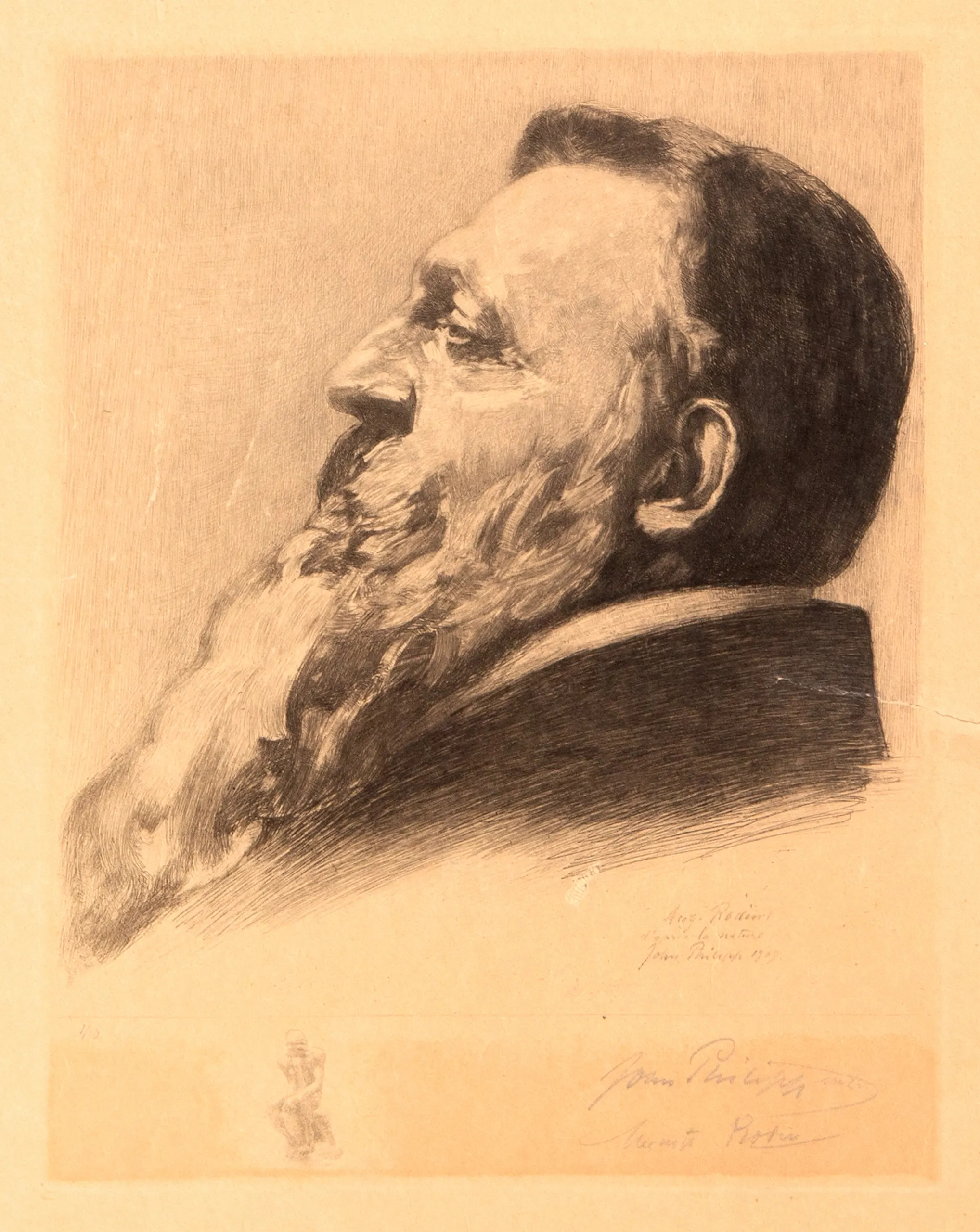
Auguste Rodin
 France
sculptor•graphic artist•draftsperson
Also known as: François Auguste René Rodin, René François Auguste Rodin, august rodin, rodin, a. rodin, rodin auguste, rodin a., aug. rodin, e. rodin, Lo-tan, Roden Rone Fransua Ogyust
Birthday
November 12, 1840
Birth Sign
Scorpio
Birthplace
Paris, France
Age
Died at 77
About
François Auguste René Rodin was a French sculptor born in Paris on November 12, 1840. He is universally recognized as the father of modern sculpture, renowned for transforming the art form by rejecting polished academic ideals in favor of raw naturalism and psychological depth. His most iconic works include The Thinker, The Kiss, The Burghers of Calais, The Gates of Hell, and the Monument to Balzac. Despite early controversy surrounding his hyper-realistic style, Rodin achieved global fame by the 1900 World's Fair in Paris, becoming one of the few artists whose name transcended the art world.
Rodin's career transformed the artistic landscape by capturing turbulent energy and emotion in bronze and marble. He spent his later years in Meudon, where he continued to produce work until his death in 1917. His legacy endures through the Musée Rodin in Paris, which houses thousands of his sculptures and drawings. He remains a pivotal figure in art history, bridging the gap between classical tradition and modern expression.
Early Life & Background
François Auguste René Rodin entered the world on November 12, 1840, into a working-class family in the Latin Quarter of Paris. His father, Jean-Baptiste Rodin, served as a clerk in the Paris police department, while his mother, Marie Cheffer, came from a family of artisans. As the second child and only son, Rodin grew up in modest circumstances that would shape his perspective on life and labor. From an early age, he displayed a profound interest in drawing, often sketching everything he observed around him with intense focus.
His education, however, was fraught with difficulties. Rodin suffered from severe myopia, or poor eyesight, which made traditional schooling a struggle. Teachers frequently labeled him as slow or clumsy because he could not see the blackboard clearly, leading to a lack of confidence in his academic abilities. He attended the Petite École, a specialized school for art and mathematics, where he studied under the painter Horace Lecoq de Boisbaudran. This institution emphasized observation and memory drawing, fostering Rodin's unique visual acuity despite his physical limitations.
Although he passed the entrance exam for the prestigious École des Beaux-Arts three times, he was repeatedly rejected due to his unconventional style and lack of adherence to rigid academic rules. Instead of formal university training, Rodin spent years working as a decorative craftsman. He designed ornamental elements like columns, friezes, and vases for various architectural projects. This period of apprenticeship in the commercial arts allowed him to master the technical aspects of modeling clay and stone while developing his own aesthetic voice outside the constraints of the academy.
Career Growth
Rodin's professional journey began in earnest in the 1860s when he started exhibiting small-scale works. A pivotal moment occurred in 1875 during a trip to Italy, where he studied the works of Michelangelo and Donatello. This exposure deepened his understanding of anatomy and movement, leading to a stylistic shift toward more dynamic and expressive forms. In 1877, Rodin achieved his first major breakthrough with The Age of Bronze. The sculpture caused a scandal because its hyper-realism led critics to accuse him of casting directly from life rather than sculpting it. Rodin had to prove his authorship through photographs taken during the creation process, but the controversy ultimately cemented his reputation as a master of realism.
In 1880, the French government commissioned him to create a set of doors for a planned Museum of Decorative Arts. Rodin embarked on his magnum opus, The Gates of Hell, inspired by Dante's Inferno. This massive project became a repository for many of his most famous figures, including The Thinker (originally intended as Dante) and The Kiss. Though the doors were never completed for their original purpose, the individual sculptures became standalone masterpieces. In 1889, he created The Burghers of Calais, a group sculpture depicting six citizens of Calais who offered themselves as hostages to end a siege. Its unidealized, anguished portrayal of the men broke convention and was initially rejected by the city council before being installed in a public park.
The unveiling of the Monument to Honoré de Balzac in 1898 sparked another fierce debate. Rodin's depiction of the writer in a simple robe, capturing his creative spirit rather than his physical likeness, was ridiculed by the commissioning committee. It took decades for the work to be recognized as a triumph of modern sculpture. By the 1900 Universal Exposition in Paris, Rodin presented a retrospective of his work that solidified his status as an international celebrity. He was sought after by wealthy patrons, intellectuals, and heads of state. Following his death in 1917, the French state acquired his estate, and the Hôtel Biron in Paris was converted into the Musée Rodin in 1919, ensuring his legacy would be preserved for the public.
Career Timeline
Public Image & Style
Rodin is portrayed in media and art history as a rebellious genius who defied conventions. His signature style is characterized by rough, unfinished surfaces that suggest movement and emotion. He is often depicted as a man of intense passion, both in his art and his personal life. His image is one of the "father of modern sculpture," a figure who bridged the gap between the classical past and the avant-garde future. Critics initially attacked his unconventional figures, but his stubbornness paid off, earning him respect as a master of realism. Today, he is celebrated for his ability to capture the human spirit in bronze and marble.
Fame & Fandom (iFAMOUS Rankings)
Auguste Rodin has never commanded a formal fandom in the modern sense, nor does his legacy rest on organized rituals, viral campaigns, or a named collective of devotees. As a figure who died long before the mechanisms of mass media could generate celebrity worship, his audience consists of scholars, museum visitors, and admirers of art history rather than an active fanbase with specific traditions. While some contemporary entities share his name, such as a thoroughbred racehorse appearing in 2026 racing news, these are distinct from the sculptor himself and carry no bearing on his historical reception. The reverence for Rodin remains strictly academic and cultural, anchored in the physical presence of his works within institutions like the Musée Rodin.
Despite the absence of a pop-culture following, his standing in the global consciousness is substantial and quantifiable by the metrics of the iFANN Global Fame Rankings. In September 2026, Rodin was recorded as the 40th most famous person in Art & Design, a position he held steady from the previous cycle. This placement reflects a sustained level of attention across media coverage, search activity, and consumption signals worldwide, confirming that his influence extends far beyond the gallery walls where his sculptures reside.
Interesting Facts and Legends
Auguste Rodin favored the lost-wax casting technique, known as cire perdue, to produce bronze versions of his sculptures. This method allowed for the preservation of the rough, textured surfaces of his original clay models, distinguishing his work from the polished bronzes of his contemporaries. A persistent legend suggests that Rodin would run his hands over the clay models of The Thinker and The Kiss for hours, convinced that the figures possessed a living spirit that demanded constant attention. Unlike other sculptors who hid the marks of their tools, Rodin intentionally left them visible to emphasize the raw energy and movement of the human form.
Rodin mentored a generation of sculptors, including Antoine Bourdelle, Constantin Brâncuși, and Charles Despiau, who went on to become influential artists in their own right. His studio in Meudon and the subsequent Musée Rodin serve as the primary sites where his life and work are commemorated. The Monument to Balzac remains a subject of continued discussion and educational focus, notably featured in series such as "50 Works 50 Weeks" by LACMA in 2026. Another widely retold anecdote describes how he rejected the polished, decorative norms of his time, preferring to leave the rough texture of the modeling tools visible on his bronze casts to emphasize the raw energy of the human form.
Notable Quotes
“Art is the expression of the soul.”
“I am not a sculptor of statues, but of life.”
“The masterpiece is not the finished work, but the idea behind it.”
Family & Personal Life
Rodin was born into a working-class family in the Latin Quarter of Paris. His father, Jean-Baptiste Rodin, worked as a clerk in the Paris police department, and his mother, Marie Cheffer, was from a family of artisans. As the second child and only son, Rodin grew up in modest circumstances. He never married Rose Beuret until January 1917, just weeks before her death, despite having known her since the 1860s. They had no children together, though there is historical speculation regarding a daughter given up for adoption early in their relationship. Rodin maintained close friendships with many writers and poets, such as Paul Bourget and Rainer Maria Rilke, who wrote extensively about him. He lived primarily in Paris and later in Meudon, where he established his large studio and home.
Notable Connections
Rose Beuret, Camille Claudel, Rainer Maria Rilke, Antoine Bourdelle, Constantin Brâncuși, Charles Despiau
Relationships & Dating History
Auguste Rodin's personal life was as intense and complex as his art. He met Rose Beuret, a model and seamstress, around 1864 when he was in his early twenties. She served as his primary model, muse, and domestic partner for over 50 years. Despite their long partnership, Rodin did not marry her until January 1917, just weeks before her death. In his will, he left his entire fortune to her, and they were married shortly before she passed away. They had no confirmed children together, though there is historical speculation regarding a daughter given up for adoption early in their relationship.
His most famous romantic involvement was with Camille Claudel, a brilliant sculptor and his student. Their relationship began around 1883 and lasted until approximately 1892. It was passionate and tumultuous, marked by intense creativity and eventual rivalry. Claudel modeled for several of his works, including The Age of Bronze and The Kiss. The relationship ended due to Rodin's infidelity, his refusal to divorce Rose, and the strain of Claudel's mental health struggles. She was eventually committed to an asylum in 1913, where she remained until her death in 1943. There are no confirmed children between them, though some historical speculation exists regarding paternity, it is generally accepted they had none.
Rodin also had other long-term relationships and mistresses throughout his life, including the actress Anna O'Mahony and the artist Mary Dagnan-Bouveret, but none matched the duration or significance of his bonds with Beuret and Claudel. He maintained close friendships with many writers and poets, such as Paul Bourget and Rainer Maria Rilke, who wrote extensively about him. At the time of his death in 1917, he was widowed, having outlived his wife Rose Beuret by two weeks.
- MarriedRose Beuret1864 - 1917Lifelong companion and model; married in January 1917, died two weeks later.
- DatedCamille Claudel1883 - 1892Student, lover, and collaborator; relationship ended due to infidelity and mental health struggles.
Death & Aftermath
Died
November 17, 1917 (aged 77)
Death Place
Meudon, Île-de-France, France
Cause of Death
Natural causes following declining health
Auguste Rodin died on November 17, 1917, at his residence in Meudon, France. He was seventy-seven years old when he passed away naturally after a period of declining health. His final public appearance occurred earlier that year while he oversaw preparations for the Musée Rodin, after which he had largely withdrawn from view due to frailty. The French government and the artistic community immediately mourned the loss of a figure who had revolutionized sculpture, with institutions like the Louvre honoring his legacy through moments of silence and formal tribute. A private funeral service attended by close friends, family, and prominent members of the Académie des Beaux-Arts took place in the cemetery of Meudon, where he was buried near the studio where he had worked for decades.
Following his death, the French state acquired his estate and works to create the Musée Rodin in 1919, ensuring his collection remained intact for public access. Numerous foundations and scholarships have since been created in his name, and his influence persists through ongoing exhibitions and scholarly studies dedicated to his life and work.
Net Worth (Estate Value)
$15 Million
iFANN Editorial Team estimate
As a deceased artist, Auguste Rodin's financial legacy is managed through his estate rather than personal income streams. The French state acquired his entire estate, including his home, studio, and thousands of works, in 1919 to establish the Musée Rodin. This acquisition ensured that his collection remained intact and accessible to the public. The estate continues to generate revenue through ticket sales to the museum, licensing of his images, merchandise, and royalties from reproductions of his sculptures. Posthumous releases and exhibitions have consistently contributed to the value of his intellectual property and physical assets. The iFANN Editorial Team estimates the current value of Rodin's estate and associated assets at approximately $15 million, reflecting the enduring demand for his work and the prestige of his name in the art market. This valuation accounts for the ongoing commercial success of the Musée Rodin and the high auction prices for his rare original pieces.
Awards Won (3)
Rodin received significant national distinctions, including the Legion of Honour, France's highest order of merit, for his contributions to art. He was awarded honorary degrees from various universities, including Oxford and Cambridge, recognizing his impact on culture. He was elected to the Royal Academy of Fine Arts in Belgium and the Accademia di San Luca in Rome. His election to the Académie des Beaux-Arts in 1896 was a testament to his standing, though he resigned in protest against its conservative policies. The establishment of the Musée Rodin in 1919 stands as a posthumous honour of the highest order, dedicated entirely to his life and work.
1889 · Order of Merit
General contribution to art
1900 · Academic Recognition
Oxford University
1900 · Academic Recognition
Cambridge University
Known For
The Thinker
1880 · Sculptor
The Kiss
1882 · Sculptor
The Burghers of Calais
1889 · Sculptor
The Gates of Hell
1880 · Sculptor
Monument to Balzac
1898 · Sculptor
Keywords
Sources
Quick Facts
- Profession
- sculptor, graphic artist, draftsperson
- Born
- November 12, 1840
- Birthplace
- Paris, France
- Died
- November 17, 1917
- Death Place
- Meudon, France
- Gender
- Male
- Spouse
- Rose Beuret
- Birth Sign
- Scorpio
Personal Details
- Full Name
- François Auguste René Rodin
- Spouse
- Rose Beuret
- Children
- Education
- Petite École; École des Beaux-Arts (rejected)
Frequently Asked Questions
Who was Auguste Rodin?
When did Auguste Rodin die?
Who was Auguste Rodin's wife?
What is Auguste Rodin's most famous sculpture?
Did Auguste Rodin have children?
Similar People
Join the community
fans discussing