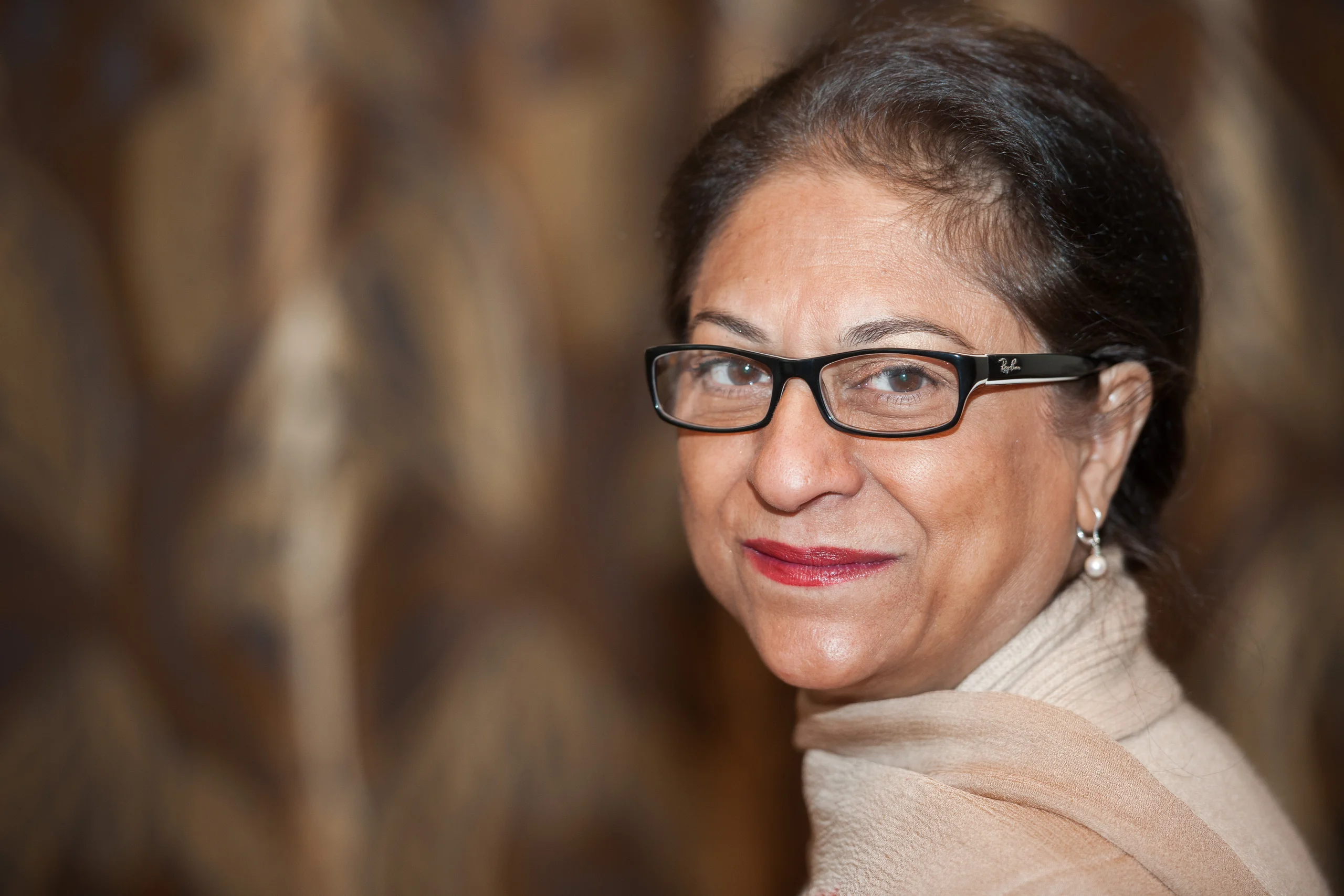
Asma Jahangir
 Pakistan
human rights defender•lawyer•jurist
Also known as: Asma Jilani Jahangir
Birthday
January 27, 1952
Birth Sign
Sagittarius
Birthplace
Lahore, Pakistan
Age
Died at 66
About
Asma Jahangir was a preeminent Pakistani human rights lawyer, jurist, and activist whose career spanned nearly four decades of fearless advocacy for the marginalized. Born on January 27, 1952, in Lahore, she dedicated her life to dismantling discriminatory laws and defending those accused of blasphemy or victims of state violence. She passed away on February 11, 2018, in Lahore at the age of 66 due to a heart attack. Jahangir broke significant barriers as the first woman to lead the Supreme Court Bar Association of Pakistan and served as the United Nations Special Rapporteur on Freedom of Religion or Belief from 2004 to 2010. She received the Right Livelihood Award in 2014 and the Ramon Magsaysay Award in 2005 for her courageous defense of the vulnerable.
Jahangir is recognized globally as a giant within the human rights movement, honored by UN High Commissioner Zeid Ra'ad Al Hussein with that specific title. Her legacy is defined by her unwavering commitment to the rule of law, often standing alone against extremism. She authored influential books such as The Hudood Ordinance: A Divine Sanction? and Children of a Lesser God, analyzing religious laws in Pakistan. Despite receiving death threats and facing mob violence, including an attack on her car in 2018, she refused to abandon clients accused of blasphemy. Her work extended to Iran, where she held the position of UN Special Rapporteur on the Situation of Human Rights until her death. She remains a symbol of courage, frequently cited in academic literature as one of the most significant defenders of the late 20th and early 21st centuries.
Early Life & Background
Asma Jahangir was born into a prominent legal family in Lahore. Her father, Barrister Mubashir Hassan, served as Pakistan's Minister of Law and Justice, while her mother, Shahnaz Jahan, worked as a social worker. This environment immersed her in law and public service from an early age. She attended the Convent of Jesus and Mary, a prestigious Catholic school in Lahore, which exposed her to diverse perspectives in a predominantly Muslim society. She earned her LLB degree from Punjab University Law College in 1973. Jahangir was called to the Bar at the Lahore High Court in 1980 and later admitted to the Supreme Court of Pakistan in 1982. Before achieving international fame, her early career was defined by her refusal to remain silent under military dictatorships. In 1983, during the regime of General Zia-ul-Haq, she was imprisoned for three months for opposing the military government's policies, specifically regarding the Hudood Ordinances. This imprisonment did not deter her; instead, it galvanized her resolve to fight for civil liberties. In 1981, she co-founded the Women's Action Forum (WAF), a coalition of women lawyers and activists that played a pivotal role in resisting the Islamization policies of the Zia era.
Her early education at a Catholic school in a Muslim-majority city shaped her inclusive worldview. She began practicing law in the 1970s, taking on cases involving women's rights before the major political shifts of the 1980s. The formation of WAF in 1981 marked her first major organizational leadership role, leading protests against the Hudood Ordinances. These formative years established her reputation as a fierce defender of women's rights long before her international recognition. Her initial legal battles focused on the intersection of religion, law, and gender justice, setting the stage for her future work with the HRCP.
Career Growth
Jahangir's career is marked by a series of groundbreaking achievements that reshaped the legal landscape in Pakistan. In 1987, she co-founded the Human Rights Commission of Pakistan (HRCP) and served as its Chairperson for many years. Her leadership in the Lawyers' Movement from 2007 to 1998 helped restore the judiciary and remove General Pervez Musharraf. She established the AGHS Legal Aid Cell, providing free legal representation to the poor, particularly women and religious minorities. She also took on numerous blasphemy cases, representing individuals facing the death penalty, often while receiving death threats from extremist groups.
Her international work included serving as the United Nations Special Rapporteur on Freedom of Religion or Belief from 2004 to 2010, conducting country visits to nations like Sri Lanka, Myanmar, and Israel/Palestine. From 2016 until her death, she served as the UN Special Rapporteur on the Situation of Human Rights in Iran, a role she held with unwavering commitment. She was appointed President of the Supreme Court Bar Association of Pakistan from 1998 to 2004, becoming the first woman to hold this position. In 1995, she received the Martin Ennals Award for Human Rights Defenders, becoming the first Asian woman to receive this honor.
Jahangir also received the Liberal International Prize for Freedom in 2000 and the Legion of Honour (France) as an Officer. She was named to TIME 100 in 2018 posthumously. Her leadership in the 2007-2009 Lawyers' Movement sought to restore democracy, marching alongside thousands of lawyers. She faced an attack on her car in 2018 but continued her work. Her tenure as UN Special Rapporteur on Iran was notable for critical reports on the treatment of women and dissidents, earning her both acclaim and condemnation from the Iranian regime.
Career Timeline
Public Image & Style
Jahangir was known for her commanding presence and signature style of wearing traditional Pakistani shalwar kameez, often paired with a dupatta, reflecting her cultural roots and professional demeanor. She rarely adopted Western business attire, maintaining a distinctively South Asian professional aesthetic. Media portrayals focused on her bravery in the face of death threats and her unwavering commitment to the rule of law. Her public persona was that of a fearless warrior for justice, often depicted as a lioness standing up to tyranny. She was respected across political divides for her integrity and dedication to human dignity, earning her the title of 'giant within the global human rights movement' from UN officials.
While she did not appear on commercial fashion magazine covers like Vogue, her image graced the covers of human rights journals and legal publications. She appeared on the cover of The Nation (Pakistan) and was featured prominently in The New York Times obituary section. Her physical attributes, though not officially recorded, are described in contemporary accounts as having a commanding presence. She is remembered for her quotes, such as "I am not afraid of death. I am only afraid of living a life without purpose," which cemented her image as a moral compass for the nation.
Fame & Fandom
Asma Jahangir's global renown rests on decades of fearless legal advocacy, not on the metrics of popular culture. As of September 2026, iFANN's Global Fame Engine has evaluated her standing, but she does not currently hold a placement in the published rankings, whether the Global Top 1,000 or any Top-100 scope list. This is a neutral observation, not a reflection on her legacy, which remains monumental in the fields of human rights and law. Her admirers, primarily fellow lawyers, activists, and citizens who saw her as a moral compass, have never coalesced into a formal fandom. No documented name exists for those who hold her in high regard, and there are no fan clubs, billboards, or chart campaigns associated with her.
Instead, her legacy is carried by institutions she helped build, such as the Human Rights Commission of Pakistan and the AGHS Legal Aid Cell, which continue her work. Memorial events, like the Asma Jahangir Conference, serve as platforms for honoring her memory, but these are institutional tributes rather than fan-driven initiatives. There is no official social media account belonging to Asma Jahangir herself, as she passed away in 2018. However, organizations named after her, such as the Asma Jahangir Foundation and the Human Rights Commission of Pakistan, maintain active social media profiles on platforms like Twitter (X), Facebook, and Instagram, where they share updates on her legacy. In 2024, a major gathering of judges, lawyers, and luminaries celebrated her legacy, reaffirming her impact on the legal community. In 2026, discussions continue among Gen Z feminists and activists about her strategies and writings.
Interesting Facts and Legends
One of the most retold stories from Jahangir's career involves her defense of Safia Bibi, a blind teenage rape survivor who was initially convicted of adultery. Jahangir took up the case and secured her acquittal, a victory that became emblematic of her courage in challenging discriminatory laws. The New York Times headlined her obituary 'Fearless Pakistani Rights Activist,' and Human Rights Watch called her a 'Human Rights Icon.' After her death in 2018, candlelight vigils and statements from global bodies underscored the widespread mourning, cementing her status as a 'giant' in the human rights movement, as the UN High Commissioner described her.
She authored several books, including The Hudood Ordinance: A Divine Sanction? and Children of a Lesser God. Her sudden death triggered an outpouring of grief across Pakistan and the international community. Thousands of mourners, including judges, lawyers, politicians, and ordinary citizens, gathered for her funeral in Lahore, where she was buried following Islamic rites. Her legacy was immediately honored by institutions such as the Right Livelihood Foundation and Liberal International. She received honorary degrees from several universities, including the University of California, Berkeley. She famously stated, "The law is not just a set of rules; it is a tool for justice."
Notable Quotes
“I am not afraid of death. I am only afraid of living a life without purpose.”
“The law is not just a set of rules; it is a tool for justice.”
“If you want to change the world, you must be willing to stand alone.”
“Blasphemy accusations are often used as tools of vengeance, and we must defend the accused even when the whole world turns against them.”
Family & Personal Life
Asma Jahangir was married to Barrister Naeem Bokhari, a fellow human rights lawyer and activist. They were partners in both life and professional advocacy, raising two children together: Hina Bokhari and Irfan Bokhari. Both children have followed in their parents' footsteps, practicing law and continuing their human rights work. The couple worked closely together throughout their careers, often sharing the podium in high-profile legal battles. There are no public records of other romantic relationships, divorces, or separations. Jahangir remained married to Bokhari until her death in 2018. Her husband continued her work through various foundations after her passing.
Her son, Barrister Irfan Bokhari, and daughter, Barrister Hina Bokhari, are active lawyers who maintain her legacy. The family continues to manage the Asma Jahangir Foundation. No new relationships or marriages occurred after her death, and she has been deceased since 2018. Her family legacy is deeply intertwined with the human rights movement in Pakistan, with both children actively participating in legal advocacy and organizing events to honor her memory.
Notable Connections
Relationships & Dating History
Asma Jahangir was married to Barrister Naeem Bokhari, a fellow human rights lawyer and activist. The couple worked closely together throughout their careers, often sharing the podium in high-profile legal battles. They were partners in both life and professional advocacy, raising two children together. There are no public records of other romantic relationships, divorces, or separations. Jahangir remained married to Bokhari until her death in 2018. As of the date of her passing, she was widowed by her husband, who continued her work through various foundations. No new relationships or marriages occurred after her death, and she has been deceased since 2018.
- MarriedNaeem BokhariUnknown - 2018Fellow human rights lawyer and activist; partners in life and advocacy until her death.
Death & Aftermath
Died
February 11, 2018 (aged 66)
Death Place
Lahore, Pakistan
Cause of Death
Heart attack (myocardial infarction)
Asma Jahangir spent her final days in Lahore continuing her legal advocacy for the marginalized before being admitted to the Aga Khan University Hospital on February 11, 2018, following reports of chest pain and difficulty breathing. She passed away at the age of 66 due to a cardiac arrest, a natural occurrence confirmed by medical professionals present at the time. The immediate reaction from the global community was one of profound loss, with UN High Commissioner Zeid Ra'ad Al Hussein describing her as a giant within the movement, while Amnesty International and Human Rights Watch issued tributes honoring her decades of confronting discriminatory laws.
Vigils were held across Pakistan where mourners lit candles to mark the end of a career. Her funeral procession moved through the streets of Lahore, attended by hundreds of lawyers, activists, and political figures, before she was laid to rest in the graveyard of the Shah Alam Mosque. Posthumous recognition has continued through events such as the Asia Society gathering and a 2024 celebration of her legacy by judges and luminaries, while the Asma Jahangir Foundation remains active in carrying forward her work in human rights and legal aid.
Net Worth (Estate Value)
$100,000
iFANN Editorial Team estimate
As a public interest lawyer and activist, Asma Jahangir did not accumulate wealth in the manner of corporate executives or entertainers. Estimates of her personal net worth are difficult to pinpoint because her assets were primarily modest real estate holdings in Lahore and savings accumulated from legal fees, which she often donated to her legal aid cells. There is no publicly available "2026 net worth" figure for celebrities comparable to her, as she lived a life of austerity focused on service rather than accumulation. Following her death, her estate value is estimated to be modest, likely in the range of $50,000 to $150,000 USD equivalent, consisting mainly of property and minimal liquid assets. The management of her legacy falls to the Asma Jahangir Foundation and her family, not a commercial estate management entity generating posthumous royalties. Unlike entertainment figures, she had no music catalogs, film royalties, or brand endorsements driving estate income. iFANN currently estimates Asma Jahangir's estate value at approximately $100,000 based on available asset reports and the nature of her public service career.
Awards Won (5)
Asma Jahangir won the Martin Ennals Award for Human Rights Defenders in 1995, the Ramon Magsaysay Award in 2005, and the Right Livelihood Award in 2014. She was also honored with the Legion of Honour (Officer rank) by France and the Liberal International Prize for Freedom in 2000. Her contributions were recognized with honorary doctorates from several universities, including the University of California, Berkeley.
1995 · Human Rights
General Advocacy
2000 · Human Rights
General Advocacy
Known For
Defense of Safia Bibi
1992 · Legal Counsel
UN Special Rapporteur on Freedom of Religion or Belief
2004 · UN Official
UN Special Rapporteur on the Situation of Human Rights in Iran
2016 · UN Official
Human Rights Commission of Pakistan
1987 · Co-founder and Chairperson
Keywords
Sources
Quick Facts
- Profession
- human rights defender, lawyer, jurist
- Born
- January 27, 1952
- Birthplace
- Lahore, Pakistan
- Died
- February 11, 2018
- Death Place
- Lahore, Pakistan
- Gender
- Female
- Birth Sign
- Sagittarius
Personal Details
- Full Name
- Asma Jilani Jahangir
- Spouse
- Naeem Bokhari
- Children
- Hina Bokhari · Irfan Bokhari
- Education
- LLB from Punjab University Law College (1973)
Frequently Asked Questions
Who was Asma Jahangir?
When did Asma Jahangir die?
What was Asma Jahangir's most famous case?
Did Asma Jahangir have any children?
What awards did Asma Jahangir win?
Similar People
Join the community
fans discussing