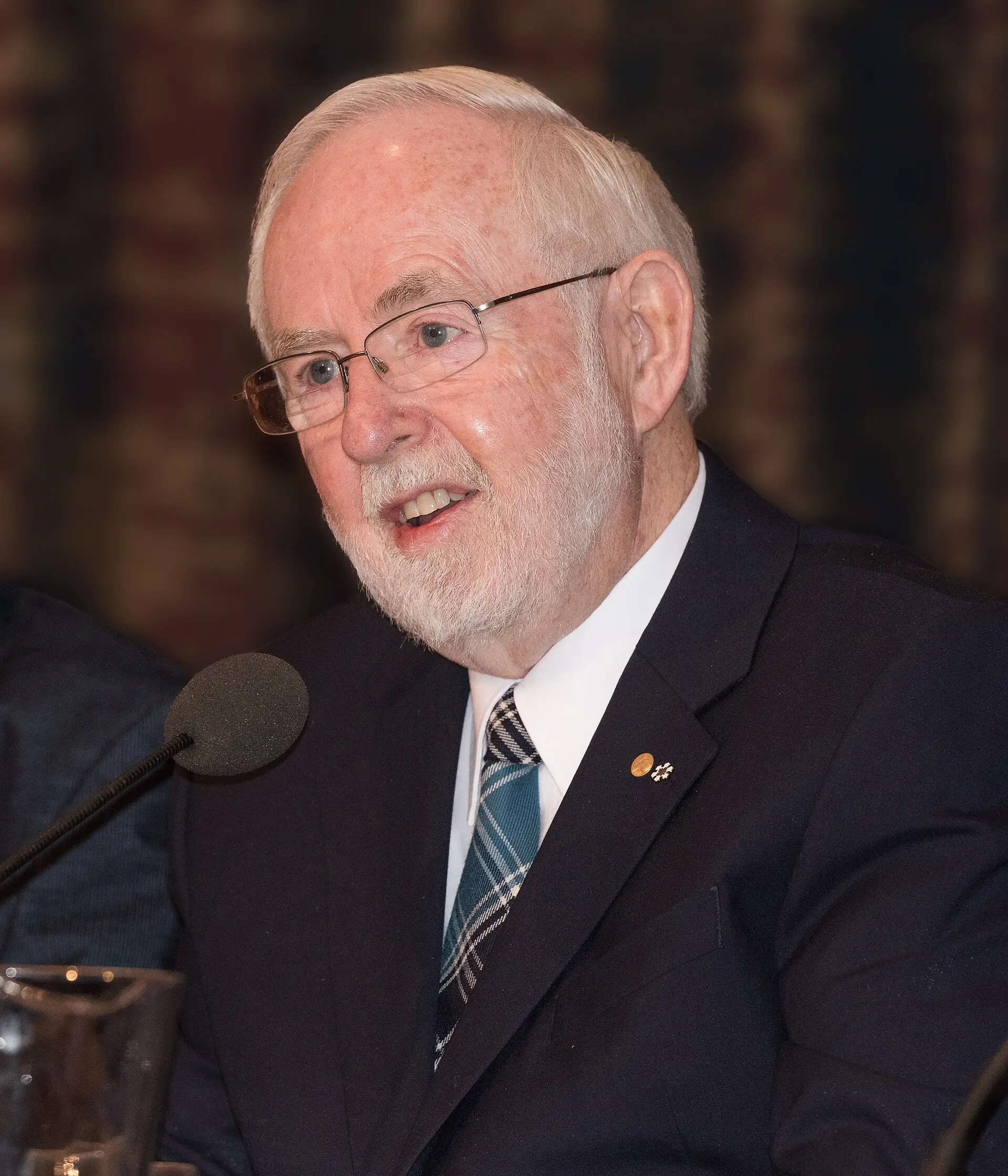
Arthur B. McDonald
 Canada
physicist•university teacher•astrophysicist
Also known as: Arthur Bruce McDonald, Arthur McDonald
Birthday
August 29, 1943
Birth Sign
Virgo
Birthplace
Sydney, Nova Scotia, Canada
Age
83 years old
About
Arthur Bruce McDonald is a Canadian astrophysicist and particle physicist whose work on neutrinos transformed our understanding of the universe. He is best known as the director of the Sudbury Neutrino Observatory (SNO) Collaboration, where his team proved that neutrinos change flavor as they travel, demonstrating that these elusive particles have mass. This landmark discovery earned him the 2015 Nobel Prize in Physics, shared with Japanese physicist Takaaki Kajita.
Now professor emeritus at Queen's University in Kingston, Ontario, McDonald remains an active researcher, contributing to the SNO+, DEAP, and DarkSide experiments. His career has been defined by collaborative science and a commitment to mentoring the next generation of physicists. He has received numerous honors, including the Order of Canada, and a national research institute bears his name.
Early Life & Background
Growing up in Sydney, Nova Scotia, McDonald showed an early aptitude for mathematics and physics. He stayed close to home for his undergraduate degree, earning a BSc in physics from Dalhousie University in Halifax. His professors there recognized his potential and encouraged him to pursue graduate studies, which led him to the California Institute of Technology.
At Caltech, McDonald worked under William Fowler, a nuclear astrophysicist who would later win the 1983 Nobel Prize in Physics. Fowler's mentorship shaped McDonald's approach to experimental physics, emphasizing precision and curiosity. McDonald completed his PhD in 1970, focusing on nuclear reactions that power stars.
After Caltech, McDonald moved to Princeton University's Chalk River Nuclear Laboratories in Ontario, Canada. There he spent nearly two decades conducting research in nuclear physics, building detectors and studying fundamental particles. The work laid the groundwork for his later career in neutrino physics, though at the time, neutrinos were still considered massless particles that barely interacted with matter.
Career Growth
McDonald joined Queen's University in Kingston, Ontario, in 1989 as a professor of physics. His appointment came just as the international physics community was grappling with the solar neutrino problem: detectors on Earth were finding only about a third of the neutrinos predicted by solar models. Either the models were wrong, or neutrinos were transforming into undetectable forms.
In the early 1990s, McDonald took the helm of the Sudbury Neutrino Observatory (SNO) Collaboration. The experiment was built 2 kilometers underground in a working mine near Sudbury, Ontario, using 1,000 tonnes of heavy water borrowed from Canada's nuclear program. The detector was designed to be sensitive to all three neutrino flavors, something no previous experiment had achieved.
In 2001 and 2002, SNO published its landmark results: neutrinos from the sun were indeed oscillating between flavors, proving they have mass. The finding solved a 30-year-old puzzle and earned McDonald and Kajita the 2015 Nobel Prize in Physics. McDonald held the Gordon and Patricia Gray Chair in Particle Astrophysics from 2006 to 2013, and in 2018, the Arthur B. McDonald Canadian Astroparticle Physics Research Institute was launched in his honor.
Career Timeline
Public Image & Style
McDonald is widely regarded as a humble and collaborative scientist, a stark contrast to the stereotype of the lone genius. Media profiles often highlight his calm leadership of the SNO Collaboration, a massive international effort that required coordinating dozens of researchers and engineers. He is known for his measured speaking style and his tendency to credit others for the success of the experiment.
In Canada, McDonald is celebrated as a national science hero, and his Nobel win was front-page news across the country. He has no celebrity fandom, but he is a revered figure in physics education, frequently invited to give talks at universities and public events. His legacy is cemented by the Arthur B. McDonald Canadian Astroparticle Physics Research Institute, which continues to train young researchers.
Fame & Fandom (iFAMOUS Rankings)
Arthur B. McDonald commands a sphere of influence defined not by screaming crowds or viral hashtags, but by the profound silence of deep underground laboratories and the reverent attention of academic peers. Unlike pop stars who cultivate armies of followers, this Canadian astrophysicist has no organized fanbase with a formal name, nor does he have a community that rallies around his personal life or birthday celebrations. His audience consists strictly of students, early-career researchers, and the global scientific community that honors his mentorship through institutions like the Arthur B. McDonald Fellowship rather than fan clubs. In 2026, a mural unveiled at Queen's University served as an institutional tribute to his legacy, marking the boundary between public adoration and professional respect. Despite his monumental contributions to physics, iFANN's Global Fame Engine evaluated his profile in August 2026 and found him to be EVALUATED_UNRANKED. He does not currently hold a placement in the published rankings, including the Global Top 1,000 or any scope-specific top-100 lists. This absence from the charts reflects a reality where fame is measured in citations and Nobel Prizes rather than search volume or media consumption signals worldwide. While he lacks the metrics of a celebrity, his standing remains unshaken within the hierarchy of human discovery, proving that true impact often exists beyond the reach of standard popularity algorithms.
Interesting Facts and Legends
McDonald's path to greatness began under the tutelage of William Fowler, a physicist who secured the Nobel Prize in Physics in 1983, exactly 32 years before McDonald claimed his own honor. The Sudbury Neutrino Observatory detector itself was constructed inside an active mine, utilizing heavy water that was loaned directly from Atomic Energy of Canada Limited for the duration of the experiment. McDonald stands as one of the rare Canadian scientists to have a national research institute named in his honor while he is still alive. He maintains a deliberate distance from the digital age, possessing no public social media presence and preferring to stay out of the spotlight. During his 2015 Nobel Banquet speech, he focused entirely on the collective effort of the SNO collaboration, which brought together over 100 researchers from multiple nations to achieve their breakthrough. The defining legend of his career emerged from the quiet depths of the observatory, where his team proved neutrinos change flavor as they travel, resolving the decades-long solar neutrino problem. This discovery did not just win a prize; it fundamentally altered our understanding of the universe's building blocks.
Notable Quotes
“The discovery of neutrino oscillations has opened a new window on the universe.”
“Science is a collaborative endeavor, and the SNO experiment was a testament to that.”
“We are all standing on the shoulders of giants.”
Family & Personal Life
McDonald keeps his family life private. He is married, and his wife accompanied him to the Nobel Prize ceremony in Stockholm in December 2015. The couple has children, though their names and occupations are not public. McDonald has mentioned that his family's support was crucial during the long years of the SNO experiment, which required frequent travel and extended periods away from home. He grew up in Sydney, Nova Scotia, in a close-knit community, and he has spoken fondly of his Maritime roots.
Notable Connections
McDonald's most famous collaborator is Takaaki Kajita, with whom he shared the 2015 Nobel Prize in Physics. His PhD advisor, William Fowler, won the Nobel in 1983. The SNO Collaboration involved hundreds of researchers from Canada, the US, and the UK, many of whom have gone on to prominent careers in physics.
Relationships & Dating History
McDonald has been married to his wife for many years, though her name is not publicly known. She accompanied him to the Nobel Prize ceremony in Stockholm in December 2015, and he thanked her in his banquet speech for her support during the demanding years of the SNO experiment.
There are no public records of any previous relationships, and McDonald has kept his personal life entirely out of the media. As of 2026, he remains married, and the couple resides in Kingston, Ontario.
- MarriedCurrentSpouse's name not publicly known; attended Nobel ceremony with him in 2015.
Salary, Net Worth In 2026
$5 Million
iFANN Editorial Team estimate
iFANN currently estimates Arthur B. McDonald's net worth at $5 Million. His financial standing derives primarily from his long-standing academic career, encompassing his salary as a professor at Queen's University and his pension as professor emeritus. The 2015 Nobel Prize carried a monetary award of 8 million Swedish kronor, with McDonald's share amounting to about 4 million SEK, roughly equivalent to $550,000 USD at the time. McDonald has never pursued commercial ventures or endorsements, keeping his wealth modest compared to celebrities. His financial situation reflects a life dedicated to research and teaching, with savings built over decades of university employment and the Nobel prize money. He holds no known real estate investments or other significant assets beyond his retirement savings.
Awards Won (9)
McDonald's most prestigious honor is the 2015 Nobel Prize in Physics, shared with Takaaki Kajita. He has also received the Benjamin Franklin Medal in Physics, the NSERC Herzberg Gold Medal, and the Killam Prize. He is a Companion of the Order of Canada and a member of the U.S. National Academy of Sciences.
2015 · Physics
Discovery of neutrino oscillations
Physics
Solar neutrino problem
Known For
Discovery of neutrino oscillations
2001–2002 · Director of SNO Collaboration
Nobel Prize in Physics
2015 · Co-recipient
Keywords
Sources
Quick Facts
- Profession
- physicist, university teacher, astrophysicist
- Born
- August 29, 1943
- Birthplace
- Sydney, Nova Scotia, Canada
- Gender
- Male
- Birth Sign
- Virgo
Personal Details
- Full Name
- Arthur Bruce McDonald
- Education
- BSc in Physics, Dalhousie University; PhD in Physics, California Institute of Technology (1970)
Frequently Asked Questions
What did Arthur B. McDonald win the Nobel Prize for?
Is Arthur B. McDonald still alive?
Where is Arthur B. McDonald from?
What is the Sudbury Neutrino Observatory?
How old is Arthur B. McDonald?
Similar People
Join the community
fans discussing