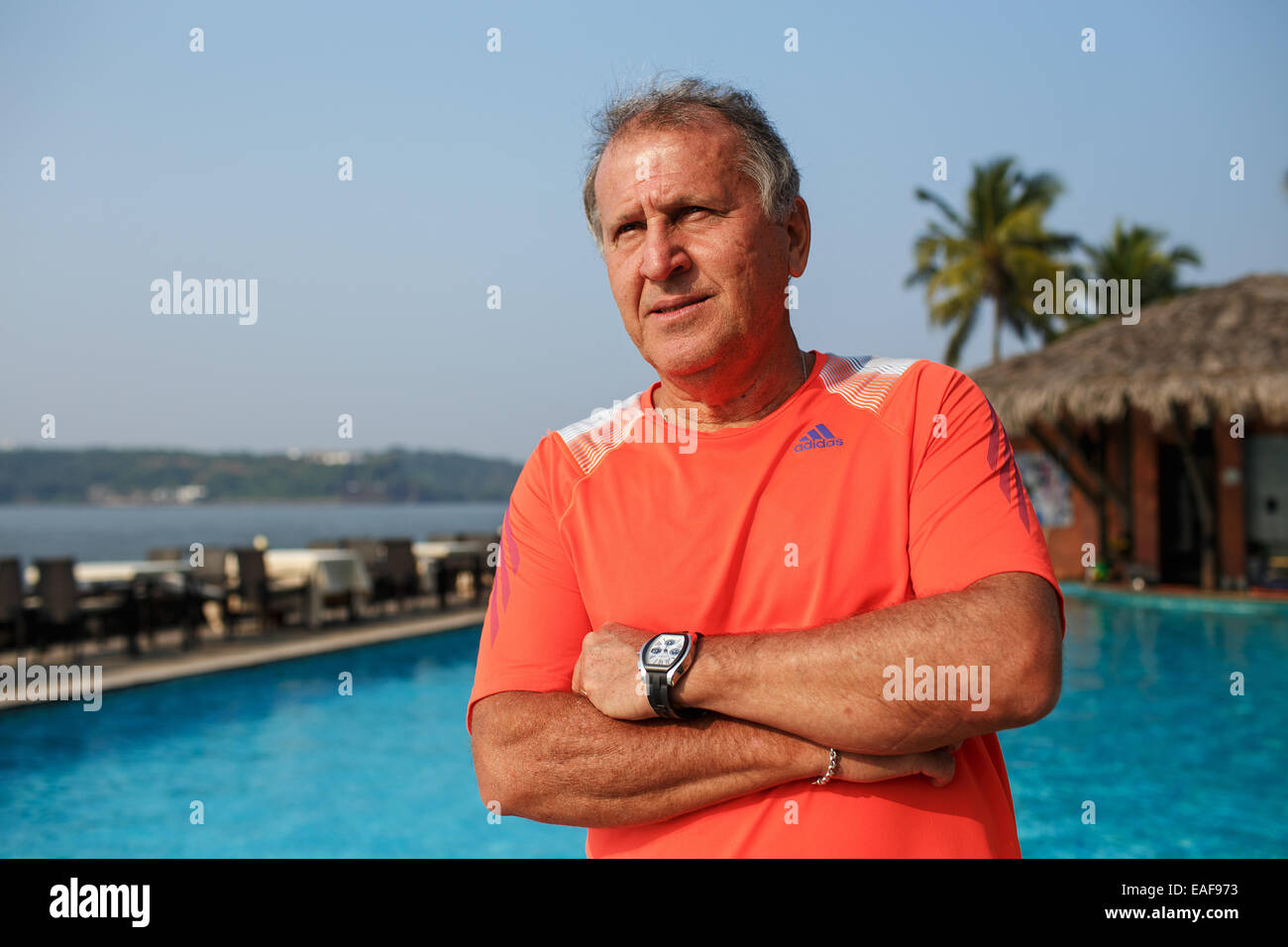
Arthur Antunes Coimbra
 Brazil
association football player•association football coach
Also known as: Zico, O Pelé Branco
Birthday
March 3, 1953
Birth Sign
Pisces
Birthplace
Rio de Janeiro, Brazil
Age
73 years old
Height
5 ft 8 in (1.72 m)
About
Arthur Antunes Coimbra, universally known as Zico, is a Brazilian former professional footballer and current coach widely regarded as one of the greatest attacking midfielders in history. Born on March 3, 1953, in Rio de Janeiro, he stands at 1.72 meters tall and is celebrated for his technical mastery, vision, and legendary free-kick ability. While he never won a World Cup with the national team, he remains the fifth-highest goal scorer in Brazil's history with 48 goals in 71 appearances. His legacy extends far beyond South America after he helped establish the J-League in Japan during the early 1990s, earning him induction into the Japan Football Hall of Fame in 2016. He was named FIFA Player of the Century in 1999, placing seventh globally, and included in the prestigious FIFA 100 list of the world's greatest living players in 2004. Today at 73 years old, Zico continues to influence the sport through coaching and philanthropy, having recently served as a keynote speaker at RootsTech in 2026. The iFANN Global Fame Rankings currently place him as the 39th most famous person from Brazil and the 58th most famous figure in the Creators & Influencers category. His life story remains a testament to loyalty, skill, and the power of cross-cultural sports diplomacy.
Early Life & Background
Arthur Antunes Coimbra entered the world on March 3, 1953, in the São Cristóvão neighborhood of Rio de Janeiro. His father, also named Arthur, worked as a dockworker while his mother Maria managed the household, creating a modest environment that shaped his humble beginnings. Like countless children in Brazil, Arthur found his first love on the dusty streets where he played barefoot soccer with friends. These informal games honed the ball control and agility that would later define his professional career. He attended local schools but spent almost every waking hour on the pitch, developing a reputation as a prodigy long before anyone noticed. The pivotal moment arrived in 1969 when the 16-year-old joined the youth system of Flamengo. Unlike many talented peers who looked toward European clubs for better opportunities, Zico chose to stay loyal to his hometown club. He progressed rapidly through the ranks, catching the eye of coaches with his vision and scoring prowess. By the time he made his professional debut in 1971, he had already transformed into a star within the club's structure. This period of intense development laid the groundwork for a career that would eventually span two decades across three continents.
Career Growth
Zico's professional journey began in earnest in 1971 when he debuted for Flamengo. He quickly became the heart of the team, leading them to numerous state championships and the prestigious Copa Libertadores in 1981. That year stands out as a peak in his career; he scored an incredible 46 goals in a single calendar season, a feat often cited as one of the greatest individual performances in South American football history. Over his first stint with Flamengo, he netted over 100 goals in official matches, cementing his status as a club legend. On the international stage, he represented Brazil in three World Cups: 1978, 1982, and 1986. The 1982 squad, featuring stars like Socrates and Falcão alongside Zico, is frequently remembered as the greatest team never to win the tournament. Although they were eliminated by Italy in the second group stage, their beautiful style of play left an indelible mark on the sport. After a brief and injury-plagued spell at Udinese in Italy from 1983 to 1985, where he scored 14 goals in 52 appearances, he returned to Flamengo before making a transformative move to Japan.
In 1991, Zico joined Kashima Antlers as a player-coach, playing a crucial role in establishing the J-League. He retired from playing in 1994 after scoring 100 goals for the Japanese club. His transition to management was equally successful, highlighted by leading the Japan national team to victory in the 2004 Asian Cup and guiding them to the 2006 World Cup. He also managed Fenerbahçe, reaching the UEFA Champions League quarter-finals in 2008, and coached CSKA Moscow, Olympiacos, and the Iraq national team. In 2015, he announced his candidacy for the FIFA presidency, though he did not win. He served as Technical Director for Kashima Antlers until recently, receiving an honorary degree for his contributions to sports and education.
Career Timeline
Public Image & Style
Zico is portrayed as a dignified, intelligent, and passionate figure in the media. His public persona is characterized by thoughtful interviews and a strong focus on youth development and education. He is seen as a cultural bridge between Brazilian and Japanese football traditions, respected for his humility and leadership. Unlike some flashy stars, his image relies on technical brilliance and sportsmanship rather than controversy. He maintains a low-key presence on social media, using platforms like Instagram, where he has 4 million followers, to share updates on football and social causes rather than personal drama. His faith as a devout Christian is often cited as a central pillar of his life and success, influencing his approach to coaching and community service.
Fame & Fandom
Arthur Antunes Coimbra commands a fanbase that transcends the typical celebrity following, rooted instead in the deep institutional loyalty of Flamengo supporters. While his admirers are formally identified as Flamenguistas, a specific subset of devotees often elevates him with the moniker O Pelé Branco, or the White Pelé, reflecting their belief in his unique ability to dominate matches with technical brilliance comparable to the legendary forward. This devotion is expressed not through transient digital trends but through enduring rituals at the Maracanã Stadium, where crowds perform human mosaics and sing dedicated chants celebrating his golden era. His influence extends into philanthropy via the Zico Foundation, allowing fans to engage with his legacy through youth development programs rather than independent campaigns.
The scale of his global standing is quantified by the iFANN Global Fame Rankings, which track attention across media coverage, search activity, and consumption signals worldwide. Current data places him as the 39th most famous person from Brazil, holding steady from the previous cycle. He also holds the rank of the 58th most famous person in Creators & Influencers, maintaining his position from the prior assessment. Within the broader sphere of digital and cultural figures, he stands as a revered icon whose legacy is preserved through annual tributes and fan-driven campaigns supporting his charitable work.
Interesting Facts and Legends
Zico holds the distinction of being the first Brazilian player to join the J-League, a move credited with popularizing football in Japan and elevating its standards to international levels. He scored over 100 free-kick goals throughout his career, a rare achievement that few modern players can match. His son Eduardo also became a professional footballer and played alongside him at Kashima Antlers, creating a unique father-son duo in professional history. Beyond the pitch, Zico is a devout Christian who often cites his faith as a central pillar of his life and success. In August 2026, he was featured in a documentary screening at the CineFoot festival in Rio de Janeiro, highlighting his legacy alongside other legends like Maradona. He was also announced as a keynote speaker for the RootsTech conference in March 2026, discussing his journey and faith-based motivations. Additionally, he received the Key to the City of Kashima in recognition of his impact on the city and the J-League.
Notable Quotes
“Football is not just a game; it is a way of life.”
“In Japan, I found a second home and a second family.”
“The 1982 team was special because we played with our hearts, not just our skills.”
Family & Personal Life
Zico has maintained a relatively private family life compared to modern celebrities. He married Maria Helena Antunes Coimbra in 1975, and the couple has been together since their teenage years. They have four children: Arthur Jr., Eduardo, Gabriel, and Rafael. The family lives a stable life amidst his high-profile career, often appearing together at charity events and club functions. His son Eduardo followed in his footsteps, becoming a footballer who played alongside his father at Kashima Antlers. The family resides primarily in Brazil but maintains strong ties to Japan due to Zico's coaching tenure there. No other romantic relationships have been publicly confirmed by credible sources; his marriage to Maria Helena remains the only documented long-term partnership. The couple's enduring bond serves as a cornerstone of Zico's personal stability throughout his global career.
Notable Connections
Pelé, Sócrates, Eduardo Coimbra, Marcelo Bielsa, Steve Young
Relationships & Dating History
Zico has maintained a remarkably stable personal life throughout his fame. He married Maria Helena Antunes Coimbra in 1975, and the couple has been together since their teenage years. Their relationship is one of the longest-lasting partnerships in Brazilian football history. There are no public reports of separation or divorce, and the couple continues to be a staple in the Brazilian football community, often appearing together at charity events and club functions. No other romantic relationships have been publicly confirmed by credible sources; his marriage to Maria Helena remains the only documented long-term partnership. The couple's unity has allowed them to navigate the pressures of international stardom while raising their four children in a supportive environment.
- MarriedMaria Helena Antunes Coimbra1975 - presentCurrentMet as teenagers; married in 1975; four children together.
Salary, Net Worth In 2026
$15 Million
iFANN Editorial Team estimate
As of 2026, research by the iFANN Editorial Team puts Zico's fortune at around $15 million, with an average consensus estimate hovering near $12.3 million based on various financial reports. This estimate reflects his diverse income streams spanning decades of high-level football and coaching. His wealth comes primarily from lucrative coaching contracts with major clubs like Fenerbahçe, CSKA Moscow, and significant roles with national teams including Japan and Iraq. Endorsement deals with Japanese brands such as Asics and Mizuno, along with Brazilian corporations, have provided steady revenue throughout his post-playing career.
Beyond salaries, Zico has invested wisely in real estate in both Rio de Janeiro and Tokyo, and owns a football academy in Brazil. He earns additional income through media appearances, paid speaking engagements, and merchandise sales linked to his foundation. The financial trajectory of his career shows consistent growth, moving from a player's salary to a high-earning executive and ambassador. His estate value continues to appreciate through licensing and royalties from his legacy in the J-League and Brazilian football, ensuring his financial stability well into his retirement years.
Awards Won (6)
Zico's trophy cabinet includes the Copa Libertadores in 1981 and the Asian Cup in 2004 as a coach. He was named FIFA Player of the Year in both 1981 and 1983, recognizing his dominance on the field. His contributions to Japanese football earned him induction into the Japan Football Hall of Fame in 2016. He received the Globe Soccer Awards Lifetime Achievement Award in 2013 and was ranked seventh in the FIFA Player of the Century vote in 1999. Additionally, he was included in the FIFA 100 list of the greatest living players in 2004.
1981 · Club Competition
Flamengo
1983 · Individual
Career
1981 · Individual
Career
Known For
Flamengo
1981 · Player
Brazil National Team
1982 · Player
Kashima Antlers
1991 · Player/Coach
Japan National Team
2004 · Coach
Keywords
Sources
Quick Facts
- Profession
- association football player, blogger, association football coach
- Born
- +1953-03-03
- Birthplace
- Rio de Janeiro
- Gender
- Male
- Birth Sign
- Pisces
Personal Details
- Full Name
- Arthur Antunes Coimbra
- Height
- 5 ft 8 in (1.72 m)
- Spouse
- Maria Helena Antunes Coimbra
- Children
- Arthur Jr. · Eduardo · Gabriel · Rafael
- Education
- Local schools in Rio de Janeiro
Filmography
1
Total
0
Film
1
TV
Frequently Asked Questions
How old is Zico?
Is Zico still alive?
What is Zico's net worth?
Did Zico win a World Cup?
Who is Zico married to?
Similar People
Join the community
fans discussing