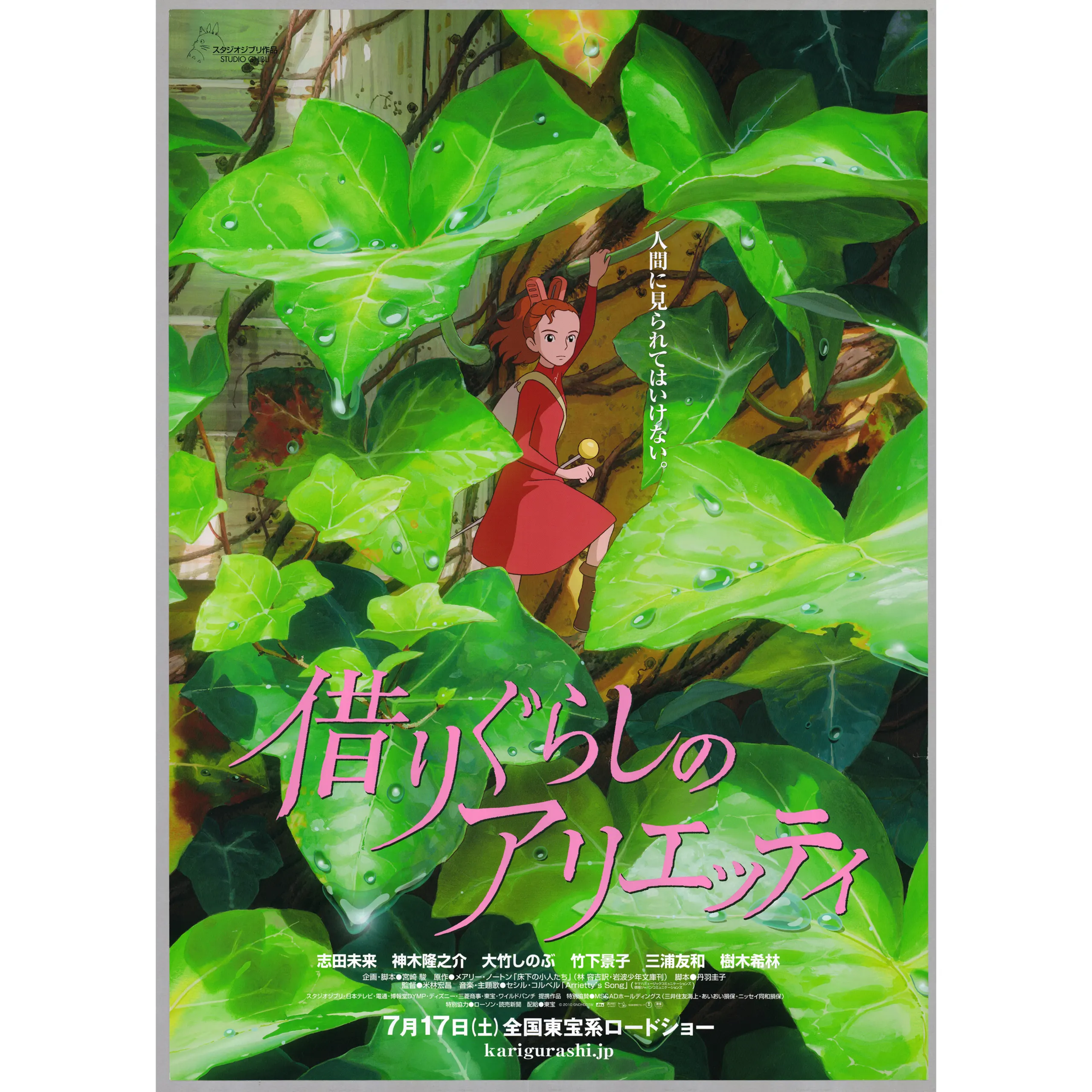
 Japan
Japan“The Secret World of Arrietty is a lovely, delicate film, a miniature masterpiece of visual storytelling that is both faithful to its source and wholly original.”
A.O. Scott
The New York Times
Part of a Collection
Arrietty, also known as Arrietty the Borrower in Japan and The Secret World of Arrietty in North America, is a 2010 Japanese animated fantasy film directed by Hiromasa Yonebayashi in his feature directorial debut. Produced by Studio Ghibli, the film adapts Mary Norton's 1952 novel The Borrowers, about a family of tiny people who live secretly within the walls and floors of a human household, borrowing items to survive. The screenplay was crafted by Hayao Miyazaki and Keiko Niwa. The Japanese voice cast includes Mirai Shida as Arrietty, Ryunosuke Kamiki as Sho, with Shinobu Otake, Keiko Takeshita, Tatsuya Fujiwara, Tomokazu Miura, and Kirin Kiki in supporting roles. The story follows a young Borrower named Arrietty who befriends a human boy named Sho, while both try to avoid detection by other humans.
Ghibli announced the project in late 2009, with Yonebayashi stepping into the director's chair and Miyazaki supervising as a developing planner. The voice actors were cast in April 2010, and French singer-songwriter Cécile Corbel composed the score and theme song. The film also marks the cinematic debut of Tom Holland, who voiced Sho in the British English dub. Released in Japan on July 17, 2010, by Toho, Arrietty received positive reviews for its animation and music. It became the highest-grossing Japanese film at the domestic box office in 2010, earning $149 million worldwide, and won Animation of the Year at the 34th Japan Academy Prize. Two English-language dubs were produced: a British version released in the UK on July 29, 2011, by Optimum Releasing, and an American version released in North America on February 17, 2012, by Walt Disney Pictures.
Stream
Max
Disney+
Rent
Apple TV
$3.99
Availability and pricing can change. Confirm on the provider's site before purchasing.
In a quiet house in the Japanese countryside, a family of tiny people lives beneath the floorboards. They are Borrowers, so called because they survive by taking small items from the human residents: a sugar cube here, a piece of tissue there. The family consists of Pod, a resourceful father who ventures out on borrowing expeditions; Homily, his anxious wife who frets about their safety; and their fourteen-year-old daughter, Arrietty, who is curious about the world above. Their existence depends on one inviolable rule: they must never be seen by humans, or they will be forced to abandon their home.
The story begins when Sho, a sickly human boy, arrives at the house to rest before undergoing heart surgery. He is the great-nephew of the elderly Sadako, who owns the home. Sho is lonely and melancholic, spending his days reading and gazing out the window. One night, Pod decides it is time for Arrietty to go on her first borrowing expedition. He takes her to the kitchen, where she must learn to be silent and swift. During this mission, Sho catches a glimpse of Arrietty in the garden. Their eyes meet, breaking the cardinal rule. Sho is fascinated, while Arrietty is terrified that her family's secret is exposed.
Pod and Homily immediately plan to move, but Arrietty is drawn to Sho. She discovers that he has left gifts for her: a sugar cube, a note, and later a tiny kitchen from a dollhouse. Sho explains that he means no harm and simply wants to be friends. Arrietty begins to trust him, visiting him at night. Their friendship grows, but it is complicated by the presence of Haru, the housekeeper. Haru is superstitious and suspicious of the strange occurrences in the house, such as missing sugar and a moving dollhouse. She becomes determined to catch the little people she believes are living there.
Arrietty's father Pod takes increasing risks to gather supplies, while Arrietty and Sho's secret meetings become more frequent. Sho builds a fully equipped miniature kitchen for the family, a gesture that both helps them and endangers them. Haru's searches grow more aggressive, and she sets traps. The tension escalates as the family must decide whether to trust Sho or flee. Arrietty is torn between her family's rules and her friendship with a human who has shown her kindness. Meanwhile, Sho finds solace in his connection with Arrietty, gaining strength to face his upcoming surgery. The story builds toward a confrontation with Haru, who will stop at nothing to capture the Borrowers.
Critical Consensus
A beautifully animated and gentle film, Arrietty is a visually stunning adaptation of a classic story that, while less complex than Studio Ghibli's best works, offers a quiet, heartfelt, and enchanting experience for all ages.
“The Secret World of Arrietty is a lovely, delicate film, a miniature masterpiece of visual storytelling that is both faithful to its source and wholly original.”
A.O. Scott
The New York Times
“A small-scale but exquisitely crafted charmer that confirms Studio Ghibli's mastery of the animated medium.”
Justin Chang
Variety
“A beautifully rendered, perfectly charming addition to the Ghibli canon that, while not reaching the heights of Miyazaki's best, is a gentle pleasure.”
Todd McCarthy
The Hollywood Reporter
“It's a film of great visual beauty and quiet charm. It's not a film of big events, but of small wonders.”
Roger Ebert
RogerEbert.com
“A sweet, exquisitely animated film that is a pleasure to look at, even if its story is as small as its characters.”
Peter Bradshaw
The Guardian
Mirai Shida
Arrietty (voice)
Ryunosuke Kamiki
Sho (voice)
Shinobu Otake
Homily (voice)
Keiko Takeshita
Sadako (voice)
Tatsuya Fujiwara
Spiller (voice)
Tomokazu Miura
Pod (voice)
Kirin Kiki
Haru (voice)
Director
Hiromasa Yonebayashi
Writers
Hayao Miyazaki, Keiko Niwa
Composer
Cécile Corbel
Cinematographer
Atsushi Okui
Producer
Toshio Suzuki
Japan Academy Prize (2011)
Animation of the Year: Won
Tokyo Anime Award (2011)
Anime of the Year (Film): Won
Tokyo Anime Award (2011)
Best Director: Won
Mainichi Film Awards (2011)
Best Animation Film: Won
Annie Awards (2012)
Best Animated Feature: Nominated
Annie Awards (2012)
Directing in an Animated Feature Production: Nominated
Saturn Awards (2012)
Best Animated Film: Nominated
Join the community
fans discussing