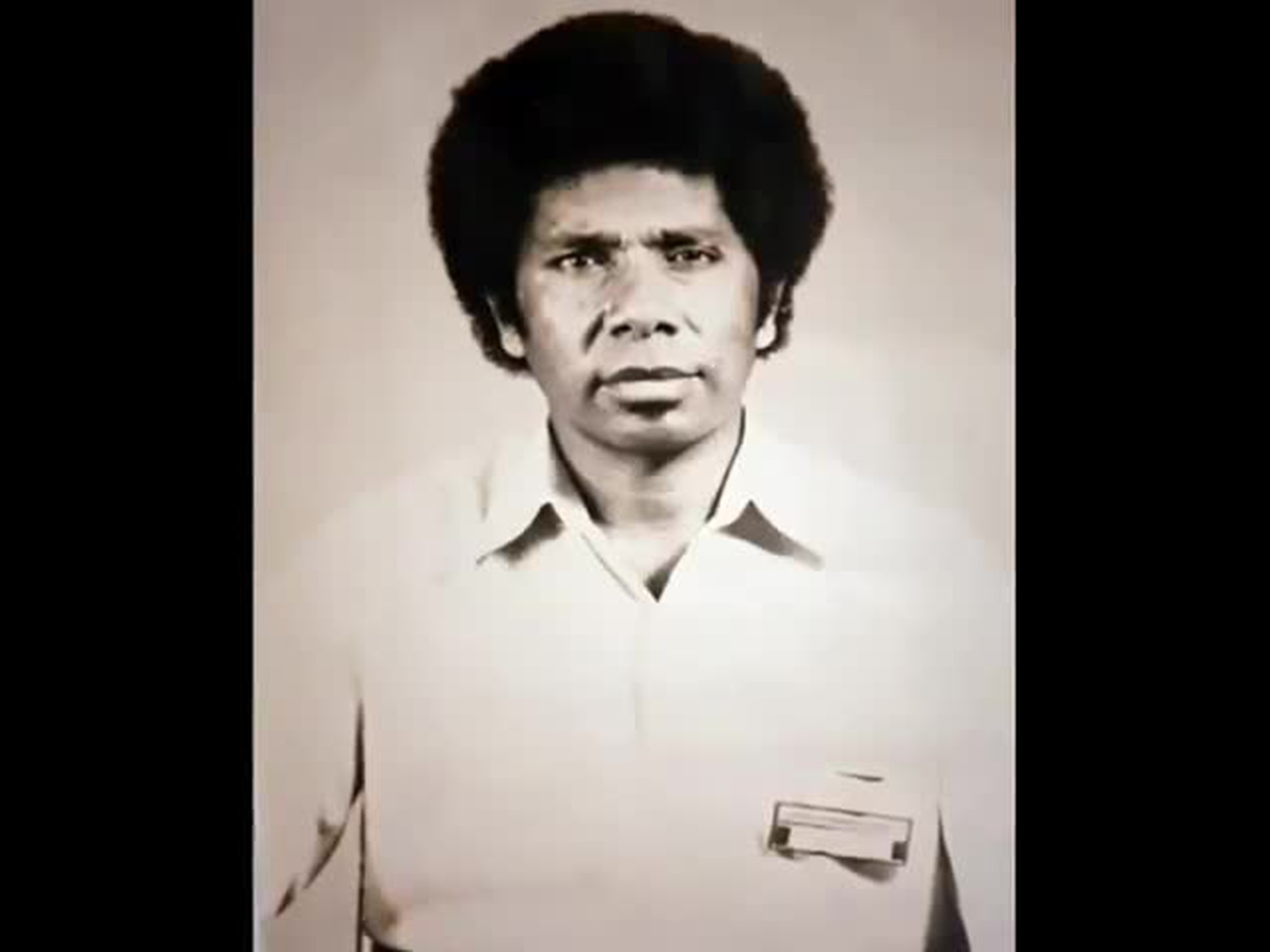
Arnold Ap
 Indonesia
Member of Mambesak
anthropologist•musician•cultural activist
Also known as: Arnold Clemens Ap
Birthday
July 1, 1946
Birth Sign
Cancer
Birthplace
Numfor Island, Netherlands New Guinea
Age
Died at 37
About
Arnold Clemens Ap was a West Papuan cultural leader, anthropologist, and musician. He led the music group Mambesak, curated the Cenderawasih University Museum, and hosted a weekly radio show celebrating Papuan culture. His life was cut short on April 26, 1984, when he was killed by Indonesian special forces, but his legacy as a symbol of Papuan identity endures.
Ap's approach was cultural rather than confrontational. Through music, humor, and joyful performance, he challenged the Indonesian government's efforts to suppress Papuan identity. His work with Mambesak and his radio program reached wide audiences, making him a beloved figure in West Papua and a quiet threat to the state.
Today, Ap is remembered as a martyr for Papuan identity. His music remains popular in West Papua, and his story has gained increasing recognition, including a major feature in The Jakarta Post in 2021. Scholars and activists continue to study his work as a model of peaceful cultural resistance.
Early Life & Background
Arnold Clemens Ap was born on July 1, 1946, on Numfor Island in Netherlands New Guinea, now part of Indonesia. He grew up on nearby Biak Island, where his father taught at mission schools. This upbringing gave him early exposure to education and the importance of cultural preservation.
From 1967 to 1973, Ap studied geography at the Teacher Training School of Cenderawasih University in Abepura. His university years were formative, combining academic study with political awakening. In 1969, he organized a demonstration against the Act of Free Choice, a UN-supervised vote that controversially resulted in Indonesian control of West Papua. For this, he was imprisoned at Ifar Gunung.
After his release, Ap dedicated himself to documenting and preserving traditional Papuan songs. He began traveling across the region, recording songs that were in danger of being lost. This passion for cultural preservation would define his career and eventually lead to the founding of Mambesak.
Career Growth
Ap's career took off in the late 1970s. In 1978, he founded Mambesak, a music group that performed traditional Papuan music and dance. The group quickly became the most prominent vehicle for Papuan cultural expression of its era.
In 1980, Mambesak appeared at the Cultural Festival in Jakarta, performing the Asmat Totem Pole Dance. This brought Papuan culture to a national stage for the first time. Ap also hosted a weekly radio program, Pelangi Budaya Irian Jaya (The Rainbow of Irian Jaya Culture), on RRI Jayapura. The show featured Papuan songs, stories, poems, and interviews, reaching a wide audience.
Ap served as curator of the Cenderawasih University Museum, where he worked to preserve and display Papuan artifacts. His work was seen as a quiet challenge to the Indonesian government's efforts to promote Javanese cultural dominance. This cultural activism made him a target. In November 1983, he was arrested by Kopassus, the Indonesian special forces, and tortured for months without charges. On April 26, 1984, he was shot in the back and killed. The official account claimed he was trying to escape, but many believe he was executed.
Career Timeline
Public Image & Style
Ap is remembered as a gentle cultural warrior who used music, humor, and joyous performance to preserve Papuan identity. The Jakarta Post describes him as someone who "fought to preserve his people's culture, celebrating it through music, humor and joyous performance." His approach was non-violent and cultural rather than political in the conventional sense.
His music with Mambesak remains popular in West Papua, where his works serve as powerful symbols of Papuan identity. He is venerated as a martyr figure in the Papuan independence movement, alongside leaders like Theys Eluay. The Interfaith Peacemakers project notes he "used music as a way to celebrate Papuan culture and express the Papuan desire for freedom."
Fame & Fandom
Arnold Ap commands a legacy defined not by commercial metrics or organized fan clubs, but by his enduring status as a cultural martyr and a symbol of West Papuan identity. His audience consists primarily of the Papuan diaspora, cultural activists, and scholars who revere him as a lost crusader rather than a celebrity with a formalized following. Unlike modern pop icons whose supporters engage in streaming parties or billboard campaigns, Ap's community sustains his memory through academic study, the preservation of Mambesak's music, and political activism. The fanbase has no formal name; the reverence he inspires manifests as a shared historical consciousness rather than a branded fandom. The narrative surrounding him is one of tragic sacrifice, where his assassination transformed a popular bandleader into an eternal figure of resistance. While his family actively preserves his archives, the broader public interaction remains retrospective, focused on the significance of his weekly radio broadcasts and his role in documenting indigenous heritage during a period of suppression. Despite his profound impact on regional culture and his recognition by anthropologists like Danilyn Rutherford, Arnold Ap does not currently hold a placement in the published global rankings. iFANN's Global Fame Engine has evaluated his profile, yet he remains unranked within the Top 1,000 or any scope list. He is not among the most famous people in the world, nor does he appear in specific category rankings such as musicians or activists. This absence reflects the limitations of global fame databases in capturing figures whose influence is deeply localized and political rather than commercially ubiquitous.
Interesting Facts and Legends
Arnold Ap pioneered the West Papua string band style, a genre uniquely blending traditional melodies with modern instruments to create a distinct sonic identity. His weekly radio program offered an unusually diverse format for its era, weaving together songs, stories, poems, and interviews into a single broadcast celebrating indigenous heritage. Fellow musician Eddie Mofu met a similar fate around the same time, underscoring the targeted nature of the era's violence against cultural figures. Scholars such as Danilyn Rutherford have analyzed Ap's contributions within the broader context of Indonesian cultural politics. A central narrative surrounding his life is the story of him being released from detention only days before his assassination, knowing he was "living on borrowed time" as military forces closed in. This tragic timeline transformed him from a popular bandleader into a symbol of sacrifice. The founding of Mambesak in 1978 is another foundational legend, credited with keeping Papuan language alive during a period of aggressive assimilation policies. Recent documentaries focusing on "The Last Song of Arnold Ap" frame his final performances as prophetic moments captured just before his silence. A widely retold story details how Ap knew the military intended to kill him yet continued his work, transforming his death into a martyrdom that defines his enduring status as a lost cultural icon.
Notable Quotes
“Music is the voice of our people, and we must let it be heard.”
“Our culture is our identity, and we will not let it be taken from us.”
“We celebrate who we are through song and dance, for that is our strength.”
Family & Personal Life
Ap married Corry Bukorpioper, a nurse, in 1974. The couple remained married until his death in 1984. Corry survived him and has maintained connections with the Papuan diaspora community in the Netherlands. The couple had children, though specific details about their number and names are limited in available sources. Corry has been documented visiting family in The Hague in recent years.
Notable Connections
Arnold Ap was married to Corry Bukorpioper, a nurse, from 1974 until his death. He founded the music group Mambesak, which became a symbol of Papuan cultural identity. Fellow musician Eddie Mofu was killed around the same time as Ap. Theys Eluay, another Papuan leader, was also targeted for peaceful activism. Scholar Danilyn Rutherford has analyzed Ap's work in the context of Indonesian cultural politics.
Relationships & Dating History
Arnold Ap married Corry Bukorpioper, a nurse, in 1974. The couple remained married until his death in 1984. Corry survived him and has maintained connections with the Papuan diaspora community in the Netherlands. The couple had children, though specific details about their number and names are limited in available sources. Corry has been documented visiting family in The Hague in recent years.
- MarriedCorry Bukorpioper1974 - 1984Married in 1974; remained together until his death in 1984.
Death & Aftermath
Died
April 26, 1984 (aged 37)
Death Place
Jayapura, Netherlands New Guinea (now Papua, Indonesia)
Cause of Death
Unknown
Arnold Ap was last active in his role as curator of the Cenderawasih University Museum and leader of the Mambesak music group before vanishing under suspicious conditions during a period of heightened military tension in West Papua. His body was discovered on Pasir Enam Beach in Jayapura, Netherlands New Guinea (now Papua, Indonesia) on April 26, 1984.
The Indonesian military government at the time did not conduct a public inquiry into his disappearance, and no suspects were officially charged or tried in connection with his killing. Decades later, the lack of justice remains a central theme in West Papuan advocacy, with historians and journalists noting that his death was part of a broader pattern of enforced disappearances by security forces in the region during the 1980s.
Funeral details are not publicly recorded given the circumstances of his disappearance, suggesting any burial or memorial service was conducted in private or clandestinely. Posthumously, his estate has been managed primarily through cultural preservation efforts rather than commercial exploitation, with his music archived and released notably on the soundtrack Strange Birds in Paradise: A West Papuan Soundtrack. In 2021, nearly four decades after his passing, scholars and activists cited him as a lost cultural crusader whose work laid the groundwork for modern West Papuan identity movements.
Net Worth (Estate Value)
$1 Million
iFANN Editorial Team estimate
Arnold Ap dedicated his life to cultural preservation rather than the accumulation of personal wealth. Working as a museum curator and musician in Papua during the 1970s and early 1980s, he sustained himself on a modest income typical of public service roles in that region. Per iFANN's editorial analysis, the total value of his estate is estimated at $1 Million. Since his passing, the primary worth of his legacy lies in his cultural impact rather than liquid commercial assets. His music with Mambesak remains widely performed in West Papua, serving as a powerful symbol of Papuan identity. The estate is managed by his surviving family, including his widow Corry Bukorpioper. While no specific breakdown of assets exists, the enduring influence of his work renders the financial valuation secondary to his historical significance.
Awards Won (1)
Arnold Ap did not receive formal industry awards during his lifetime, as his work was cultural and political rather than commercially recognized within Indonesia's state structures. However, his posthumous recognition has been significant, with The Jakarta Post honoring him in 2021 as "Papua's lost cultural crusader."
2021 · Cultural Recognition
Lifetime achievement in preserving Papuan culture
Known For
Mambesak
1978 · Founder and leader
Pelangi Budaya Irian Jaya
1980 · Host
Cenderawasih University Museum
1973 · Curator
Keywords
Sources
Quick Facts
- Profession
- anthropologist, musician, cultural activist
- Born
- July 1, 1946
- Birthplace
- Numfor Island, Netherlands New Guinea
- Died
- April 26, 1984
- Death Place
- Jayapura, Irian Jaya, Indonesia
- Gender
- Male
- Birth Sign
- Cancer
- Spouse
- Corry Bukorpioper
- Group
- Mambesak
Personal Details
- Full Name
- Arnold Clemens Ap
- Spouse
- Corry Bukorpioper
- Education
- Cenderawasih University, Abepura (Geography, 1967-1973)
Frequently Asked Questions
How did Arnold Ap die?
What was Arnold Ap known for?
Was Arnold Ap married?
What is the legacy of Arnold Ap?
When was Arnold Ap born?
Similar People
Join the community
fans discussing