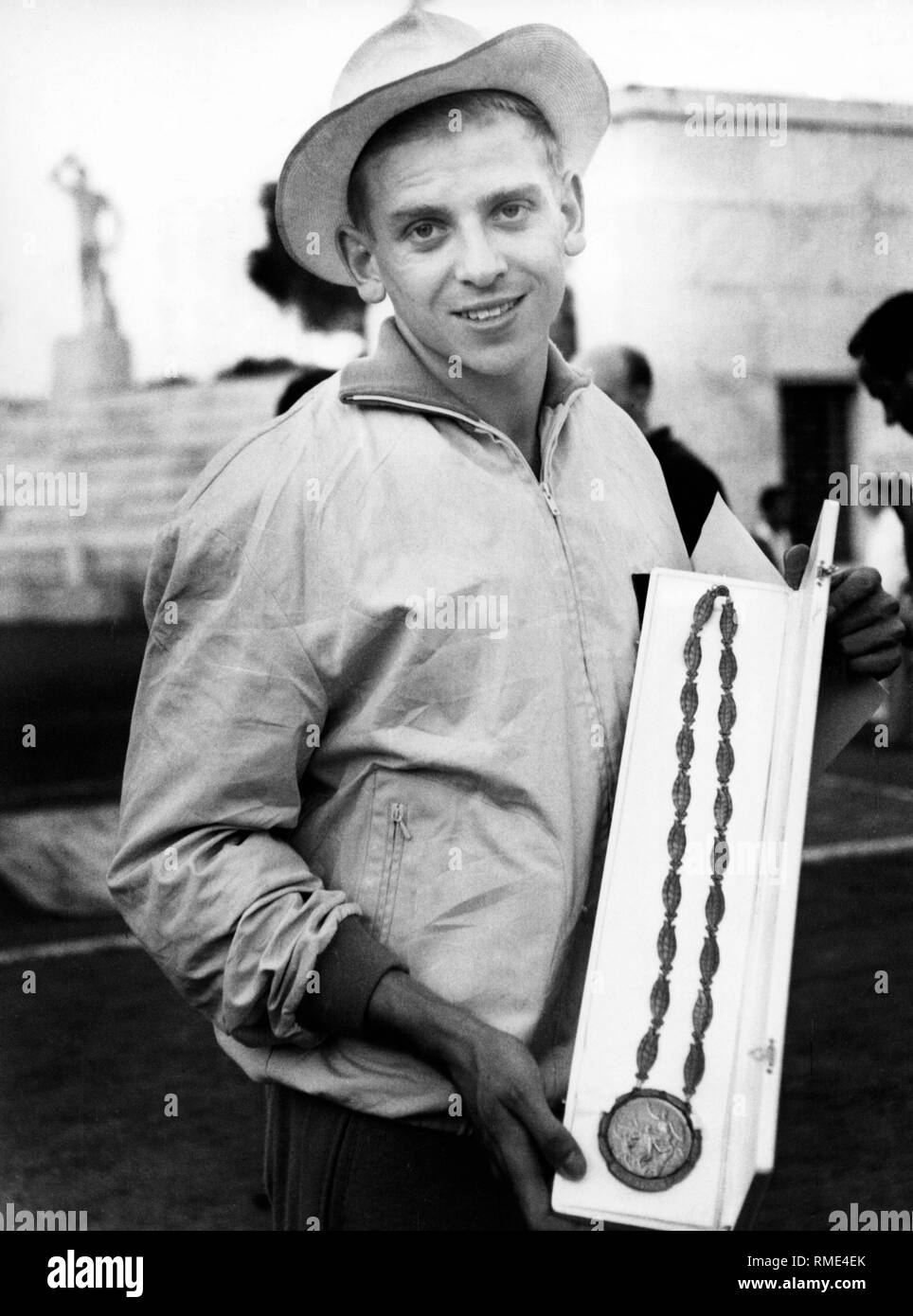
Armin Hary
 Germany
athletics competitor•sprinter•athlete
Birthday
March 22, 1937
Birth Sign
Aries
Birthplace
Quierschied, Saarland, Germany
Age
89 years old
About
Armin Hary is a retired German sprinter who specialized almost exclusively in the 100-meter dash. Born on March 22, 1937, in Quierschied, Saarland, he remains the only German ever to win the Olympic 100 meters, a feat he accomplished at the 1960 Rome Olympics. That victory broke a 32-year streak of American dominance in the event, making Hary a national icon and a pivotal figure in sprinting history.
Today, Hary is remembered as a trailblazer who pushed the boundaries of human speed. He was the first athlete to officially break the 10.0-second barrier in the 100 meters, a record that stood as a testament to his explosive power and flawless technique. His legacy endures through his official website, which curates his career highlights, and through his ongoing presence in Olympic retrospectives.
Early Life & Background
Armin Hary grew up in the small mining town of Quierschied in the Saarland region, near the French border. His early years were shaped by the post-war atmosphere of the 1940s and 1950s, and like many boys in the area, he played soccer. He was a decent footballer, but at age 16, in 1953, he made the switch to athletics, drawn by the pure speed of sprinting.
His natural talent was immediately apparent. Coaches noticed his explosive acceleration and his uncanny ability to react to the starting gun. Hary's first taste of international success came in 1958 when he won the European Championships 100 meters in Stockholm. That same year, he was ranked third in the world, signaling that he was ready to challenge the American sprinting elite.
The path to the top wasn't without its hurdles. Hary's start was so fast that officials often suspected him of anticipating the gun. He was tested multiple times for his reaction time, but he consistently proved he was simply that quick. This reputation as a 'thief of starts' would follow him throughout his career, both as a compliment and a source of controversy.
Career Growth
Hary's breakthrough came in 1958 when he set a world record of 10.0 seconds in the 100 meters, becoming the first athlete to officially break the 10-second barrier. The record was initially disputed due to concerns about wind assistance, but it was eventually ratified, cementing his place in history.
The pinnacle of his career arrived at the 1960 Rome Olympics. Hary posted the fastest times in both the quarterfinals (10.2 seconds) and semifinals, then won the final in 10.2 seconds, defeating American Dave Sime. He followed that with a second gold medal in the 4×100 meter relay, running the anchor leg for the German team.
After the Olympics, Hary retired from competitive athletics, stepping away at the height of his powers. He did not defend his titles or pursue further records, choosing instead to leave the track on his own terms. His world record stood until 1968, when it was broken by Jim Hines, who ran 9.95 seconds at altitude in Mexico City.
Career Timeline
Public Image & Style
Armin Hary is celebrated in Germany as a national sporting hero, a symbol of post-war athletic resurgence. His public image is that of a precise, scientific sprinter, known for his meticulous attention to the start. The media has portrayed him as a figure who broke American dominance in the 100 meters, a narrative that resonates with fans. He doesn't have a large social media presence, but his official website serves as a curated archive of his career, offering photos and stories. Fans admire his humility and his willingness to share his experiences, even decades after his glory days.
Fame & Fandom
Armin Hary remains a singular figure in the annals of track and field, his name echoing through history books as the man who shattered the 10-second barrier. Despite his monumental achievements, iFANN's Global Fame Engine has evaluated this person, but they do not currently hold a placement in the published rankings (Global Top 1,000 or a Top-100 scope list). This absence from the current global leaderboard reflects the passage of time rather than a lack of impact; while modern celebrities often dominate daily headlines through constant digital engagement, Hary's fame is rooted in specific, historic moments that defined an era of sprinting. His reputation persists among sports historians and German national heroes, yet he lacks a formal fanbase with a documented name. There are no organized clubs, viral social media campaigns, or dedicated fan rituals associated with him today. The audience for Armin Hary exists primarily within the realm of historical archives and retrospective sports journalism rather than an active, self-identifying community. His legacy is maintained by those who study the evolution of human speed, ensuring his story survives without the noise of contemporary celebrity culture. While he does not appear on the latest popularity charts, his contribution to athletics stands as a permanent fixture in the sport's mythology.
Interesting Facts and Legends
Before finding his stride on the track, Armin Hary was a soccer player until age 16, a background often credited for his exceptional footwork and acceleration. He famously described himself as a 'thief of starts' due to lightning-fast reaction times that prompted officials to repeatedly test him for false alarms. His 10.0-second world record in 1958 faced initial controversy over a borderline wind gauge reading but was ultimately ratified. Hary competed almost exclusively in the 100 meters, making his Olympic relay gold all the more remarkable. He holds the distinction of being the last white man to set a world record in the 100 meters, highlighting the shifting demographics of elite sprinting. A defining legend of his career occurred at the 1960 European Championships in Stockholm, where he ran exactly 10.0 seconds, officially becoming the first human to break the century mark in a fully automatic timing event. Another iconic moment cemented his status as a national hero during the 1960 Rome Olympics. Entering the Games ranked third in the world, he defeated American favorite Dave Sime to win the gold medal, ending a long streak of American dominance in the event.
Notable Quotes
“I was a thief of starts.”
“The start is half the race.”
“I never ran for records, I ran to win.”
Family & Personal Life
Details about Armin Hary's family are scarce. He was born in Quierschied, a mining town in the Saarland, to a family that likely had roots in the region's coal-mining community. His upbringing was modest, and he has spoken little about his parents or siblings. He has never publicly discussed his own family, and no information is available about a spouse or children. As of 2026, Hary's personal life remains private, and he has not shared details about his household or any pets.
Notable Connections
Armin Hary's career intersected with several notable figures. American sprinter Dave Sime was his fiercest rival, finishing second to Hary in the 1960 Olympic 100 meters final. The two competed in a memorable race that highlighted the contrast between American power and Hary's explosive start. Athletics journalist Olaf Brockmann interviewed Hary for the 60th anniversary of his world record, providing a platform for Hary to reflect on his achievements.
Relationships & Dating History
Armin Hary has kept his personal life remarkably private. No public records or credible sources document any romantic relationships, marriages, or children. He has never been linked to any high-profile partners, and his focus throughout his career was on athletics. As of 2026, his relationship status remains unknown, and he has not shared details about his personal life with the media. This privacy is a testament to his dedication to his sport and his desire to keep his private affairs out of the spotlight.
Salary, Net Worth In 2026
$2 Million
iFANN Editorial Team estimate
Armin Hary competed during the amateur era of athletics, long before the lucrative sponsorships and prize money structures of modern sports defined athlete earnings. His income stemmed primarily from athletic achievements which did not include significant financial rewards at the time. Per iFANN's editorial analysis, his net worth is estimated at around $2 million as of 2026, a modest figure reflecting the economic realities of his era. This wealth likely derives from speaking engagements, appearances, and the curation of his personal archives. Unlike modern athletes, Hary did not have endorsement deals or business ventures that would have multiplied his income. His legacy, however, remains priceless, as he continues to stand as a symbol of German sporting excellence.
Awards Won (3)
Armin Hary's trophy cabinet includes two Olympic gold medals from the 1960 Rome Games, in the 100 meters and the 4×100 meters relay. He also claimed the European Championships title in 1958. His world record of 10.0 seconds in 1958 was a landmark achievement that remained unbeaten for a decade. These accolades place him among the greatest sprinters of his era.
1960 · 100 meters
1960 Rome Olympics
1960 · 4×100 meters relay
1960 Rome Olympics
1958 · 100 meters
1958 European Championships
Known For
1960 Rome Olympics
1960 · Gold medalist in 100 meters and 4×100 meters relay
First sub-10.0 100 meters
1958 · Set world record of 10.0 seconds
Keywords
Sources
Quick Facts
- Profession
- athletics competitor, sprinter, athlete
- Born
- March 22, 1937
- Birthplace
- Quierschied, Saarland, Germany
- Gender
- Male
- Birth Sign
- Aries
- Nationality
- German
Personal Details
- Full Name
- Armin Hary
Frequently Asked Questions
Is Armin Hary still alive?
What is Armin Hary's net worth?
Did Armin Hary win Olympic gold?
Who was the first person to run 100 meters under 10 seconds?
Is Armin Hary the only German to win Olympic 100 meters?
Similar People
Join the community
fans discussing