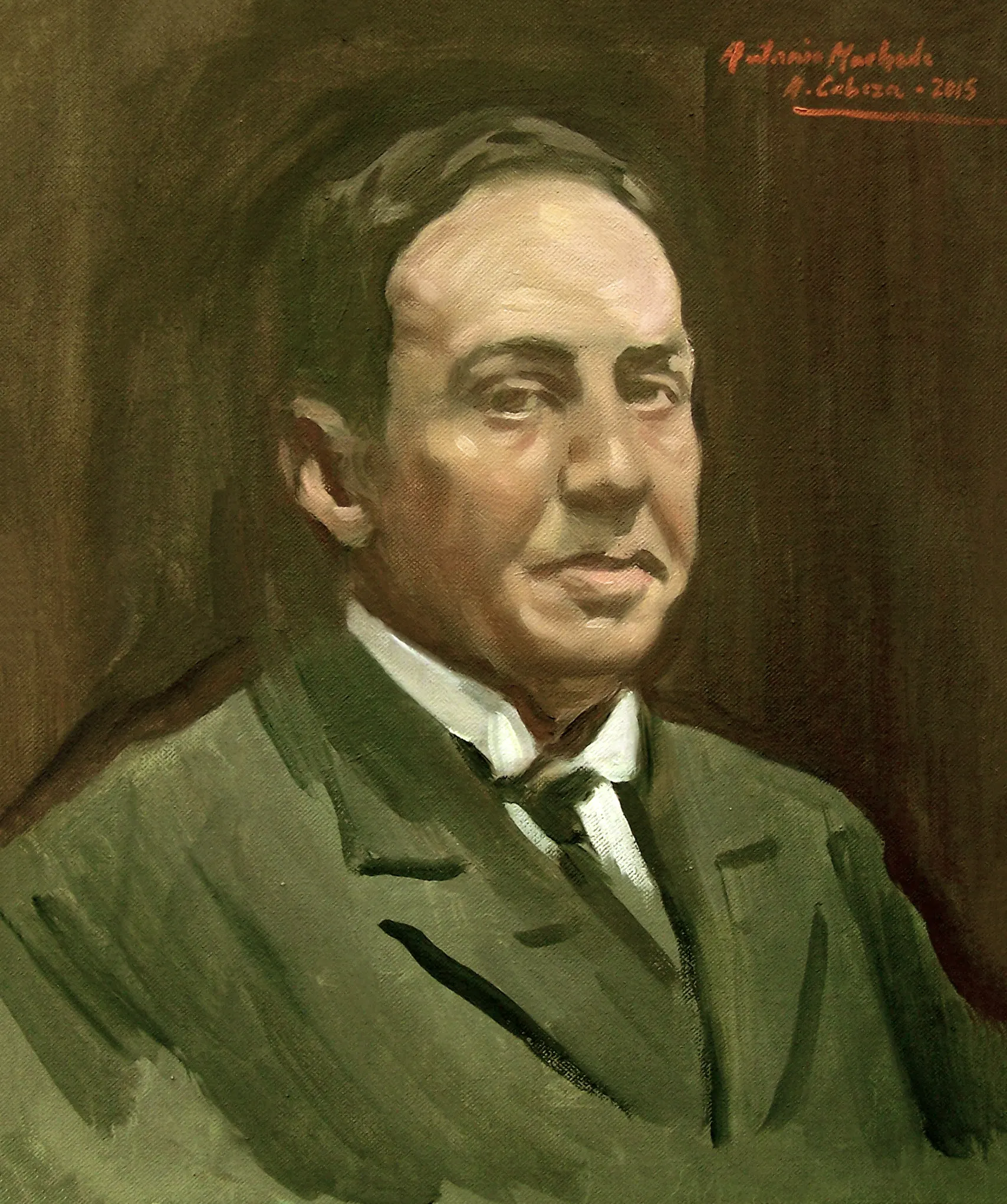
Antonio Machado
 Spain
SpainAlso known as: Antonio Cipriano José María y Francis de Santa Ana Machado y Ruiz
Birthday
July 26, 1875
Birth Sign
Sagittarius
Birthplace
Seville, Spain
Age
Died at 63
About
Antonio Machado, born Antonio Cipriano José María y Francis de Santa Ana Machado y Ruiz, stands as a seminal Spanish poet and playwright whose life and work defined the intellectual landscape of early 20th-century Spain. Born on July 26, 1875, in Seville at the Palacio de las Dueñas, he became the youngest and most prominent figure of the Generation of '98, a literary movement dedicated to revitalizing Spanish culture following the nation's decline after the loss of its colonies in 1898. His poetry evolved from early modernist influences into a unique duality blending personal symbolism with philosophical contemplation of life, connecting his work to timeless popular wisdom.
Machado is best known for his collection Campos de Castilla, which turned away from abstract symbolism to engage directly with the Spanish landscape and the soul of the Castilian people. He is consistently ranked among the top 10 Spanish poets of all time, often cited alongside Garcilaso de la Vega and Lope de Vega. His works remain staples in education and public discourse, serving as touchstones for philosophical reflection nearly a century after his death. Though he passed away in 1939, his legacy endures as a pillar of Spanish identity, with his words continuing to inspire political and cultural dialogue globally.
Early Life & Background
Antonio Machado was born into a well-to-do family in Seville at the Palacio de las Dueñas. His father, José María Machado, was a professor of Latin and Greek, while his mother, Leonor Ruiz de la Torre, came from a distinguished lineage. His early childhood was spent in Seville, where he developed a deep love for the Andalusian landscape and folklore, influences that would permeate his later poetry. Following his father's death in 1893, the family moved to Madrid due to financial difficulties, though they retained their connection to the south.
His education was rigorous but unconventional. He attended the Instituto Cardenal Cisneros in Madrid and later studied law and philosophy at the Universidad Central de Madrid (now Complutense University), though he never completed a degree in either field. Instead, he preferred self-directed study and participation in literary circles. In 1894, he published his first poems in local newspapers under pseudonyms, showing an early interest in modernist aesthetics. However, his true artistic awakening occurred during his travels through Europe and his return to Spain, where he began to distance himself from the ornate style of Modernism toward a more intimate, symbolic, and philosophical voice.
A pivotal moment before his full fame was his appointment as a teacher in Soria in 1902. It was here, in the harsh, windswept Castilian plateau, that his poetic style matured significantly. The isolation and stark beauty of the region, combined with a profound personal tragedy, catalyzed his transition from a romantic modernist to a master of introspective realism. This period laid the groundwork for his masterpiece, transforming him from a promising young writer into a national icon.
Career Growth
Machado's career is best understood through his major poetic cycles, which reflect his evolving philosophy and historical context. His debut collection, Soledades (published in 1903, expanded in 1907), established him as a leading modernist. These works were characterized by dreamlike imagery, symbolism, and a focus on the interior world, influenced by French Symbolists like Baudelaire and Verlaine.
The publication of Campos de Castilla in 1912 marked his breakthrough as a national icon. This collection turned away from abstract symbolism to engage directly with the Spanish landscape, history, and the "soul" of the Castilian people. It is considered his masterpiece and a cornerstone of Spanish literature. In 1924, he released Nuevas canciones, introducing a lighter, more lyrical tone often incorporating folk rhythms and themes of everyday life, time, and memory.
As political tensions rose in Spain, his work became increasingly engaged with social justice and the impending conflict. Collections like La guerra reflected his anti-fascist stance. Beyond poetry, Machado wrote plays such as Juan de Mañara (1905) and El crimen del otro (1906), and prose works like Jardines lejanos (1917). He also served as a professor and held administrative roles in the Republican government during the Civil War. His commercial success was not measured in sales figures typical of pop stars but in enduring cultural impact. His works are staples in Spanish education, and his quotes are ubiquitous in public discourse.
Career Timeline
Public Image & Style
Antonio Machado is viewed as the "poet of the soul," a man of quiet dignity and profound wisdom. His aesthetic is associated with the austere landscapes of Castile and the intellectual rigor of the Generation of '98. Unlike living celebrities, his interaction with the public is entirely mediated through his texts, which continue to inspire political and philosophical reflection nearly a century after his death. His public image is one of the "poet of the soul," a man of quiet dignity and profound wisdom. His aesthetic is associated with the austere landscapes of Castile and the intellectual rigor of the Generation of '98.
Photographs from the early 20th century depict him as a slender man with a distinctive beard and thoughtful expression, typical of the intellectuals of his era. His work is characterized by a deep connection to human experience and a reflective, almost philosophical contemplation of life itself. This fusion, he believed, connected his work to timeless popular wisdom. As fellow poet Gerardo Diego put it, Machado truly "spoke in verse and lived in poetry." His reputation rests on the enduring power of his words rather than any modern-style celebrity status.
Fame & Fandom (iFAMOUS Rankings)
Antonio Machado commands a reverence distinct from the volatile adoration of modern pop culture, resting instead on the stable foundation of academic canon and national identity. His audience consists primarily of scholars, students, and citizens who engage with his work as a pillar of Spanish heritage rather than a transient entertainment product. Unlike contemporary celebrities who cultivate organized fanbases with specific nomenclatures, Machado has no formal fandom name; his admirers are defined by their study of literature and history rather than membership in a dedicated club or digital community. There are no records of fan-funded campaigns, birthday billboards, or viral social media initiatives, as his legacy is preserved through institutional memorials, university curricula, and state-sponsored cultural observances rather than organic grassroots mobilization.
The interaction between the poet and the public remains entirely mediated through his texts, which continue to serve as touchstones for philosophical reflection and historical memory nearly a century after his death. While his influence permeates Spanish thought, it lacks the active, performative engagement characteristic of living stars. According to the iFANN Global Fame Engine evaluation conducted in September 2026, Antonio Machado is evaluated but does not hold a placement in the published rankings, including the Global Top 1,000 or any Top-100 scope list. This absence of a numeric rank reflects his status as a historical figure whose fame is measured in enduring cultural impact rather than current consumption metrics.
Interesting Facts and Legends
Antonio Machado is renowned for his aphoristic style, particularly the line "Wanderer, your footsteps are the road, and nothing more; wanderer, there is no road, the road is made by walking." This phrase has become a universally recognized piece of cultural mythology in Spain, frequently quoted in educational and political contexts as a symbol of resilience. Another notable fact is that his poem containing this line is often cited as a defining philosophy of his life.
A defining chapter of his biography involves his tenure as a teacher in Soria, where he fell in love with Leonor Izquierdo. Her death profoundly inspired the melancholic tone found in his collection Campos de Castilla. The most significant event in his later life was his forced exile during the Spanish Civil War. Fleeing advancing Nationalist forces in January 1939, he crossed into France and died just weeks later in Colliure on February 22, 1939. This tragic end is often cited as a symbol of the intellectual class's suffering during the conflict.
Despite his passing, Machado remains highly relevant in contemporary discourse. In May 2026, media outlets commemorated him as a "symbol of democratic Spain," reflecting ongoing efforts to honor the victims of the Civil War and the Franco dictatorship. Quotes from Machado continue to appear in daily columns and news articles, particularly those discussing resilience, patience, and the value of human endeavor. His poem "Wanderer, your footsteps are the road" has become a universally recognized piece of cultural mythology in Spain, frequently quoted in educational and political contexts as a symbol of resilience.
Notable Quotes
“Wanderer, your footsteps are the road, and nothing more; wanderer, there is no road, the road is made by walking.”
“Only a fool thinks price and value are the same.”
“Don't try to rush things, for the cup to run over, it must...”
“To live is to forget, and to remember is to die.”
“I speak in verse and live in poetry.”
Family & Personal Life
Antonio Machado was born into a well-to-do family in Seville. His father, José María Machado, was a professor of Latin and Greek, while his mother, Leonor Ruiz de la Torre, came from a distinguished lineage. His brother, Manuel Machado, was also a poet and a close companion throughout his life. In his later years, during the Spanish Civil War, he was accompanied by his brother and his sister-in-law, Carmen de Burgos. There are no documented romantic relationships after Leonor.
He married Leonor Izquierdo Cuevas in 1903. Their relationship was passionate but short-lived. Leonor suffered from tuberculosis, and despite their move to Soria hoping the dry climate would help, she died there on March 23, 1912, at the age of 23. Her death devastated Machado and directly inspired the melancholic, reflective tone of Campos de Castilla. There were no children from this union. Following Leonor's death, Machado remained unmarried.
Notable Connections
Relationships & Dating History
Antonio Machado's romantic life was brief but deeply impactful. He met Leonor Izquierdo Cuevas in 1901 in Seville, and they married on September 18, 1903, in Madrid. Their relationship was passionate but short-lived. Leonor suffered from tuberculosis, and despite their move to Soria hoping the dry climate would help, she died there on March 23, 1912, at the age of 23. Her death devastated Machado and directly inspired the melancholic, reflective tone of Campos de Castilla. There were no children from this union.
Following Leonor's death, Machado remained unmarried. He had a close friendship with the writer and poet Manuel Altolaguirre and later lived with his brother, Manuel Machado, who was also a poet. In his later years, during the Spanish Civil War, he was accompanied by his brother and his sister-in-law, Carmen de Burgos. There are no documented romantic relationships after Leonor. As of his death in 1939, he was widowed. There is no current dating status as he has been deceased for over 80 years.
- MarriedLeonor Izquierdo Cuevas1903 - 1912Married in Madrid; she died of tuberculosis in Soria, inspiring his masterpiece Campos de Castilla.
Death & Aftermath
Died
February 22, 1939 (aged 63)
Death Place
Collioure, France
Cause of Death
Acute heart failure from exhaustion and pneumonia
Antonio Machado died on February 22, 1939, in Collioure, France, at the Hôtel de la Cité. His passing came just weeks after he fled Spain to escape the advancing Nationalist forces of General Franco during the Spanish Civil War. He had crossed the border on February 5, 1939, accompanied by his brother Manuel, already suffering from severe pneumonia, malnutrition, and exhaustion caused by the harsh winter journey. Hospital records confirmed that acute heart failure was the immediate cause of death, a direct result of the physical toll endured during his flight. No formal autopsy was conducted, but the circumstances were well-documented by family accounts and medical staff.
The public reaction within literary circles was immediate and somber. Exiled intellectuals and fellow writers recognized him as a symbol of resistance against fascism and a voice for the Spanish people. Tributes poured in from those who understood the gravity of losing such a prominent figure of the Generation of '98. However, broader commemoration was initially constrained by the ongoing repression in Francoist Spain and the chaos of World War II. His funeral was small and private, held in Collioure with only fellow exiles and refugees in attendance. He was buried in the local cemetery, a quiet resting place that would stand for decades as a symbol of the exile's plight.
In 1975, following the death of Francisco Franco and Spain's transition to democracy, Machado's remains were repatriated to Soria. A massive ceremony attended by thousands of citizens and government officials marked the event, symbolizing the nation's reconciliation with its democratic past. His body was interred in the Plaza de San Juan Bautista in Soria, near the house where he once lived and taught. Since then, his legacy has been managed by cultural institutions like the Antonio Machado Foundation and the Casa-Museo de Antonio Machado. His estate continues to generate revenue through the licensing of his works and educational publications, ensuring his words remain accessible to new generations. The poet's final journey and subsequent return have become an integral part of Spain's modern history, representing the resilience of its intellectual class.
Net Worth (Estate Value)
$0
iFANN Editorial Team estimate
As a deceased literary figure, Antonio Machado did not accumulate wealth in the modern sense of salaries or endorsements. His estate, managed by the Antonio Machado Foundation and cultural institutions, continues to generate revenue through the licensing of his works, educational publications, and merchandise. Specific financial figures for the estate are not publicly disclosed in detail, but the management of his copyright ensures that his works remain accessible for educational purposes. The estate's trajectory has been stable, with royalties continuing to support the Casa-Museo de Antonio Machado in Soria and various scholarships. The iFANN Editorial Team estimates that the estate's value, derived from these long-term rights and cultural assets, remains significant in terms of cultural capital, though precise monetary figures are not available for public comparison.
Awards Won (2)
While Machado did not win modern entertainment awards, he received numerous posthumous honours. He was awarded an honorary doctorate by the University of Paris (Sorbonne) in 1933. In 1975, the Spanish government officially recognized him as a national hero of democracy. He is universally ranked as one of the "Greatest Spanish Poets" and has received numerous lifetime achievement recognitions from cultural institutions.
1933 · Literature
University of Paris (Sorbonne)
1975 · Cultural Recognition
Spanish Government
Known For
Campos de Castilla
1912 · Poet
Soledades
1903 · Poet
Nuevas canciones
1924 · Poet
Keywords
Sources
Quick Facts
- Profession
- poet, writer, playwright
- Born
- July 26, 1875
- Birthplace
- Seville
- Died
- February 22, 1939
- Death Place
- Collioure
- Gender
- Male
- Spouse
- Leonor Izquierdo Cuevas
- Birth Sign
- Sagittarius
Personal Details
- Full Name
- Antonio Cipriano José María y Francis de Santa Ana Machado y Ruiz
- Spouse
- Leonor Izquierdo Cuevas
- Children
- Education
- Instituto Cardenal Cisneros; Universidad Central de Madrid (did not complete degree)
Frequently Asked Questions
Who was Antonio Machado?
When did Antonio Machado die?
What is Antonio Machado's most famous poem?
Did Antonio Machado have any children?
Where is Antonio Machado buried?
Similar People
Join the community
fans discussing