 United States
“A haunting and beautifully acted meditation on guilt and the possibility of second chances, anchored by Brit Marling's remarkable performance.”
A.O. Scott
The New York Times
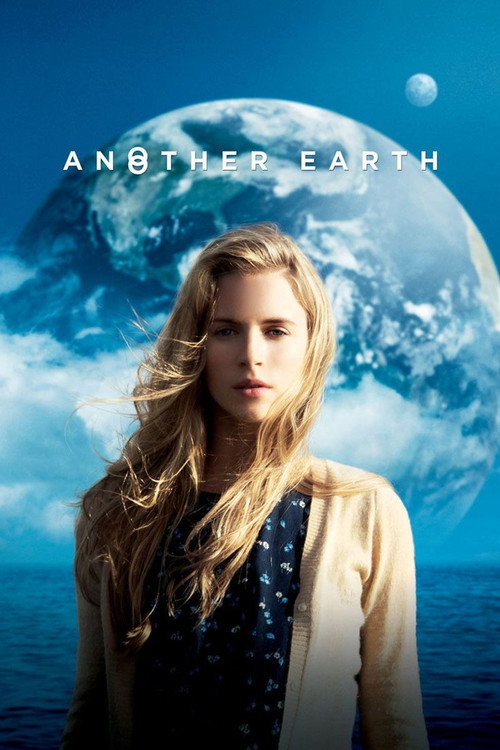
On the night astronomers announce the discovery of a mirror planet, 17-year-old Rhoda Williams gets behind the wheel after too many drinks. Her car collides with a family's vehicle, killing a pregnant woman and her young son, and leaving composer John Burroughs in a coma. Four years later, Rhoda is released from prison and works as a janitor at her old high school, carrying a guilt she cannot shake. She begins cleaning houses under a fake name and deliberately chooses John's home, hoping for a form of atonement she cannot name.
Shot in 20 days for $100,000, Another Earth premiered at Sundance in 2011 and won the Alfred P. Sloan Prize. Brit Marling, who co-wrote the script with director Mike Cahill, delivers a breakout performance that balances vulnerability with quiet resolve. The film avoids sci-fi spectacle, using the parallel planet as a philosophical mirror for questions about identity, forgiveness, and whether second chances are ever truly earned. It grossed nearly $2 million worldwide and holds a 63% Tomatometer score.
Availability and pricing can change. Confirm on the provider's site before purchasing.
Rhoda Williams is 17, brilliant, and freshly accepted to MIT's astrophysics program. On the same night scientists confirm the existence of Earth 2, a planet identical to ours within the solar system, she attends a party and drinks too much. Driving home, she looks up at the sky and misses a red light. Her car slams into a stationary vehicle, killing a pregnant woman and her young son. The father, John Burroughs, survives but remains in a coma for months.
The film jumps ahead four years. Rhoda has served her sentence and is released, now living in a cramped apartment and working as a janitor at her former high school. She is hollow, consumed by what she did. Meanwhile, John has awakened to find his family gone. He has abandoned his career as a composer, letting his home fall into disrepair, and lives as a recluse, refusing to engage with the world.
Earth 2 has become a global obsession. A private space program announces a lottery for a one-way civilian mission to the mirror planet, offering ordinary people the chance to travel to an alternate version of Earth. Rhoda, seeking escape or punishment, applies for the lottery without telling anyone.
In a bid for redemption, Rhoda begins cleaning houses under a false name. She deliberately selects John's home, though she does not reveal her identity. John, initially hostile and withdrawn, slowly allows her presence. She cleans his cluttered living room, they share meals in silence, and eventually he plays piano for her. A fragile bond forms, she becomes a quiet anchor in his life, while he gives her a sense of purpose she has not felt since the accident.
But the secret sits between them. Rhoda knows the truth; John does not. As the lottery deadline approaches and news breaks that Earth 2's inhabitants appear to be identical versions of Earth's people, Rhoda must decide whether to confess or continue living a lie. The story builds to a moment where her past, her future, and the mirror planet converge, forcing a choice that will define both their lives.
Official International Trailer
Official Trailer
Critical Consensus
An ambitious low-budget indie that uses its sci-fi premise as a thoughtful backdrop for a deeply human drama about guilt and redemption, though its pacing and execution divide critics.
“A haunting and beautifully acted meditation on guilt and the possibility of second chances, anchored by Brit Marling's remarkable performance.”
A.O. Scott
The New York Times
“The film's strength lies in its intimate, character-driven approach, but the sci-fi elements feel underdeveloped and sometimes distracting.”
Justin Chang
Variety
“A quiet, contemplative film that asks profound questions about identity and forgiveness, even if its narrative occasionally strains credibility.”
David Rooney
The Hollywood Reporter
“Brit Marling gives a breakout performance that is both vulnerable and fierce, carrying the film on her shoulders with remarkable grace.”
Roger Ebert
RogerEbert.com
“A thought-provoking and emotionally resonant debut that proves you don't need a big budget to make a powerful science fiction film.”
Peter Bradshaw
The Guardian
Brit Marling
Rhoda Williams
William Mapother
John Burroughs
Matthew-Lee Erlbach
Alex
Meggan Lennon
Maya Burroughs
AJ Diana
Amos Burroughs
Kumar Pallana
Purdeep
Bruce Colbert
Symposium Speaker
Paul S. Mezey
Symposium Speaker
Ana Valle
Symposium Speaker
Jeffrey Goldenberg
Symposium Speaker
Joseph A. Bove
Symposium Speaker
Jordan Baker
Kim Williams
Director
Mike Cahill
Writers
Mike Cahill, Brit Marling
Composers
Phil Mossman, Will Bates
Cinematographer
Mike Cahill
Producers
Nicholas Shumaker, Mike Cahill, Hunter Gray, Brit Marling
Sundance Film Festival (2011)
Alfred P. Sloan Prize: Won
Sundance Film Festival (2011)
Grand Jury Prize (Dramatic): Nominated
Independent Spirit Awards (2012)
Best First Feature: Nominated
Independent Spirit Awards (2012)
Best First Screenplay: Nominated
Gotham Awards (2012)
Best Breakthrough Actor: Nominated
Saturn Awards (2012)
Best Independent Film: Nominated
Join the community
fans discussing