 Japan
Japan“A breathtakingly beautiful and profoundly unsettling film that defies easy interpretation. Oshii's visual poetry creates a world that feels both ancient and futuristic, personal and universal.”
Jonathan Clements
Anime Encyclopedia
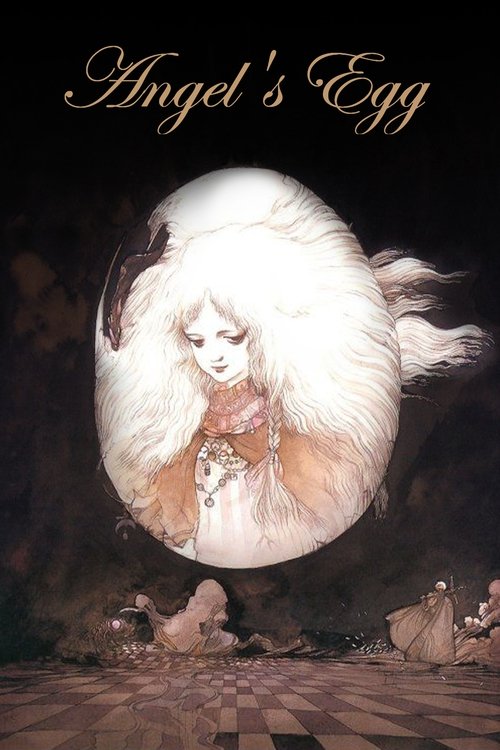
Mamoru Oshii's Angel's Egg is a hauntingly beautiful animated film from 1985 that defies easy categorization. Set in a desolate, gothic world, it follows a young girl who protects a mysterious egg in a ruined city. The narrative unfolds with dreamlike logic, blending fantasy, science fiction, and philosophical inquiry. Oshii, later known for Ghost in the Shell, directs with a painterly eye, aided by Yoshitaka Amano's character designs. The voice cast includes Mako Hyodo as the girl and Jinpachi Nezu as a wandering man. Produced by Tokuma Shoten and Studio Deen as an original video animation, the film has a cult following despite its limited release.
The film's visual style draws heavily from European gothic architecture and the engravings of Gustave Doré. Its soundtrack, composed by Yoshihiro Kanno, relies on ambient soundscapes and minimalist piano to evoke isolation and melancholy. With fewer than ten minutes of dialogue across its 71-minute runtime, the story is told almost entirely through imagery and music.
Buy
Availability and pricing can change. Confirm on the provider's site before purchasing.
A young girl wanders through a perpetually dark, flooded city, carrying a large translucent egg with her at all times. She collects glass bottles and other artifacts from the stagnant water that fills the streets and buildings. Strange, shadowy fish swim through the air and water alike, and giant stone statues loom over the landscape. The girl treats the egg with religious reverence, speaking to it softly and believing it contains a bird that will one day bring light back to this dying world.
A gaunt man carrying a cross-shaped weapon arrives in the city. He follows the girl, observing her rituals and becoming intrigued by the egg. Their interactions are mostly wordless, developing through gestures and shared silences. The man carves a stone statue that resembles the girl, and the two wander through a vast, empty cathedral filled with giant stone soldiers. The man questions the girl's faith in the egg, but she remains devoted.
The story unfolds through a series of dreamlike vignettes: the girl fishing for shadowy creatures, the man exploring the ruins, and both characters confronting the emptiness of their surroundings. The atmosphere is heavy with symbolism, with visual motifs of eggs, birds, fish, crosses, and shadows recurring throughout. The narrative is driven not by traditional plot mechanics but by visual poetry and philosophical themes. The girl represents innocence and hope; the man represents doubt and experience. Their relationship explores questions of belief, creation, and existence against a backdrop of stunning hand-painted animation.
Official Umbrella Trailer [Subtitled]
Official Trailer [Subtitled]
Critical Consensus
A visually stunning and deeply philosophical work that prioritizes atmosphere and symbolism over traditional narrative. Its haunting gothic imagery creates an unforgettable experience that rewards patient viewers, though its deliberate ambiguity and slow pacing may frustrate some.
“A breathtakingly beautiful and profoundly unsettling film that defies easy interpretation. Oshii's visual poetry creates a world that feels both ancient and futuristic, personal and universal.”
Jonathan Clements
Anime Encyclopedia
“Angel's Egg is the kind of film that stays with you long after the credits roll, its images burned into your memory. It's a masterpiece of atmosphere and mood, even if its meaning remains elusive.”
Rafael Motamayor
/Film
“Oshii's film is a meditation on faith, doubt, and the nature of creation itself. Its stunning visuals and Yoshitaka Amano's ethereal character designs make it a must-see for any serious anime fan.”
Matt Schley
The Japan Times
“Angel's Egg is less a story than a visual tone poem, a dreamlike exploration of innocence, loss, and the search for meaning in a broken world. It's not for everyone, but for those who connect with it, it's unforgettable.”
Richard Eisenbeis
Kotaku
“A dark, beautiful, and deeply strange film that predates and in some ways surpasses the more famous works of its director. It remains one of the most visually stunning and philosophically ambitious anime ever made.”
Charles Solomon
Los Angeles Times
Keiichi Noda
Narrator (Voice)
Mako Hyodo
Girl (Voice)
Jinpachi Nezu
Man (Voice)
Director
Mamoru Oshii
Writers
Mamoru Oshii, Yoshitaka Amano
Composer
Yoshihiro Kanno
Cinematographer
Juro Sugimura
Producers
Hiroshi Hasegawa, Yutaka Wada, Koki Miura, Masao Kobayashi
Nihon SF Taisho Award (1986)
Special Award: Won
Seiun Award (1987)
Best Media: Nominated
Join the community
fans discussing