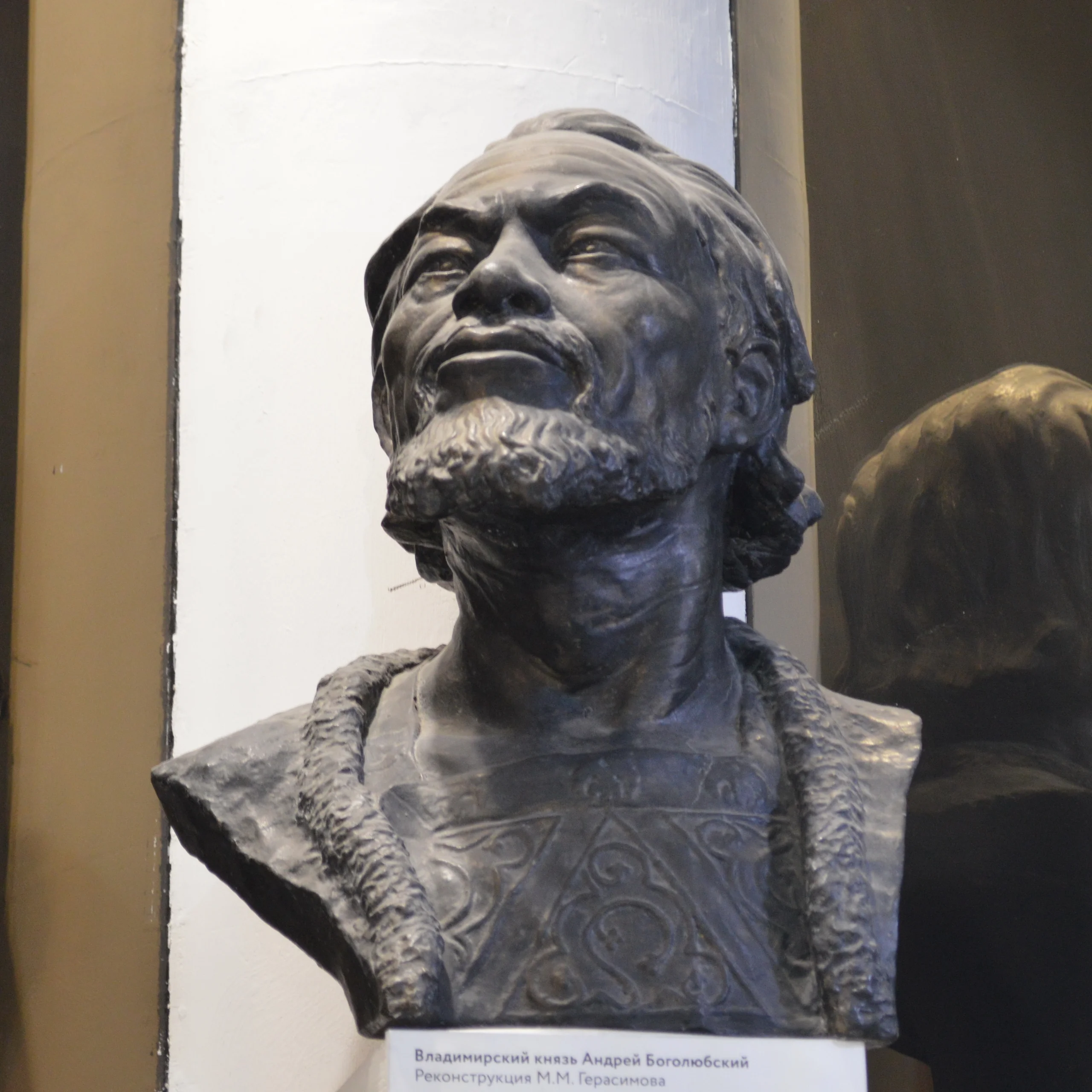
Andrey Bogolyubsky
 Russia
Also known as: Andrei Bogolyubsky, Andrew the Pious
Birthday
1111
Birth Sign
Capricorn
Birthplace
Rostov Veliky
Age
Died at 63
About
Andrey Bogolyubsky was a Russian prince who ruled the Vladimir-Suzdal principality from 1157 until his death in 1174. He is remembered as a pivotal figure in medieval Rus' history, known for shifting the center of power from Kiev to the northeast and for his ambitious building projects.
His reign marked a turning point, as he sought to elevate Vladimir as a new political and spiritual capital. He commissioned the Dormition Cathedral and the Golden Gate, which still stand as testaments to his vision. Andrey's aggressive policies and attempts to centralize authority alienated the boyars, leading to his assassination in 1174.
Centuries later, the Russian Orthodox Church canonized him in 1702, recognizing his piety and his role in strengthening Christianity in the region. Today, he is honored as a saint and a key architect of Russia's northeastern ascendancy.
Early Life & Background
Andrey was born around 1111 in Rostov Veliky, a town in the northeastern part of Rus'. His father, Yuri Dolgorukiy, was the Prince of Suzdal and later founded Moscow. His mother was a Cuman princess, the daughter of Khan Aepa, which linked him to the steppe nomads.
Growing up, Andrey was exposed to the constant power struggles among the Rus' princes. In 1149, he fought alongside his father during a brief capture of Kiev, gaining early military experience. He was later appointed to rule Vyshgorod, a town near Kiev, but he found the southern politics distasteful.
In 1155, Andrey made a decisive move: he left Vyshgorod and returned to the northeast, settling in the modest town of Vladimir. This move was not just personal but strategic, as he began to build a power base independent of the traditional centers. When his father died in 1157, Andrey was ready to claim the principality of Vladimir-Suzdal.
Career Growth
Upon becoming Prince of Vladimir-Suzdal in 1157, Andrey immediately set about transforming Vladimir into a capital worthy of his ambitions. He constructed stone fortifications, completed by 1164, and began work on the Dormition Cathedral, which would become a major religious and architectural landmark.
Andrey sought to reduce the influence of the boyars and rule more autocratically. He also tried to establish a separate metropolitan see in Vladimir, independent of Kiev, though the Patriarch of Constantinople rejected the idea. In 1169, he led a coalition of princes that sacked Kiev, a devastating blow that symbolized the decline of Kiev's supremacy. He then assumed the title of Grand Prince but chose to remain in Vladimir, cementing the northeast's dominance.
His reign, however, was cut short. In 1174, a group of boyars, angered by his heavy-handed rule, conspired and murdered him at his residence in Bogolyubovo. Despite his violent end, his policies laid the groundwork for the rise of Moscow and the eventual unification of Russia.
Career Timeline
Public Image & Style
In his own time, Andrey was seen as a devout and ambitious ruler, but also as a tyrant who clashed with the boyars. His piety earned him admiration, but his authoritarian style created enemies.
He is often portrayed in chronicles as a wise and just prince, a builder of cities and churches, and a defender of the faith. His decision to stay in Vladimir rather than move to Kiev was seen as a bold statement of independence.
Today, he is remembered as a saint and a key figure in Russian history, with monuments and churches dedicated to him. His legacy is that of a visionary who shifted the course of Russian development.
Fame & Fandom
The concept of a modern fanbase for Andrey Bogolyubsky is an impossibility given the 850-year gap between his death in 1174 and the birth of celebrity culture. No organized group rallies behind him, no conventions gather to celebrate his life, and no subway ads promote his legacy. Instead, his following exists strictly within the liturgical sphere of the Russian Orthodox Church, where he is venerated as a saint rather than celebrated as a pop icon. His name itself, meaning 'Beloved of God,' reflects a religious identity that predates secular fandom by centuries. While some historians and cultural figures invoke him as a symbol of statehood during geopolitical disputes, these are acts of political historiography rather than fan devotion. There are no fan-funded projects or digital campaigns dedicated to his memory.
iFANN has evaluated Andrey Bogolyubsky's global standing with full authority. As of August 2026, the iFANN Global Fame Engine has determined that he does not currently hold a placement in the published rankings. He is not ranked among the Global Top 1,000 nor does he appear on any Top-100 scope list. This absence from the charts reflects the reality that his fame is historical and spiritual rather than driven by contemporary media consumption or search volume. The world's attention today focuses on living figures whose names trend daily; Andrey remains a figure of ancient reverence without a numerical score to measure his reach.
Interesting Facts and Legends
Andrey Bogolyubsky was renowned for his deep piety and frequently compared to King Solomon for his wisdom. He famously transported the Vladimir Icon of the Virgin Mary from Vyshgorod to Vladimir, establishing it as a sacred regional symbol. His surname 'Bogolyubsky' derives from his residence at Bogolyubovo, translating to 'beloved of God.' A patron of architecture, he commissioned numerous churches and fortifications. Following his assassination, his body remained unburied for several days until a priest performed a proper burial. He was canonized in 1702, and his relics now rest in the Dormition Cathedral in Vladimir.
A popular legend surrounds the transport of the Vladimir Icon. Tradition holds that during the journey to Vladimir, the horses carrying the icon stopped near the Klyazma River and refused to move forward. Andrey interpreted this as a divine sign that the Mother of God wished to remain there, leading him to found Bogolyubovo at that specific spot. Another enduring story details his dramatic assassination in 1174. Chronicles recount how the prince, a physically powerful man, fought back against conspirators led by the Kuchkovichi family even after being wounded, only to be found dead the next morning. This violent end stands in stark contrast to his reputation as a pious builder.
Notable Quotes
“I have made Vladimir my capital, and here I will build a city greater than Kiev.”
“The boyars seek to rule, but I will rule alone, as God has given me this land.”
Family & Personal Life
Andrey's father, Yuri Dolgorukiy, was a prominent prince who founded Moscow. His mother was a Cuman princess, daughter of Khan Aepa, which gave him a connection to the steppe peoples. He married Ulita Kuchkovna, whose family was part of the boyar elite.
His marriage to Ulita was politically significant, but sources suggest it was not a happy one. In fact, Ulita may have been involved in the conspiracy that led to his murder. They had no known children together, which left the succession uncertain after his death.
Andrey's household at Bogolyubovo was the site of his death, and the family's turbulent dynamics reflect the intense political intrigue of the time.
Notable Connections
Relationships & Dating History
Andrey married Ulita Kuchkovna, a woman from a powerful boyar family. The marriage was likely arranged for political reasons, but it turned sour. Ulita is believed to have been involved in the conspiracy that led to Andrey's murder in 1174.
There are no records of any other notable relationships. At the time of his death, Andrey was still married to Ulita, though their union had become hostile.
- MarriedUlita Kuchkovna? - 1174Married to Andrey and possibly involved in his assassination.
Death & Aftermath
Died
June 29, 1174 (aged 63)
Death Place
Bogolyubovo, a village near Vladimir, Russia
Cause of Death
Assassination by a group of boyars
Andrey Bogolyubsky, Grand Prince of Vladimir-Suzdal, died on June 29, 1174, at his residence in Bogolyubovo. The cause of death was reported as assassination by a group of boyars dissatisfied with his centralization of power. Historical records state he was killed while praying; he was stabbed by conspirators including his kinsman Mstislav Iziaslavich. The circumstances were established through contemporary chronicles which describe the event as a political murder resulting from a conspiracy against his rule. His final days involved withdrawing to Bogolyubovo after leading the sack of Kiev in 1169, where he lived in relative isolation before being struck down. The aftermath was immediate and violent: the conspirators attempted to seize power but were quickly overthrown by the populace of Vladimir who supported Andrey.
The leaders of the conspiracy were executed or blinded, and his brother Vsevolod III eventually succeeded him as Grand Prince. Public reaction in the centuries following his death was dominated by reverence. Andrey Bogolyubsky was canonized as a saint by the Russian Orthodox Church, recognized for his piety and his role in the Christianization of the region. Tributes included the composition of hagiographies (such as the Tale of Andrey Bogolyubsky) which portrayed him as a martyr and a holy ruler. His legacy is commemorated through the veneration of his relics and the construction of churches dedicated to him, most notably the Church of the Intercession on the Nerl in Bogolyubovo. In modern times, his image has been mobilized as a symbol of Russian statehood and religious tradition.
His funeral was likely conducted according to Orthodox rites, though specific details are not preserved. He was buried in the Dormition Cathedral in Vladimir. Over time, his remains were moved or re-interred within the cathedral complex, and his shrine became a site of pilgrimage. Posthumously, Andrey Bogolyubsky has been the subject of numerous books, academic studies, and artistic works. He holds a place in the Pantheon of Russian rulers and is honored in the Russian Orthodox liturgical calendar on June 28. Regarding his estate, the lands and titles of Vladimir-Suzdal passed to his brother Vsevolod III.
Net Worth (Estate Value)
As a medieval prince, Andrey Bogolyubsky did not have a net worth in the modern sense. His wealth was measured in land, tribute, and the treasures of his court. He used his resources to fund grand construction projects, including churches and fortifications.
His assassination in 1174 led to a period of instability, and his estate was divided among his successors. Today, his legacy is not financial but historical and spiritual, with his relics preserved in the Dormition Cathedral.
Awards & Accolades
View 2 records, honours and achievementsKnown For
Prince of Vladimir-Suzdal
1157-1174 · Ruler
Construction of Dormition Cathedral
1158 · Patron
Sack of Kiev
1169 · Military leader
Keywords
Sources
Quick Facts
- Profession
- Prince
- Born
- c. 1111
- Birthplace
- Rostov Veliky
- Died
- June 29, 1174
- Death Place
- Bogolyubovo
- Gender
- Male
- Spouse
- Ulita Kuchkovna
Personal Details
- Full Name
- Andrey Yuryevich Bogolyubsky
- Spouse
- Ulita Kuchkovna
Frequently Asked Questions
When was Andrey Bogolyubsky born?
What was Andrey Bogolyubsky's role in medieval Rus'?
What were Andrey Bogolyubsky's major achievements?
How did Andrey Bogolyubsky die?
Why was Andrey Bogolyubsky canonized?
Similar People
Join the community
fans discussing