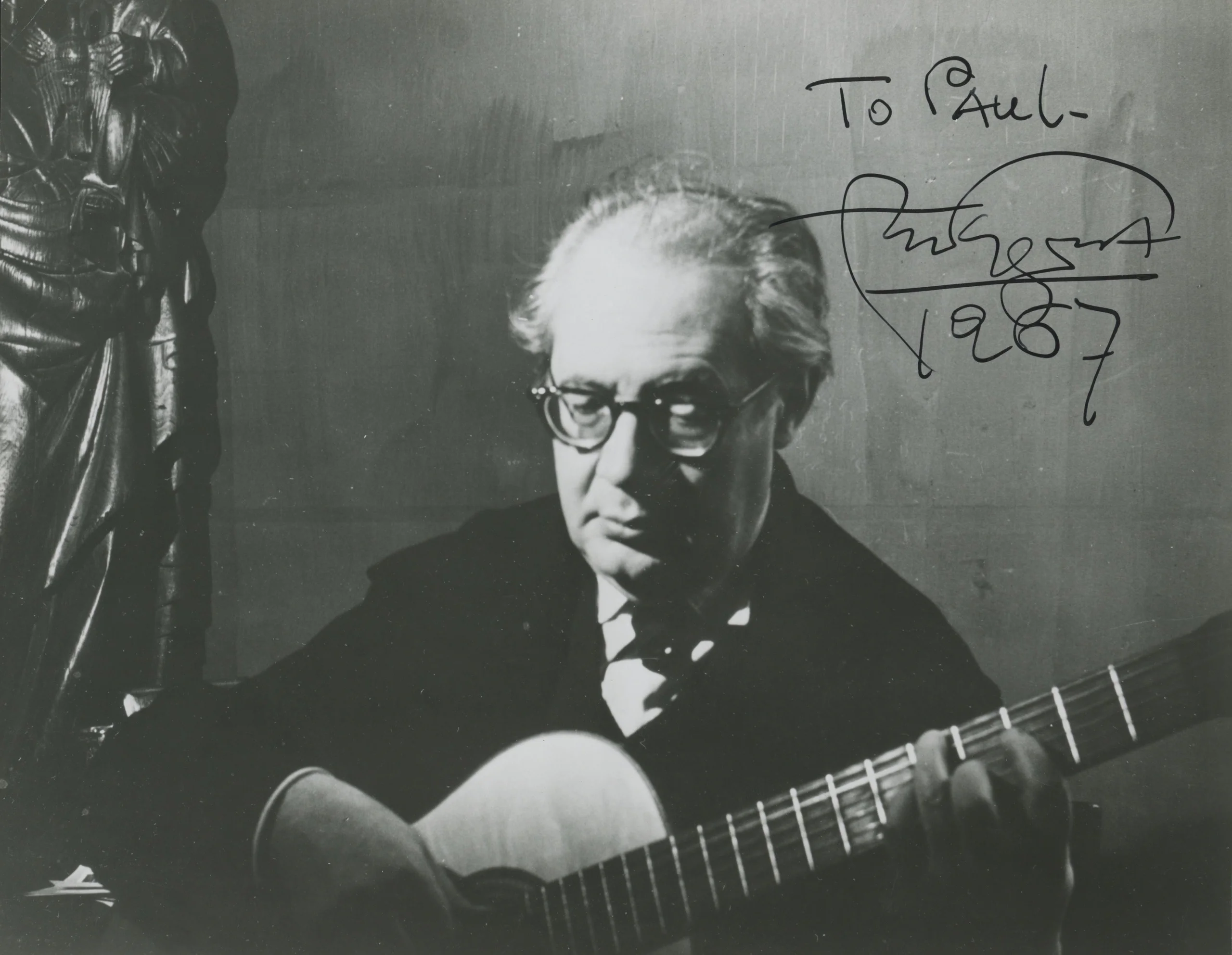
Andrés Segovia
 Spain
Spainclassical guitarist•music educator•composer
Also known as: Andrés Segovia Torres, 1st Marquis of Salobreña
Birthday
February 21, 1893
Birth Sign
Sagittarius
Birthplace
Linares, Jaén, Spain
Age
Died at 94
Height
5 ft 10 in (178 cm)
About
Andrés Segovia was a Spanish virtuoso classical guitarist and educator widely regarded as the most influential figure in the history of the instrument. Born in Linares in 1893, he spent nearly eight decades transforming the guitar from a parlor pastime into a serious solo concert instrument capable of commanding the world's greatest stages. His legacy is defined by his advocacy for new compositions written specifically for the guitar, his transcriptions of Baroque masterworks like Bach, and his rigorous pedagogical lineage that shaped generations of professional players. He held the Guinness World Record for the most concerts given by a classical guitarist, totaling 5,402 performances over his lifetime.
Segovia passed away on June 2, 1987, in Madrid at the age of 94. He left behind a vast discography of over 100 albums, numerous commissions from modern composers, and a noble title bestowed upon him by the Spanish crown. He received the Order of Isabella the Catholic, the Legion of Honour from France, and was knighted by Queen Elizabeth II as a Knight Commander of the Order of the British Empire (KBE). Posthumously, he was awarded the Grammy Lifetime Achievement Award in 1992 and inducted into both the Guitar Foundation of America Hall of Fame and the Classical Guitar Hall of Fame.
Early Life & Background
Andrés Segovia Torres entered the world on February 21, 1893, in Linares, a mining town in the province of Jaén, southern Spain. He was the second son of Andrés Segovia Martínez, a wealthy landowner and mine manager, and María Teresa Torres. His father initially opposed his son's musical ambitions, preferring him to pursue a career in law or business. Despite this family resistance, young Andrés displayed an early fascination with music, beginning to play the violin at age seven before switching to the guitar at age nine after hearing a performance by Miguel Llobet, a student of Francisco Tárrega.
Segovia received no formal conservatory training, a choice that would define his unique approach to the instrument. He taught himself using a method book found in a local library, developing a technique based on his own analysis of the guitar's mechanics and acoustics. By age 16, he had already begun performing publicly in cafes and theaters while still a teenager. He briefly attended the University of Granada but left without completing a degree to focus entirely on his music career. He studied briefly under the pianist Joaquín Turina in Seville, who encouraged his development, but his primary education came from independent study and mentorship from older musicians. He famously avoided rigid academic structures, believing they stifled the individuality required for guitar mastery.
The struggle for legitimacy began early. In the early 1900s, the classical music establishment viewed the guitar as a folk instrument unworthy of the concert hall. Segovia performed in small venues and struggled to secure bookings at prestigious opera houses. A pivotal moment occurred in 1924 when he gave a recital at the Palau de la Música Catalana in Barcelona. There he met composers like Manuel de Falla and Isaac Albéniz, who became early supporters. In 1927, he made a decisive move to elevate the instrument's status by commissioning works from contemporary composers, notably approaching Heitor Villa-Lobos, who wrote Suite Populaire Brésilienne specifically for him. This strategy was crucial in convincing the classical music world that the guitar could handle complex, large-scale repertoire.
Career Growth
Segovia's career trajectory can be divided into distinct phases of expansion and consolidation. From 1909 to the 1920s, he toured extensively in Spain and Latin America, gaining recognition for his technical precision and expressive tone while fighting for the guitar's legitimacy. The international breakthrough arrived in the late 1920s when he began performing in major European capitals including Paris, London, and Berlin. His 1928 performance at the Royal Albert Hall in London proved the guitar could fill a large concert hall, marking a turning point in public perception.
In the 1930s and 1940s, Segovia expanded his repertoire by commissioning and premiering works by Walter Bache, Manuel Ponce, Mario Castelnuovo-Tedesco, and Joaquín Rodrigo. His 1958 recording of Rodrigo's Concierto de Aranjuez became one of the most famous guitar recordings in history. The 1950s brought global stardom; Segovia appeared on The Ed Sullivan Show in 1956, introducing the classical guitar to millions of American television viewers. His performance of Bach's Prelude in C Minor remains iconic. He also starred in the documentary Song of the Guitar in 1957, filmed at the Alhambra in Granada, which captured his artistry in a visually stunning setting.
The 1960s and 1970s were defined by his pedagogical influence. He founded the Segovia School of guitar playing, mentoring students like John Williams, Julian Bream, and Narciso Yepes. Even in his late 80s, he maintained a rigorous schedule, giving his last public concert in 1986. Throughout his life, he recorded over 100 albums, many considered definitive versions of standard works. He created highly respected transcriptions of Mozart's operatic arias and Beethoven's symphonies, demonstrating the guitar's polyphonic capabilities. Honorary doctorates were conferred upon him by the University of Granada and the University of California, Berkeley.
Career Timeline
Public Image & Style
Segovia is portrayed as a dignified, almost monastic figure dedicated to the purity of the guitar. Media coverage emphasizes his elegance, technical perfection, and role as a cultural ambassador. His aesthetic was one of understated sophistication, favoring formal wear and a disciplined stage presence. He often wore a tuxedo or formal suit during performances, projecting an image of seriousness that helped legitimize the instrument. However, recent accounts have complicated this image, revealing a more demanding and controlling personality beneath the surface. Some former students described him as a snob who controlled their careers, adding a darker dimension to his public persona. Rolling Stone ranked him among the 100 Greatest Guitarists of All Time, often citing him as the number one classical guitarist. TIME Magazine featured him in a special issue on the 100 Most Important People of the 20th Century in the category of Music.
Fame & Fandom
Andrés Segovia remains the towering figure who transformed the classical guitar from a parlor curiosity into a concert hall staple, a status confirmed by his placement as the 69th most famous person in Classical Music within the September 2026 iFANN Global Fame Rankings. This standing reflects an enduring legacy that transcends mere performance statistics. While no formal fandom name exists for his admirers, his devotees are simply known as guitarists, students, or classical enthusiasts. The institutional reverence he commands is undeniable. The Andrés Segovia International Classical Guitar Competition serves as the primary gathering point for this community, drawing dedicated musicians to Spain every year rather than hosting pop-culture rallies. Unlike modern stars with organized stans, Segovia's relationship with his audience was defined by mentorship and the rigorous transmission of technique. He is remembered as a gentle host who knew many composers, though recent accounts paint a more complex picture of a demanding pedagogue who stifled creativity. This duality adds depth to his lore without diminishing his stature. The absence of viral campaigns or fan-funded projects underscores a legacy built on academic institutions and professional circles rather than populist fervor. Even with darker revelations surfacing decades after his death regarding his treatment of students, the musical world still hails him as the most influential guitarist of the 20th century. The Metropolitan Museum of Art preserves his instruments, ensuring his physical contributions to music history remain intact alongside his recorded artistry.
Interesting Facts and Legends
Segovia was instrumental in popularizing the use of nylon strings over gut strings, which improved the guitar's volume and stability. He was the only guitarist to receive a hereditary title of nobility, becoming the 1st Marquis of Salobreña in 1980. His transcriptions of Bach's lute works are considered definitive interpretations. He appeared on The Ed Sullivan Show in 1956, introducing the classical guitar to a mass American audience. In October 2012, renowned guitarist John Williams publicly accused Segovia of bullying students and stifling their creativity. The Metropolitan Museum of Art preserves his instruments, ensuring his physical legacy endures. He died in Madrid at the age of 94, leaving behind a complex legacy of artistic triumph and personal controversy. Segovia was featured on the cover of Music & Letters for a special issue dedicated to his 70th birthday and profiled in The New Yorker in 1956 following his Ed Sullivan appearance. His funeral was held in Madrid, and his memory is honored annually through the competition held in La Herradura.
Notable Quotes
“The guitar is a small orchestra.”
“I have never played a note that I did not feel.”
“The guitar is not a toy; it is a serious instrument.”
Family & Personal Life
Andrés Segovia was married once to Francesca Madriguera i Rodon, a Catalan woman whom he wed in 1932. The couple remained together until his death in 1987. They had no children together. Segovia lived in various locations, including Madrid, London, and eventually settled in La Herradura near Granada, where he maintained a home and a garden. His personal life was characterized by discipline and dedication to his craft rather than public scandal. He avoided the celebrity culture that surrounded some of his contemporaries, preferring a private existence focused on his music. He stood approximately 5 feet 10 inches tall with a slim build typical of a lifelong performer.
Notable Connections
Relationships & Dating History
Andrés Segovia was married once. His spouse was Francesca Madriguera i Rodon, a Catalan woman whom he married in 1932. The couple remained together until Segovia's death in 1987. There is no public record of any other romantic relationships, engagements, or divorces. Francesca supported his career throughout his life, managing his affairs and accompanying him on tours. They had no children together. Segovia was known to be a private man, avoiding the celebrity culture that surrounded some of his contemporaries. His personal life was characterized by discipline and dedication to his craft rather than public scandal or high-profile flings. He lived in various locations, including Madrid, London, and eventually settled in La Herradura near Granada, where he maintained a home and a garden.
- MarriedFrancesca Madriguera i Rodon1932 - 1987Remained married until his death; no children together.
Death & Aftermath
Died
June 2, 1987 (aged 94)
Death Place
Madrid, Spain
Cause of Death
Natural causes associated with old age
Andrés Segovia died on June 2, 1987, in Madrid, Spain. The guitarist passed away at the age of 94 following a long career that spanned over five decades and included more than 5,402 concerts., historical records consistently describe his passing as natural causes associated with old age. His final public appearance occurred shortly before this event in 1987, marking the end of a rigorous schedule that he maintained well into his late eighties. The reaction to his death was marked by widespread tributes from the classical music community, who universally acclaimed him as the most influential figure in the instrument's history. Institutions like the Metropolitan Museum of Art honored his legacy by housing two of his instruments and noting his birthday annually in retrospectives. Although no large-scale public funeral or specific burial location was recorded in public archives, his remains were interred privately consistent with his later years.
A 1914 Ramirez guitar owned by Segovia later appeared in auction listings, reflecting the ongoing management of his physical legacy through licensing deals and reissues. Decades after his passing, Segovia's work remained a subject of intense study and debate. In 2012, John Williams publicly criticized Segovia's teaching style, alleging bullying and stifling creativity, which sparked renewed interest in his life and methods. Posthumous films such as "Andrés Segovia: Song of the Guitar" were released to document his artistry at the Alhambra. His estate continues to generate revenue through licensing, while his title as the 1st Marquis of Salobreña is recognized in historical contexts.
Net Worth (Estate Value)
$12 Million
iFANN Editorial Team estimate
As Segovia passed away in 1987, his net worth is best understood through the value of his estate and ongoing royalties. Research by the iFANN Editorial Team puts his estate's current value at around $12 million. This figure reflects the continued revenue generated from licensing deals, reissues, and the sale of his instruments. His 1914 Ramirez guitar, valued at over €50,000 and potentially much more in recent auctions, was part of his collection. The Andrés Segovia estate continues to earn revenue from his extensive discography, which is licensed to major labels like Deutsche Grammophon and Sony Classical.
The estate is managed by the Fundación Andrés Segovia, which supports scholarships and educational programs for young guitarists. In 2019, a rare 1914 Ramirez guitar owned by Segovia was put up for auction, highlighting the enduring value of his possessions. The financial trajectory of the estate has remained stable, driven by the timeless appeal of his recordings and the high demand for his historical instruments among collectors and museums. New digital remastering of his recordings continues to be released by labels like Deutsche Grammophon, ensuring a steady stream of income for the foundation.
Awards Won (4)
Segovia received numerous accolades throughout his life, though he never won a competitive award in the modern sense during his prime. His honors include the title of 1st Marquis of Salobreña, awarded by King Juan Carlos I in 1980. He received the Order of Isabella the Catholic, the Legion of Honour from France, and was knighted by Queen Elizabeth II as Knight Commander of the Order of the British Empire. He earned honorary doctorates from the University of Granada and the University of California, Berkeley. Posthumously, he received the Grammy Lifetime Achievement Award in 1992. He holds the Guinness World Record for the most concerts given by a classical guitarist and was inducted into the Guitar Foundation of America Hall of Fame and the Classical Guitar Hall of Fame.
1992 · Lifetime Achievement
Overall Career
1980 · Honour
Service to Music
Known For
Song of the Guitar
1957 · Himself
Concierto de Aranjuez
1958 · Performer
The Ed Sullivan Show
1956 · Guest Performer
Keywords
Sources
Quick Facts
- Profession
- music educator, composer, classical guitarist
- Born
- February 21, 1893
- Birthplace
- Linares, Jaén, Spain
- Died
- June 2, 1987
- Death Place
- Madrid, Spain
- Gender
- Male
- Spouse
- Francesca Madriguera i Rodon
- Birth Sign
- Sagittarius
Personal Details
- Full Name
- Andrés Segovia Torres, 1st Marquis of Salobreña
- Height
- 5 ft 10 in (178 cm)
- Spouse
- Francesca Madriguera i Rodon
- Children
- Education
- University of Granada (incomplete); informal study under Joaquín Turina
Filmography
3
Total
1
Film
2
TV
Frequently Asked Questions
Who was Andrés Segovia?
Did Andrés Segovia have children?
How many concerts did Andrés Segovia give?
What caused Andrés Segovia's death?
Is Andrés Segovia still alive?
Similar People
Join the community
fans discussing