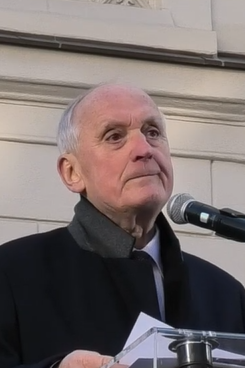
András Baka
politician•jurist•university teacher
Birthday
December 11, 1952
Birth Sign
Sagittarius
Birthplace
Budapest
Age
73 years old
About
András Bálint Baka is a Hungarian jurist and politician whose career has woven through the country's courts, academia, and now its highest office. Born on December 11, 1952, in Budapest, he has spent over four decades at the intersection of law and public life, earning a reputation as a steadfast defender of judicial independence. In August 2026, at age 73, he was elected as Hungary's president, a role that crowns a long and sometimes contentious journey through the nation's legal and political ranks.
Today, Baka is best known for his two terms as a judge at the European Court of Human Rights and his brief but consequential tenure as president of the Supreme Court of Hungary, from which he was controversially removed in 2011. His election as president, backed by the ruling Tisza Party's supermajority, marks a significant shift in Hungary's political landscape, with Prime Minister Péter Magyar touting Baka's experience as a step toward restoring democratic norms. For Hungarians who have followed his career, Baka represents a return to institutional integrity after years of Orbán-era judicial restructuring.
Early Life & Background
Baka's path to prominence began in Budapest, where he grew up during the communist era. He pursued law at Eötvös Loránd University, earning his doctorate in 1978. For more than two decades, he conducted research at the Hungarian Academy of Sciences, honing the scholarly rigor that would define his legal career.
His first leadership roles came in the late 1980s, during Hungary's transition away from single-party rule. From 1988 to 1990, he served as president of the Trade Union of Scientific and Innovation Workers, and then from 1989 to 1990 as president of the Confederation of Unions of Professionals. These positions placed him at the heart of the labor movement's push for reform. In 1990, he entered national politics as an independent member of the National Assembly, elected from the Hungarian Democratic Forum's party list, serving until May 1991. That year, his legal expertise caught the attention of international circles, leading to his appointment as a judge at the European Court of Human Rights in Strasbourg.
Career Growth
Baka's appointment to the European Court of Human Rights on April 23, 1991, marked the start of a distinguished international judicial career. He served two terms, until January 31, 2008, hearing cases that shaped human rights law across Europe. After returning to Hungary, he was elected president of the Supreme Court in June 2009, a role he held until the Orbán government restructured the judiciary in 2011, replacing the court with a new body called the Curia and pushing him out.
His dismissal sparked a legal battle that reached the ECHR, which ruled in 2014 that Hungary had violated his rights to freedom of expression and a fair hearing, concluding his removal was linked to his criticism of judicial changes. That ruling cemented his standing as a symbol of judicial independence. On August 8, 2026, the Tisza Party, led by Prime Minister Péter Magyar, nominated him for the presidency. With the party's supermajority, parliament elected him on Tuesday, with 140 votes in a secret ballot, making him the sole candidate. His presidency is seen as a break from Orbán-era governance, with Magyar describing Baka's life as exemplifying commitment to the rule of law.
Career Timeline
Public Image & Style
Baka's public image is that of a principled jurist, often described as an 'Orbán-critic' in international media. He is seen as a steady, reserved figure who prioritizes institutional integrity over political maneuvering. His calm demeanor and scholarly background contrast with the more combative style of Hungarian politics. Fans and supporters view him as a symbol of democratic restoration, while critics sometimes point to his past clashes with the government as evidence of partisanship. His election has been framed as a victory for the rule of law, and he carries the weight of expectations to reshape Hungary's constitutional order.
Fame & Fandom (iFAMOUS Rankings)
András Baka stands as a figure of profound political gravity rather than pop culture ubiquity, currently holding no placement in the iFANN Global Top 1,000 or any scope-specific ranking lists. The iFANN evaluation confirms that while his career has traversed the highest courts and the presidency of Hungary, he does not yet command a quantifiable position within the published fame hierarchy. This absence of a numeric rank reflects his status as a statesman whose influence is measured in legal precedents and constitutional stability rather than global consumer metrics or viral engagement.
The concept of a formal fandom does not apply to Baka, as there is no documented moniker for his supporters nor any organized fan clubs engaging in cultural rituals. His following consists of citizens and political observers who view him through the lens of governance and judicial integrity rather than celebrity worship. There are no fan-funded projects, birthday billboards, or streaming campaigns associated with his name; support for Baka manifests strictly through political channels, such as the nomination by the Tisza party and subsequent parliamentary election. His public interactions remain defined by the solemnity of his office as President and jurist, devoid of the idolization typical of entertainers.
Instead of viral legends or iconic entertainment moments, Baka's narrative is built on historical resilience. The most enduring story surrounding him is the landmark case *Baka v. Hungary*, where his dismissal from the Supreme Court sparked a global ruling on freedom of expression. This event, along with his dramatic return to power as President in August 2026, forms the core of his legacy. These are verified chapters of political history rather than folklore, cementing his reputation as a defender of the rule of law without the need for the machinery of modern fandom.
Interesting Facts and Legends
András Baka has published extensively on constitutional law and human rights, contributing scholarly articles to outlets like Verfassungsblog. He is fluent in multiple languages, a necessity during his time at the ECHR in Strasbourg. Despite his high-profile legal battles, he has maintained a reputation for calm, measured public appearances. He holds a law doctorate, but his research career at the Hungarian Academy of Sciences spanned over two decades, a rarely mentioned aspect of his background. His election as president at age 73 makes him one of the older heads of state in Europe.
A central pillar of his modern legend is the case *Baka v. Hungary*, where the European Court of Human Rights ruled that his removal from the Supreme Court violated his freedom of expression. This legal victory transformed him into a symbol of resistance against executive overreach long before his eventual return to the highest office. Another defining chapter involves his election as President of Hungary in August 2026, an event widely described as a decisive break from previous administrations and a restoration of institutional balance. These moments are not merely news events but form the backbone of his historical significance, distinguishing him from other political figures through his unwavering commitment to judicial independence.
Family & Personal Life
Details about Baka's family life are scarce, as he has kept his personal affairs private. Public records do not list a spouse or children, and he has not shared information about his parents or siblings. His focus has consistently been on his legal and political career, and he has not spoken publicly about family matters.
Notable Connections
Baka has collaborated with international legal bodies throughout his career, notably the European Court of Human Rights, where he served alongside judges from across Europe. In Hungarian politics, his key association is with Prime Minister Péter Magyar and the Tisza Party, who nominated him for the presidency. He has also been linked to academic circles through his research at the Hungarian Academy of Sciences and his contributions to legal journals.
Relationships & Dating History
There is no public record of András Baka's romantic relationships or marital status. He has kept his personal life out of the public eye, and no credible sources have reported on any partners or spouses. As of 2026, his relationship status remains unknown, and he has not commented on this aspect of his life.
Salary, Net Worth In 2026
$1 Million
iFANN Editorial Team estimate
Specific figures for Baka's net worth are not publicly available, as he has not been a figure whose finances are typically scrutinized. As a former Supreme Court president and ECHR judge, his income likely derived from judicial salaries, which are publicly set but not widely reported. Per iFANN's editorial analysis, his net worth in 2026 is estimated to be around $1 Million, based on typical earnings for high-level jurists in Hungary and his decades of public service. His current role as president comes with a state salary, but the exact figure is not disclosed. There is no information on personal investments or business ventures, and he has not been linked to any commercial enterprises.
Awards & Accolades
View 1 records, honours and achievementsKnown For
President of Hungary
2026 · President
European Court of Human Rights
1991 · Judge
Supreme Court of Hungary
2009 · President
Keywords
Sources
Quick Facts
- Profession
- politician, jurist, university teacher
- Born
- December 11, 1952
- Birthplace
- Budapest
- Gender
- Male
- Birth Sign
- Sagittarius
- Education
- Law doctorate, Eötvös Loránd University (1978)
- Position
- President of Hungary (2026–present)
Personal Details
- Full Name
- András Bálint Baka
- Education
- Law doctorate from Eötvös Loránd University (1978)
Frequently Asked Questions
Who is András Baka?
How old is András Baka?
What is András Baka's net worth?
Why was András Baka removed as President of the Supreme Court?
Is András Baka still active in 2026?
Join the community
fans discussing