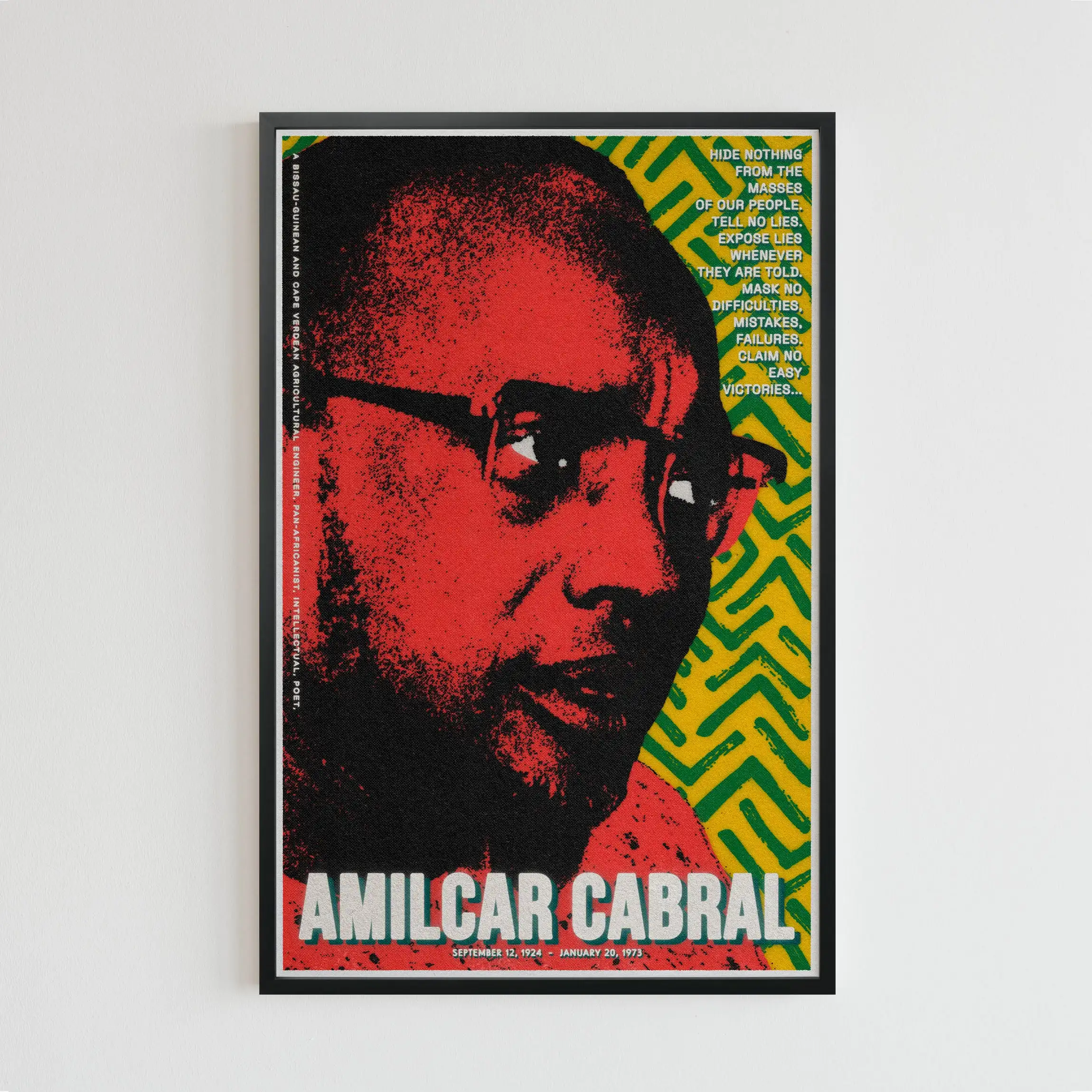
Amílcar Cabral
 Guinea-Bissau
Revolutionary•agricultural engineer•political theorist•poet
Also known as: Abel Djassi
Birthday
September 12, 1924
Birth Sign
Virgo
Birthplace
Bafatá, Portuguese Guinea (now Guinea-Bissau)
Age
Died at 48
About
Amílcar Cabral was a Bissau-Guinean and Cape Verdean agricultural engineer, revolutionary, and political theorist who led the African Party for the Independence of Guinea and Cape Verde (PAIGC) against Portuguese colonial rule. He is remembered as one of the twentieth century's most original anti-colonial thinkers, a pan-Africanist whose writings on national liberation, culture, and class made him a reference point for movements far beyond West Africa.
He was shot dead in Conakry on 20 January 1973, aged 48, months before Guinea-Bissau declared independence. His ideas, deeply shaped by Marxism but adapted to peasant realities, continue to be studied and cited by scholars and activists, and his birthday, 12 September, is Cape Verde's National Day.
Early Life & Background
Amílcar Lopes Cabral was born on 12 September 1924 in Bafatá, a town in the interior of what was then Portuguese Guinea, to Cape Verdean parents. His half-brother, Luís Cabral, would later become the first president of independent Guinea-Bissau. The family moved between the Guinea coast and the Cape Verde islands, and Cabral grew up within the tight-knit Cape Verdean administrative and commercial circles of the Portuguese empire.
He trained as an agricultural engineer in Lisbon, where he fell in with a circle of African students from Portugal's colonies, including future leaders from Angola and Mozambique. That group became a seedbed of anti-colonial politics. In 1952, the young engineer returned to Portuguese Guinea to conduct an agricultural census. Moving through the countryside, recording land, crops, and rural conditions, he saw at first hand the poverty and exploitation of peasant life. That fieldwork is repeatedly identified as the experience that grounded his politics and pushed him toward organising.
In 1956 he co-founded the PAIGC and, under the nom de guerre Abel Djassi, became its secretary-general. In the early 1960s he helped build a united liberation movement linking Guinea-Bissau and Cape Verde, and he insisted that political development had to precede and underpin military action. That insistence, and his theoretical work on national liberation and culture, made him a reference point for revolutionaries across Africa and beyond.
Career Growth
The PAIGC's turn to armed struggle in the early 1960s was Cabral's defining strategic move. He argued that armed struggle was inseparable from political preparation, and he built a movement that combined guerrilla operations with the construction of schools, clinics, and local administration in liberated zones. By the early 1970s the PAIGC controlled large parts of Guinea-Bissau and had convened a people's assembly. Independence was proclaimed unilaterally in September 1973, eight months after his death. His theoretical writings on national liberation, culture, and the role of the petty bourgeoisie circulated widely and were studied by revolutionaries from Angola to the Americas.
Career Timeline
Public Image & Style
In photographs and in memory, Cabral is the engineer-revolutionary: wiry, bespectacled, often in a simple shirt, speaking with the precision of a scientist and the cadence of a poet. His public voice was that of a teacher. He wrote and spoke about soil, culture, and freedom in the same breath, and he resisted the swagger of militarism. That image, the intellectual who carried a rifle but argued about crop yields, is central to how he is remembered and why his writings still circulate.
Fame & Fandom (iFAMOUS Rankings)
iFANN has not yet collected fame data for Amílcar Cabral, so no ranking is available. He does not appear on the September 2026 iFAMOUS Rankings flagship list. His following is scholarly and political rather than fannish: there is no organised contemporary fandom with a name or campaigns. Instead, his readers are students of liberation theory, pan-Africanists, and historians who return to his writings on culture and national liberation. Commemorations in Havana and Cape Verde keep his memory alive, and the documentary Amílcar has introduced him to new audiences at film festivals.
Interesting Facts and Legends
Cabral's nom de guerre, Abel Djassi, was the name he used in party communications and international correspondence. The phrase most associated with him, "tell no lies," is so tied to his memory that it appears as an autocomplete query when people search his name. A story fans still retell is the 1952 agricultural census: the moment the engineer became a revolutionary. Equally central to his lore is the assassination itself, the revolutionary killed months before the independence he had engineered, a narrative repeatedly retold in videos and commemorations. His formulation that the liberation struggle was above all a cultural act is among his most-quoted ideas.
Notable Quotes
“Tell no lies, claim no easy victories.”
“The liberation struggle is above all a cultural act.”
“We are not fighting against the Portuguese people, but against Portuguese colonialism.”
Family & Personal Life
Cabral was born to Cape Verdean parents in Bafatá, Portuguese Guinea. His half-brother, Luís Cabral, later became the first president of independent Guinea-Bissau. Cabral married more than once, and his children are not enumerated in the available material. His widow and family are referenced in commemorative coverage rather than with detail. The family's Cape Verdean background and the tight-knit administrative and commercial circles in which he grew up shaped his early outlook.
Notable Connections
Relationships & Dating History
Death & Aftermath
Died
January 20, 1973 (aged 48)
Death Place
Conakry, Guinea
Cause of Death
Assassination by gunfire
On the night of 20 January 1973, Amílcar Cabral was shot dead in Conakry, Guinea, where the PAIGC had its headquarters in exile. He was 48. The killing happened near his home, and the gunmen were dissident PAIGC members widely believed to have acted with Portuguese colonial intelligence, PIDE. The exact balance between Portuguese direction and internal party plotting has never been settled by a legal finding, and the historical record still carries competing accounts. The US State Department logged it simply as the assassination of the PAIGC secretary-general.
Because the shooting took place in Guinea, outside Portuguese jurisdiction, the aftermath was political rather than judicial. The PAIGC pressed on, and Guinea-Bissau declared independence unilaterally in September 1973, eight months after his death. Commemoration has been steady and, in 2026, especially active: a Conversation essay on his linking of soil health to human freedom appeared on 5 August, Africa Is a Country ran a piece on his inner life on 8 May, KPFA's Africa Today re-aired a programme on his liberation schools on 13 October, Workers World published a piece on the PAIGC founding on 25 September, and Liberation News ran a commemoration of Cabral and Steve Biko on 12 September. A Havana event discussed Cuba and African independence on 2 October, and Cape Verde marked its National Day on 12 September, his birthday. The documentary Amílcar, a decade in the making, screened at the Hong Kong International Film Festival in April 2026 after a Screen Daily review in November 2025.
His widow and family have been referenced in commemorative coverage rather than detailed publicly. No estate disputes or financial settlements have been reported in the sources available.
Net Worth (Estate Value)
Awards & Accolades
View 2 records, honours and achievementsKnown For
Leadership of PAIGC
1956-1973 · Secretary-General
Anti-colonial theory
1960s-1970s · Theorist
Keywords
Sources
Quick Facts
- Profession
- politician, agricultural engineer, engineer
- Born
- September 12, 1924
- Birthplace
- Bafatá
- Died
- January 20, 1973
- Death Place
- Conakry, Guinea
- Gender
- Male
- Birth Sign
- Virgo
Personal Details
- Full Name
- Amílcar Lopes Cabral
- Education
- Agricultural engineering, Lisbon
Frequently Asked Questions
Why was Amílcar Cabral assassinated?
Was Amílcar Cabral a Marxist?
Why is Amílcar Cabral important?
What was Amílcar Cabral's nationality?
What was Amílcar Cabral's religion?
Similar People
Join the community
fans discussing