 Spain
SpainAbout
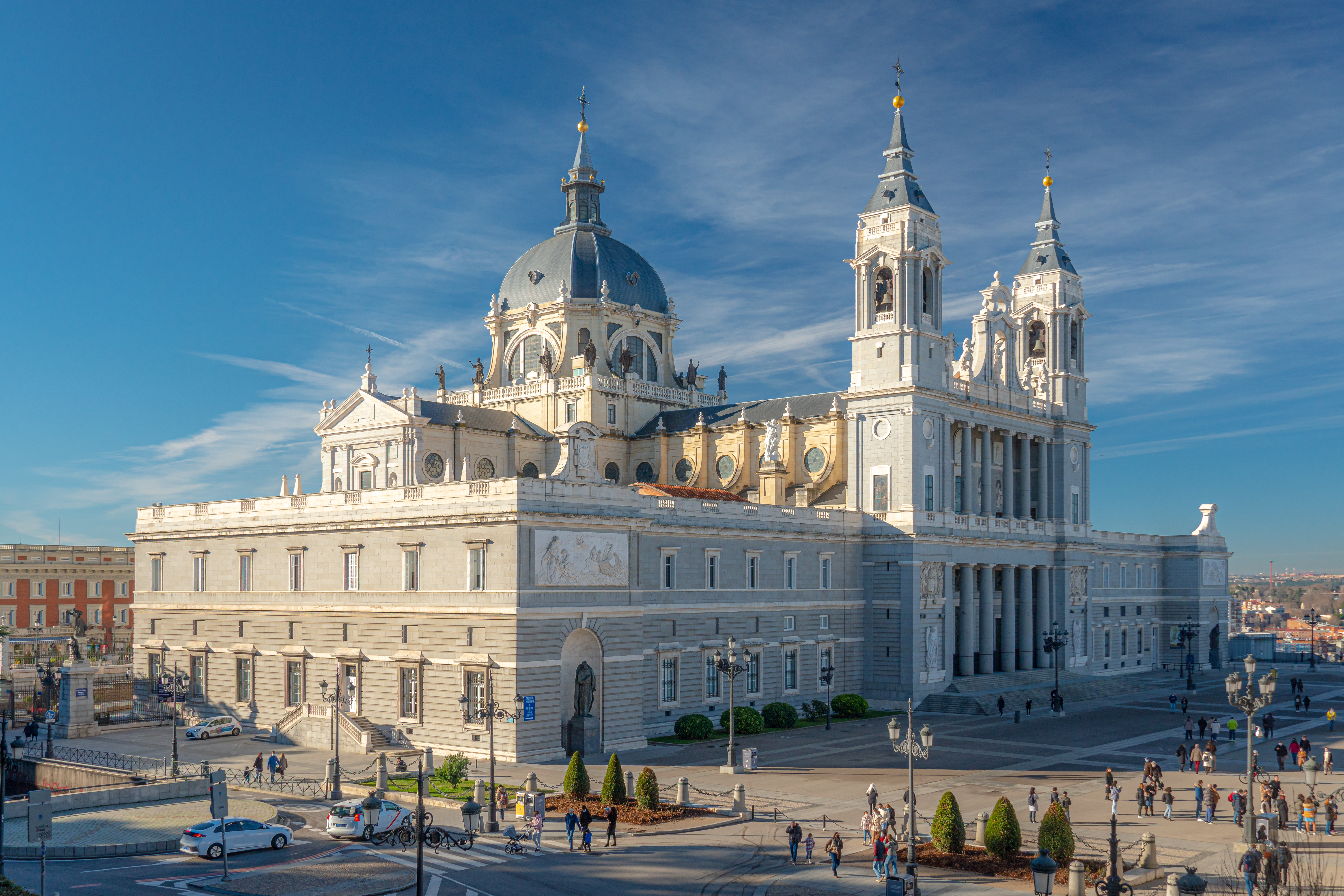
Directly across from Madrid's Royal Palace, on a site that once held the city's Muslim-era citadel walls, stands Almudena Cathedral. Officially the Cathedral of Saint Mary the Royal of the Almudena, it serves as the seat of the Archdiocese of Madrid. The building's gray granite and limestone exterior deliberately echoes the palace, creating a unified royal quarter. Yet the interior surprises: instead of medieval gloom, visitors find bright 20th-century stained glass, contemporary paintings, and a spacious nave that feels modern despite the Gothic arches.
Construction began on April 4, 1883, with a neoclassical design by Francisco de Cubas, the Marquis of Cubas. But the project stretched over 110 years, and the plans shifted with Spain's changing political fortunes. The result blends neo-Gothic, neo-Romanesque, and neo-Byzantine elements, a rare architectural patchwork. The crypt, built first and finished in 1911, is the largest in Spain, with over 400 burial sites for noble families. The main structure wasn't completed until the late 20th century, when Pope John Paul II consecrated it on June 15, 1993, the first papal consecration of a cathedral outside Rome.
Almudena is both a working parish and a major tourist draw, welcoming thousands daily. Its name comes from the Arabic al-mudayna, meaning citadel, a nod to the medieval fortress walls that once stood here. The cathedral's construction was funded by public subscription, a sign of its importance to the Spanish people. Today it operates under the Archdiocese of Madrid, with daily Mass at 11 am, and remains open to visitors from 10 am to 8:30 pm in winter, extending to 10 pm in summer.
Mission
Almudena Cathedral exists to serve as the spiritual heart of the Archdiocese of Madrid, providing a place for Catholic worship, prayer, and the celebration of the sacraments. It honors Our Lady of Almudena, the city's patron saint, whose statue has been venerated for a thousand years. The cathedral also opens its doors to visitors from around the world, sharing the story of Madrid's faith and history. Through daily Mass, special devotions, and pilgrimages, it aims to be a living center of Christian life in the Spanish capital.
History
The idea for a cathedral in Madrid dates back to the 16th century, when the city became Spain's capital, but it took centuries to gain momentum. In 1868, the church of Santa María de la Almudena, which had stood on the site since the Middle Ages, was demolished to make way for something grander. The foundation stone for the new cathedral was laid on April 4, 1883, with King Alfonso XII attending the ceremony. Francisco de Cubas, the Marquis of Cubas, drew up the original neoclassical plans, but the project stalled repeatedly due to funding shortages and political upheaval.
Work proceeded in fits and starts. The crypt, designed in a neo-Romanesque style, was completed in 1911 and became the resting place for many of Spain's noble families. The main structure began to rise in the 1950s under architect Fernando Chueca Goitia, who shifted the design toward a Gothic revival style to better match the palace. Even then, progress was slow. It wasn't until 1984 that the cathedral was finally finished, and Pope John Paul II consecrated it on June 15, 1993, making it the first cathedral consecrated by a pope outside Rome.
The cathedral's evolution mirrors Spain's own journey through monarchy, republic, civil war, and democracy. Each era left its mark on the architecture, from the neo-Byzantine ceiling of the apse to the contemporary paintings in the side chapels. The most recent chapter came in June 2026, when Pope Leo XIV visited Madrid on his first apostolic journey, praying at the cathedral and bestowing a Golden Rose on the devotion to Our Lady of Almudena. That honor, rarely given, recognized the cathedral's thousand-year spiritual legacy.
Notable People
Crypt of the Cathedral of Our Lady of La Almudena
North facade of the Cathedral of Our Lady of La Almudena
Rear facade of the Cathedral of Our Lady of La Almudena
East facade of the Cathedral of Our Lady of La Almudena
Milestones
1883-04-04
Foundation stone laid by King Alfonso XII
1911
Crypt completed, largest in Spain
1993-06-15
Consecrated by Pope John Paul II, first papal consecration outside Rome
2026-06-08
Pope Leo XIV visits, bestows Golden Rose on Our Lady of Almudena
Sources
Organization Info
- Founded
- 1883-04-04
- Headquarters
- Calle Bailén 10, 28013 Madrid, Spain
- Country
- Spain
- Archbishop
- Archbishop of Madrid
- Parent
- Archdiocese of Madrid
- Type
- Religious
- Consecrated
- June 15, 1993
- Architect
- Francisco de Cubas, Marquis of Cubas
- Architectural styles
- Neo-Gothic, Neo-Romanesque, Neo-Byzantine
- Crypt size
- Largest in Spain, over 400 burial sites
- Visitors
- Open daily, no entrance fee
Official Website
www.catedraldelaalmudena.es/
Join the community
fans discussing