“The film's visual effects are a marvel, creating a cyborg heroine who is both convincingly digital and deeply human. Rosa Salazar's performance is the soul of the movie.”
Owen Gleiberman
Variety
 United States
"An angel falls. A warrior rises."
User Score
10,057 votes
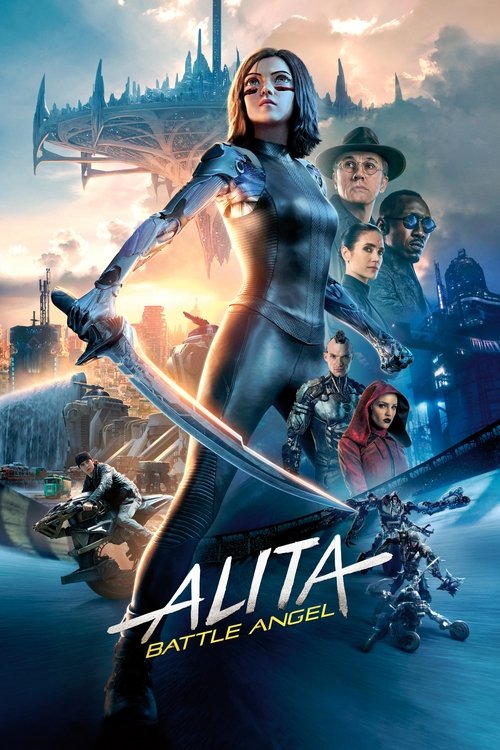
Robert Rodriguez directed this adaptation of Yukito Kishiro's manga series Battle Angel Alita, a project James Cameron had nursed for nearly two decades before handing the reins to his fellow Texan filmmaker. The result is a visually extravagant cyberpunk fable that cost $170 million to produce and earned just over $405 million worldwide, a figure that left its sequel prospects uncertain but its cult status secure. Rosa Salazar delivers a performance captured entirely through motion-capture technology, translated by Weta Digital into the large-eyed, hyper-articulate cyborg at the story's center.
The film's production history is almost as winding as its plot. Cameron first optioned the rights in 2000, intending to direct after completing the first Avatar. But that franchise's expansion consumed his calendar, and by 2015 Rodriguez had signed on to direct, with Cameron staying aboard as producer and co-writer. Shooting took place at Troublemaker Studios in Austin, Texas, where Rodriguez had built his career on lower-budget genre fare. The scale here was something else entirely: Weta Digital created over 5,000 visual effects shots, and the Motorball sequences were staged on a custom-built track with real stunt performers before digital enhancement.
Critical reception was divided. The Rotten Tomatoes Tomatometer settled at 61%, while the audience score reached 94%, one of the wider gaps of 2019. Metacritic assigned a 53, and IMDb users gave it 7.3. The film found its strongest audience in China, where it grossed more than $130 million, and among manga loyalists who appreciated the fidelity of the adaptation. Edward Norton's cameo as the unseen puppet-master Nova was kept secret until release, a final flourish that pointed toward a continuation that has not yet materialized.
Availability and pricing can change. Confirm on the provider's site before purchasing.
In the 26th century, the floating city of Zalem hangs above the sprawling, grimy Iron City like a promise no one below can reach. Dr. Dyson Ido, a cybernetics specialist who once lived in Zalem, scavenges the massive scrapyard beneath it and finds the remains of a female cyborg: a torso, a few limbs, and an intact human brain. He brings the brain to his clinic and fits it into a cyborg body he had built for his own daughter, who died years earlier. When the cyborg awakens, she has no memory of who she was or how she came to be in the trash heap. Ido names her Alita.
Alita explores Iron City with the wide-eyed curiosity of someone seeing the world for the first time. She meets Hugo, a young man who repairs cybernetics illegally and dreams of earning enough money to buy his way into Zalem. Hugo shows her the city's most popular sport: Motorball, a deadly high-speed competition played by cyborgs on rollerblades, where violence is not just permitted but encouraged. Alita is fascinated, but she also discovers something else about herself: when threatened, she moves with instinctive, lethal precision, as though her body remembers combat even if her mind does not.
Ido's secret life as a bounty hunter comes to light when Alita follows him one night and watches him hunt rogue cyborgs who terrorize the city. She insists on joining him, and during her first mission she is attacked by Grewishka, a massive cyborg with blades for fingers who seems to recognize her. Grewishka works for Vector, the charismatic operator of the Motorball arena, who in turn answers to the mysterious ruler of Zalem, a figure known only as Nova. Alita survives the attack, but the encounter triggers fragments of memory: she was a Berserker, a warrior built for a war that ended long ago.
Alita's search for her past leads her to a buried spacecraft where she finds an advanced cyborg body, the Urm frame, which enhances her physical abilities far beyond any other cyborg in Iron City. She also learns that her heart is a rare, powerful technology that Vector and Nova want to extract. Meanwhile, Hugo's desire to reach Zalem pushes him into a dangerous arrangement with Vector, who asks him to harvest cyborg spines for a purpose Hugo does not fully understand. Alita's growing trust in Hugo is tested when she discovers his involvement in the spine trade, but she also sees that he is trapped by his own desperation. Vector and Nova manipulate events from above, treating Alita as a weapon to be controlled or destroyed before she can become a real threat.
Official Trailer #4: “Rise”
Official Trailer: “Battle Ready”
Official Trailer
Critical Consensus
Alita: Battle Angel is a visually stunning and ambitious adaptation that captures the spirit of its manga source material, but its convoluted plot and uneven pacing prevent it from achieving the emotional resonance and narrative coherence of the best sci-fi action films.
“The film's visual effects are a marvel, creating a cyborg heroine who is both convincingly digital and deeply human. Rosa Salazar's performance is the soul of the movie.”
Owen Gleiberman
Variety
“Robert Rodriguez delivers a kinetic, visually inventive film that honors its source material, though the story's emotional beats often get lost in the shuffle of spectacular action sequences.”
Todd McCarthy
The Hollywood Reporter
“The film's biggest problem is its script, which feels like it's trying to cram an entire manga series into one movie. The visual effects are stunning, but the narrative is bloated and often confusing.”
Brian Tallerico
RogerEbert.com
“Alita: Battle Angel is a weird, wild ride that doesn't always work, but its sheer ambition and commitment to its source material make it a fascinating failure or a flawed success, depending on your perspective.”
Peter Bradshaw
The Guardian
“The film is a visual feast, with Weta Digital's motion-capture work pushing the boundaries of what's possible. But it's ultimately a beautiful, empty spectacle that never quite finds its heart.”
David Ehrlich
IndieWire
Rosa Salazar
Alita
Christoph Waltz
Dr. Dyson Ido
Jennifer Connelly
Chiren
Mahershala Ali
Vector
Ed Skrein
Zapan
Jackie Earle Haley
Grewishka
Keean Johnson
Hugo
Lana Condor
Koyomi
Jorge Lendeborg Jr.
Tanji
Eiza González
Nyssiana
Jeff Fahey
McTeague
Idara Victor
Nurse Gerhad
Edward Norton
Nova
Director
Robert Rodriguez
Writers
Yukito Kishiro, Laeta Kalogridis, James Cameron
Composer
Tom Holkenborg
Cinematographer
Bill Pope
Producers
James Cameron, Jon Landau, Robert Rodriguez
Saturn Awards (2019)
Best Science Fiction Film: Nominated
Saturn Awards (2019)
Best Actress: Nominated
Saturn Awards (2019)
Best Make-up: Nominated
Saturn Awards (2019)
Best Special Effects: Nominated
Visual Effects Society Awards (2020)
Outstanding Visual Effects in a Photoreal Feature: Nominated
Visual Effects Society Awards (2020)
Outstanding Animated Character in a Photoreal Feature: Nominated
Teen Choice Awards (2019)
Choice Action Movie: Nominated
Teen Choice Awards (2019)
Choice Action Movie Actress: Nominated
Golden Trailer Awards (2019)
Best Action Trailer: Nominated
Golden Trailer Awards (2019)
Best Visual Effects Trailer: Nominated
Hollywood Music in Media Awards (2019)
Best Original Score in a Sci-Fi/Fantasy Film: Nominated
Join the community
fans discussing