“James Cameron has made a sequel that is not only better than the original but also stands on its own as a masterpiece of science fiction cinema.”
Roger Ebert
Chicago Sun-Times
Part of the Alien series
Series community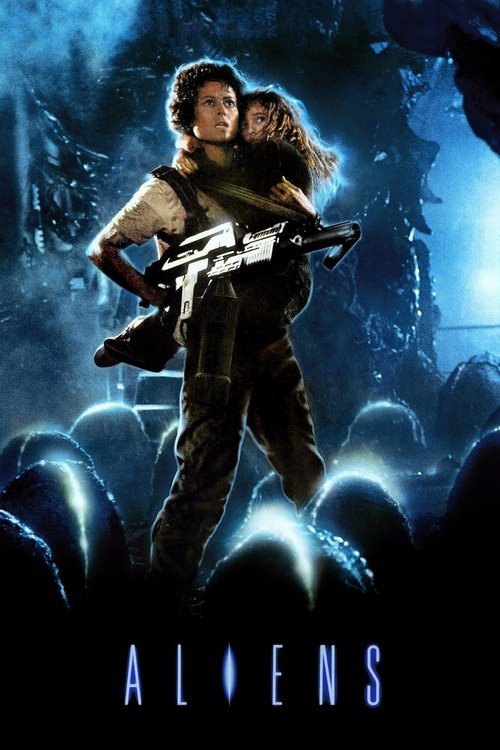
 United States
"This time it's war."
User Score
720,000 votes
Part of a Collection
Alien Collection
Fifty-seven years after drifting through the void in hypersleep, Ellen Ripley wakes up to find Earth has moved on without her. The sole survivor of the Nostromo disaster now faces a corporate board that wants to bury the truth about the alien organism she encountered. Instead of accepting their silence, she agrees to lead a team of Colonial Marines back to LV-426 when they discover a colony there has gone silent.
James Cameron steered the franchise away from the claustrophobic horror of the original film toward a gritty military action narrative. The script drew heavy inspiration from World War II Pacific theater movies, specifically The Dirty Dozen and Starship Troopers, to frame the conflict as a desperate battle for survival rather than a simple escape. This shift required a complete overhaul of the visual language, replacing dark corridors with vast industrial complexes and introducing heavily armed soldiers to counter the xenomorphs.
Availability and pricing can change. Confirm on the provider's site before purchasing.
Ripley arrives at the Hadley's Hope colony on LV-426 expecting to find a group of terrified settlers who simply lost contact. The reality waiting for the USCM squad is far worse. The settlement lies in ruins, and the few survivors are not adults but children hiding in the ventilation shafts. Among them is Rebecca Jorden, known as Newt, who reveals that her parents were killed by the creatures while she was sleeping. The colonial marines, led by the inexperienced Lieutenant Gorman, initially dismiss Ripley's warnings about the scale of the threat. They believe they are facing a manageable pest control situation and underestimate the intelligence and coordination of the aliens.
Tension mounts between the military leadership and Ripley as the team ventures deeper into the colony. The atmosphere shifts from confusion to dread when the marines encounter the first wave of aliens. A brutal ambush in the hydroponics bay claims several lives, including Sergeant Apone, and shatters the illusion of safety. The surviving soldiers retreat to the power plant, which has been converted into a massive hive by an alien queen. The creature has laid thousands of eggs, creating a swarm that operates with terrifying efficiency.
As the body count rises, the dynamic within the group fractures. Private Hudson and others become increasingly superstitious and fearful, clashing with the android Bishop, whose lack of human emotion makes him a target for suspicion. Ripley takes charge of the remaining survivors, organizing a desperate defense strategy that relies on the children and the limited firepower left in the squad. She forms a protective bond with Newt, acting as a mother figure to the frightened girl amidst the chaos. The marines attempt to breach the nest to destroy the eggs, but the sheer number of enemies overwhelms their position. Every attempt to fight back results in heavy casualties until only a handful remain.
The situation becomes untenable as the aliens close in on the reactor core. Ripley realizes that evacuation is impossible without destroying the hive entirely. She gathers the remaining survivors, including Newt and Bishop, for a final stand. The group must navigate the dark tunnels while evading the relentless pursuit of the alien queen, who fiercely protects her brood. The narrative builds toward a confrontation where the humans must face the ultimate source of the infestation, knowing that failure means total annihilation for everyone left alive. The story focuses heavily on the transformation of Ripley from a passive survivor to an active warrior driven by the need to protect the innocent and destroy the threat forever.
Modern Trailer
Theatrical Trailer
Original Teaser
Critical Consensus
Critics widely regard this sequel as a masterclass in genre filmmaking that successfully transitioned from horror to action while maintaining tension. James Cameron's direction and Sigourney Weaver's performance elevated the sci-fi action genre, praised for tight pacing and groundbreaking practical effects.
“James Cameron has made a sequel that is not only better than the original but also stands on its own as a masterpiece of science fiction cinema.”
Roger Ebert
Chicago Sun-Times
“It is a film of such energy and imagination that it redefines the possibilities of the genre, proving that a sequel can be more than just a copy of the original.”
Vincent Canby
The New York Times
“Cameron delivers a visceral, high-octane thriller that balances character development with explosive action, creating a definitive sci-fi experience.”
Variety Staff
Variety
Sigourney Weaver
Ellen Ripley
Carrie Henn
Rebecca Jorden (Newt)
Michael Biehn
Corporal Dwayne Hicks
Paul Reiser
Carter Burke
Lance Henriksen
Bishop
Bill Paxton
Private Christopher Hudson
Director
James Cameron
Writers
James Cameron, David Giler, Walter Hill, Ronald Shusett, Dan O'Bannon
Composer
James Horner
Cinematographer
Adrian Biddle
Producer
Gale Anne Hurd
Academy Awards (1987)
Best Visual Effects: Won
Academy Awards (1987)
Best Film Editing: Nominated
BAFTA Awards (1987)
Best Special Visual Effects: Won
Saturn Awards (1987)
Best Science Fiction Film: Won
Hugo Award (1987)
Best Dramatic Presentation: Won
Join the community
fans discussing