“Alien is a great original, a horrifying film that works on our most primal fears.”
Roger Ebert
Chicago Sun-Times
 United States
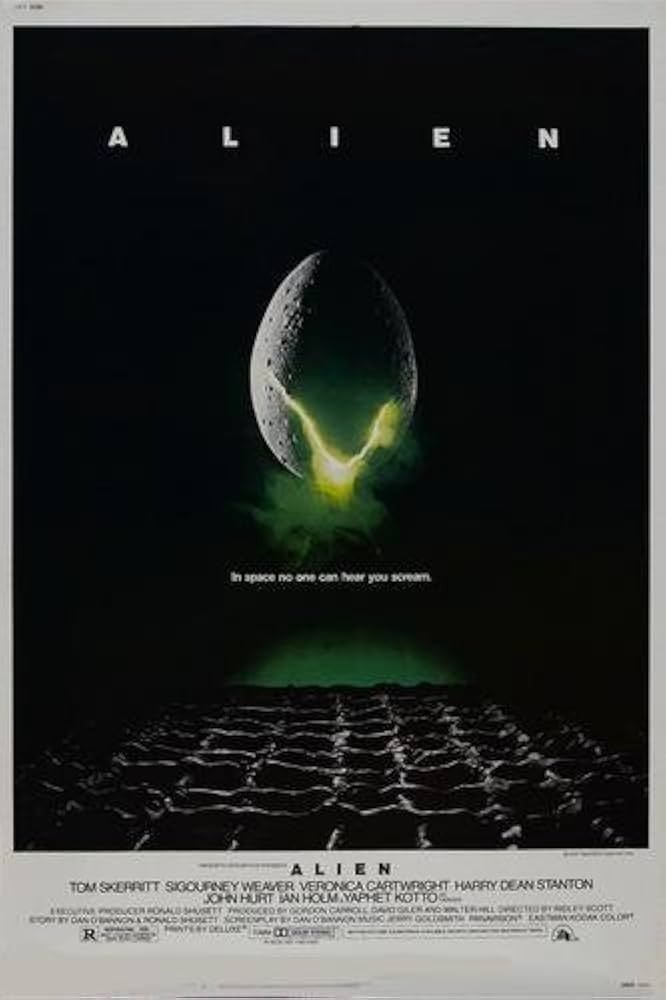
"In space no one can hear you scream."
User Score
950000 votes
Part of a Collection
Alien Collection
Ridley Scott's 1979 Alien didn't just launch a franchise, it rewrote the rules of science fiction horror. Set aboard the grimy commercial towing vessel Nostromo, the film follows seven crew members who wake from hypersleep to investigate a distress signal on a desolate planetoid. What they find is a derelict alien spacecraft, a chamber of leathery eggs, and a parasitic lifeform that turns their routine haul back to Earth into a desperate fight for survival. At its core, the story is as much about corporate greed as it is about monsters: the Weyland-Yutani Corporation's secret directive to retrieve the alien at any cost makes the crew expendable long before the creature starts picking them off.
Dan O'Bannon and Ronald Shusett's script, famously pitched as Jaws in space, drew on everything from B-movie creature features to the claustrophobic paranoia of The Thing. But what truly set Alien apart was H.R. Giger's biomechanical creature design, a nightmarish fusion of organic and industrial that felt unlike anything audiences had seen. The film's dark, lived-in aesthetic, shot by cinematographer Derek Vanlint, gave the Nostromo a working-class authenticity that contrasted sharply with the sterile starships of earlier sci-fi. Jerry Goldsmith's eerie, atonal score added another layer of dread, though Scott famously replaced some cues with spare sound design during the final chase.
Sigourney Weaver's Ellen Ripley started as a supporting character but emerged as one of cinema's great heroes, a competent, no-nonsense warrant officer whose survival instincts and moral compass drive the story. The supporting cast is equally memorable: Tom Skerritt's doomed captain, John Hurt's ill-fated Kane, Ian Holm's unsettling Ash, and Yaphet Kotto and Harry Dean Stanton as the blue-collar engineers. Released in 1979, the film grossed over $100 million worldwide on a modest budget and won the Academy Award for Best Visual Effects. It was selected for preservation in the National Film Registry in 2002, and its influence on horror, sci-fi, and pop culture remains immense.
Availability and pricing can change. Confirm on the provider's site before purchasing.
The commercial starship Nostromo, towing a massive mineral refinery, is returning to Earth with its seven-person crew in hypersleep. The ship's computer, Mother, intercepts a mysterious signal and awakens the crew, forcing them to investigate per company policy. Captain Dallas, Executive Officer Kane, Warrant Officer Ripley, Navigator Lambert, Science Officer Ash, and engineers Parker and Brett land on the barren planetoid LV-426, where they discover a derelict alien spacecraft of unknown origin.
Inside the derelict, Kane descends into a chamber filled with hundreds of leathery eggs. When he touches one, it opens, and a creature, later called a facehugger, leaps onto his face, attaching itself with a tail around his neck and a proboscis down his throat. Ripley insists on quarantine protocols, refusing to let Kane back aboard, but Ash overrides her, opening the airlock. The facehugger remains attached to Kane for days, sustaining him in a coma. When it finally detaches and dies, Kane wakes seemingly healthy, with no memory of the incident.
The crew sits down for a final meal before re-entering hypersleep. Suddenly, Kane chokes and convulses as a small creature bursts from his chest, the chestburster, killing him instantly. The creature escapes into the ship's labyrinthine corridors. The crew arms themselves with flamethrowers and motion trackers, attempting to hunt it down. But the alien, now grown to over seven feet tall, is a perfect predator: it moves through the ventilation shafts, has acidic blood that burns through the hull, and uses the ship's own systems against them. One by one, the crew falls. Brett is taken in the cargo bay. Dallas is ambushed in the air ducts. Lambert and Parker are killed while gathering supplies. Ripley, now the sole survivor, discovers that Ash was actually a synthetic programmed to bring the alien back for the company, even if it meant sacrificing the crew.
Ripley decides to destroy the Nostromo. She sets the self-destruct sequence and heads for the shuttle Narcissus, grabbing her cat Jones along the way. As she prepares to launch, she realizes the alien has stowed away in the shuttle's equipment bay.
Official Trailer
Critical Consensus
Alien is a masterful blend of science fiction and horror, using claustrophobic sets, groundbreaking creature design, and a strong performance from Sigourney Weaver to create one of cinema's most terrifying and influential thrillers.
“Alien is a great original, a horrifying film that works on our most primal fears.”
Roger Ebert
Chicago Sun-Times
“Sigourney Weaver gives a strong, resourceful performance, and the film's special effects are spectacular.”
Janet Maslin
The New York Times
“Ridley Scott's direction is assured, creating a palpable sense of dread and claustrophobia that never lets up.”
Variety Staff
Variety
“The film's design, from the Nostromo's industrial interiors to Giger's nightmarish alien, is a triumph of production art.”
The Hollywood Reporter
The Hollywood Reporter
Sigourney Weaver
Ellen Ripley
Tom Skerritt
Captain Dallas
John Hurt
Kane
Veronica Cartwright
Lambert
Ian Holm
Ash
Yaphet Kotto
Parker
Harry Dean Stanton
Brett
Director
Ridley Scott
Writers
Dan O'Bannon, Ronald Shusett
Composer
Jerry Goldsmith
Cinematographer
Derek Vanlint
Producers
Gordon Carroll, David Giler, Walter Hill
Academy Awards (1980)
Best Visual Effects: Won
Academy Awards (1980)
Best Art Direction: Nominated
Saturn Awards (1980)
Best Science Fiction Film: Won
Hugo Awards (1980)
Best Dramatic Presentation: Won
National Film Registry (2002)
Preservation: Inducted
Join the community
fans discussing