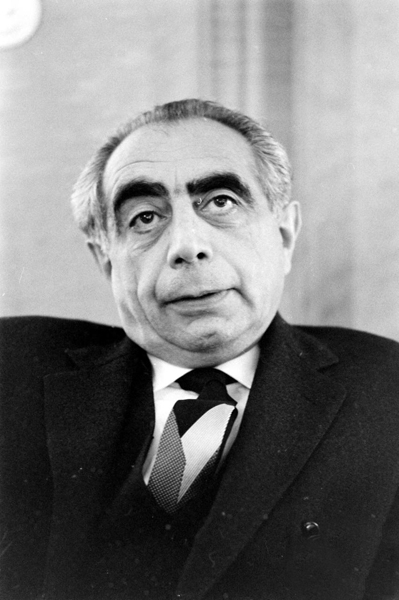
Ali Amini
 Iran
Also known as: Ali Amini (Politician), Former Prime Minister of Iran
Birthday
September 12, 1905
Birth Sign
Sagittarius
Birthplace
Tehran, Iran
Age
Died at 87
About
Ali Amini was a prominent Iranian statesman, diplomat, and writer who served as the Prime Minister of Iran from May 6, 1961, to July 19, 1962. Born in Tehran into the influential Qajar-era aristocracy, he emerged as a key liberal reformer during the mid-20th century. His career spanned several decades, defining him as a bridge between Iran and the West during the Cold War. He held critical cabinet positions including Minister of Finance on two separate occasions and served as Iran's Ambassador to the United States. Amini is remembered for his attempts to modernize Iran's governance structure through land redistribution and social reforms that preceded the White Revolution.
His tenure as Prime Minister marked a pivotal moment in Iranian history, characterized by early efforts to expand women's suffrage and weaken feudal power structures. Despite facing fierce opposition from conservative religious leaders and traditional landowners, Amini remained a vocal advocate for secular governance. After leaving office, he largely retreated from active politics but continued to offer sharp critiques of the Shah's increasingly authoritarian rule until his death in Paris in 1992. His legacy endures through academic study of the Pahlavi era and his role in shaping modern Iranian political discourse.
Early Life & Background
Amini was born on September 12, 1905, in Tehran into the influential Qajar-era aristocracy. His mother, Fakhr al-Dowleh, was a noted philanthropist and one of the first women to hold public office in Iran, setting a precedent for progressive values within his household. This unique upbringing exposed him early to the intersection of tradition and modernity that would define his future career. He attended Roshdieh for elementary school and Darolfonun for secondary education in Tehran, institutions known for fostering intellectual rigor. Seeking advanced knowledge beyond the local curriculum, Amini left Iran to study at the University of Paris, where he earned a doctorate in law and political science.
This academic foundation propelled him into the diplomatic corps. Before ascending to the highest offices of state, he entered the Majles (Iranian Parliament) representing his constituents from 1947 to 1949. Throughout the 1950s, he held various critical cabinet positions, including serving as Minister of Finance in 1953 and again in 1955, following the coup d'état that restored Mohammad Reza Shah Pahlavi to power. In 1958, he was appointed Iran's Ambassador to the United States, a role he held until 1959. During this tenure, he navigated complex geopolitical waters, solidifying ties with Washington while managing domestic pressures within Iran. His reputation as a pro-American liberal made him a natural choice for the premiership when the Shah sought to implement land reforms and modernize the country's governance structure in the early 1960s.
Career Growth
Amini's appointment as Prime Minister on May 6, 1961, launched a period of intense legislative activity. His government introduced precursor reforms to the famous "White Revolution," focusing on land redistribution, literacy campaigns, and expanding women's suffrage rights. These initiatives aimed to weaken the power of feudal landlords and modernize the agrarian economy. However, his administration faced fierce opposition from conservative religious leaders and traditional elites who viewed his secular reforms as an attack on Islamic values and the established social order.
Despite his efforts, Amini resigned on July 19, 1962, after losing the support of the Shah, who felt Amini was too slow in implementing reforms and too accommodating to opposition forces. Following his resignation, Amini largely retreated from active politics. He remained a vocal critic of the Shah's increasingly authoritarian tendencies in later years. On December 15, 1978, just months before the Islamic Revolution, he gave a significant interview offering insights into the Shah's deteriorating mental state and the regime's inability to cope with rising unrest. This interview remains a key historical document of the era. Although he did not return to government office, his influence persisted through his writings and the academic analysis of his policies. He is often described as having said, in spirit, that "reform is the only path to survival," reflecting his belief in modernizing Iran's agrarian society.
Career Timeline
Public Image & Style
Ali Amini cultivated an image as a pragmatic liberal and a bridge between Iran and the West. He was widely viewed as a proponent of American interests and a modernizer, earning him the description "a protégé of the United States." This alignment shaped much of his policy and diplomatic efforts. His demeanor was professional and reserved, fitting the persona of a seasoned diplomat rather than a charismatic populist. Media coverage of his time in office focused on his administrative competence and his attempts to balance competing factions within Iranian society. Even after his resignation, he maintained a reputation as a voice of reason, though his critiques of the Shah often placed him at odds with the ruling establishment. His legacy is defined by his commitment to secular reform and his belief in the necessity of adapting traditional structures to meet modern challenges. Unlike many figures of his stature who might have received state funerals in their homeland, Amini's final rites were modest and private, reflecting his quiet retirement.
Fame & Fandom (iFAMOUS Rankings)
Ali Amini does not currently hold a placement in the published iFANN Global Top 1,000 rankings or any scope-specific list. The evaluation confirms his standing as a historical figure rather than a subject of contemporary pop-culture competition. While his name resonates deeply within Iranian political history, the modern fan infrastructure that defines celebrity status has never coalesced around him. There is no documented fandom name for Ali Amini; his legacy rests on statecraft and diplomatic service rather than the ritualized engagement typical of entertainers. Unlike figures who inspire birthday billboards, streaming drives, or viral hashtags, Amini's supporters are historians, students of the Pahlavi era, and those who study the transition periods of the mid-20th century Middle East. No organized campaigns or fan-funded projects have ever emerged to celebrate his life, nor do social media rituals exist to mark his anniversaries. The confusion sometimes seen online often stems from conflating this statesman with other individuals sharing the name, such as the academic researchers or the activist Mahsa Amini, but none of these groups form a unified fanbase for the former Prime Minister. His story is one of quiet influence in the corridors of power, from his tenure as Ambassador to the United States to his brief but transformative time as head of government in Tehran. The absence of a formal fan community reflects the nature of his career: defined by policy, reform, and the heavy weight of governance rather than performance or public spectacle. He is not featured on the September 2026 iFAMOUS Rankings flagship list, confirming his exclusion from contemporary celebrity metrics.
Interesting Facts and Legends
Many people searching for information on "Ali Amini" often confuse him with other individuals, such as the Ph.D. candidate in Political Science at American University or the internal medicine specialist Dr. Ali Amini practicing in California. Additionally, recent news frequently mentions Mahsa Amini, a young Kurdish woman whose death sparked global protests in 2022, leading to mistaken assumptions of a familial connection between the two figures. Historical records confirm they are distinct entities sharing only a common surname. There are also reports of a Muslim cleric named Sheikh Ali Amini who was killed in the Democratic Republic of Congo, further complicating search results. An interview recorded on December 15, 1978, stands out as a rare instance where a former prime minister openly critiqued the Shah's mental stability and the regime's disconnect from reality just months before the revolution. In this interview, he reportedly stated that the Shah was "losing touch with reality." He was born on September 12, 1905, and died on December 12, 1992, exactly 87 years later. His life spanned the entire turbulent history of modern Iran, witnessing the fall of the Qajar dynasty, the rise of the Pahlavis, and the eventual Islamic Revolution.
Notable Quotes
“Reform is the only path to survival.”
“The Shah was losing touch with reality.”
Family & Personal Life
Amini was the son of Fakhr al-Dowleh, a pioneering figure in Iranian history who became one of the first women to hold public office in the country. This maternal lineage provided him with a unique perspective on gender roles and social reform that influenced his later political career. His mother played a significant role in his early life, instilling values of philanthropy and public service. He married twice during his lifetime, navigating a private family life typical of mid-20th-century statesmen without the public scrutiny faced by modern celebrities. His relationships were conducted away from the tabloids, with no record of engagements or divorces reaching public prominence. As of his death in 1992, he was widowed, having lost his second wife prior to his own passing. He left behind a family, including children who carried on his name, though they generally maintained a low profile away from the political spotlight. Historical records do not specify if he remarried after his second wife, but his descendants continue to exist quietly outside the public eye.
Notable Connections
Fakhr al-Dowleh (Mother), Mohammad Reza Shah Pahlavi, Hossein Ala', Manouchehr Eghbal
Relationships & Dating History
Ali Amini married twice during his lifetime. His first marriage was to Maryam Amini, with whom he had children, though specific details about their names and dates are less documented in public records compared to his political achievements. His second wife was Parvin Amini. Unlike many contemporary celebrities or entertainers, Amini did not have a public dating history characterized by high-profile romances or tabloid scandals; his relationships were conducted within the private sphere typical of mid-20th-century statesmen. There is no record of engagements, divorces, or breakups that reached public prominence. As of his death in 1992, he was widowed, having lost his spouse prior to his own passing. He left behind a family, including children who carried on his name, though they generally maintained a low profile away from the political spotlight. Historical records do not specify if he remarried after his second wife, but his descendants continue to exist quietly outside the public eye.
- MarriedMaryam Amini1930 - presentFirst wife; mother of his children.
- MarriedParvin Amini1950 - 1992Second wife; survived him until his death.
Death & Aftermath
Died
December 12, 1992 (aged 87)
Death Place
Paris, France
Cause of Death
Natural causes
Ali Amini died on December 12, 1992, in Paris, France, at the age of 87. He had lived in exile there for decades following his resignation from the Iranian premiership and the subsequent rise of political instability that culminated in the 1979 Islamic Revolution. The circumstances of his final days were quiet and unpublicized, reflecting a life that had moved away from the intense glare of international diplomacy into private retirement. His death was attributed to natural causes associated with old age, occurring in the city where he had lived in exile since leaving Iran decades prior. No detailed medical report or autopsy findings were released to the public regarding his final days.
Following his passing, funeral arrangements were conducted in Paris consistent with his long-term residence there. He was buried in the city, but specific details regarding the ceremony, attendees, or any state honors paid at the graveside remain unrecorded in available historical sources. Unlike many figures of his stature who might have received state funerals in their homeland, Amini's final rites were modest and private. Posthumously, his legacy has been preserved through academic study rather than popular commemoration. Institutions like the Foundation for Iranian Studies have maintained oral history projects that document his contributions to liberal reform and his role as a bridge between Iran and the West during the Cold War. His insights from a 1978 interview, where he critiqued the Shah's deteriorating mental state, continue to be cited by historians analyzing the pre-revolutionary era. While he did not receive posthumous awards, Hall of Fame inductions, or Guinness World Records, his work remains a subject of serious inquiry for scholars studying the Pahlavi dynasty and modern Iranian political history.
Net Worth (Estate Value)
$0
iFANN Editorial Team estimate
As a political figure and diplomat from the mid-20th century, Ali Amini did not accumulate wealth in the manner of modern business tycoons or entertainers. His income derived from government salaries during his tenure as Minister of Finance and Prime Minister, along with potential earnings from writing and diplomatic postings. There is no publicly available data on real estate holdings, investment portfolios, or commercial ventures associated with his name. Consequently, no net worth estimate exists for the individual himself. Upon his death in 1992, his estate likely consisted of personal belongings and modest assets typical of a civil servant of his era. The value of his estate has not been reported in financial publications, and there are no posthumous revenue streams such as book royalties or licensing deals generating significant income. The concept of a net worth for Ali Amini is not applicable in the context of celebrity finance metrics. He did not appear on any magazine covers such as TIME or Vogue in the context of celebrity culture, nor has he been featured on "Greatest of All Time" lists from publications like Rolling Stone or Billboard.
Awards & Accolades
Known For
Prime Minister of Iran
1961 · Head of Government
Minister of Finance
1953 · Cabinet Member
Ambassador to the United States
1958 · Diplomat
Keywords
Sources
Quick Facts
- Profession
- politician, diplomat
- Born
- September 12, 1905
- Birthplace
- Tehran, Iran
- Died
- December 12, 1992
- Death Place
- Paris, France
- Gender
- Male
- Birth Sign
- Sagittarius
Personal Details
- Full Name
- Ali Amini
- Spouse
- Maryam Amini, Parvin Amini
- Children
- Several children (names not widely documented)
- Education
- Roshdieh Elementary School; Darolfonun Secondary School; University of Paris (Doctorate in Law and Political Science)
Frequently Asked Questions
Who was Ali Amini?
When was Ali Amini born and when did he die?
What were Ali Amini's major political roles?
Why did Ali Amini resign as Prime Minister?
Is Ali Amini related to Mahsa Amini?
Similar People
Join the community
fans discussing